
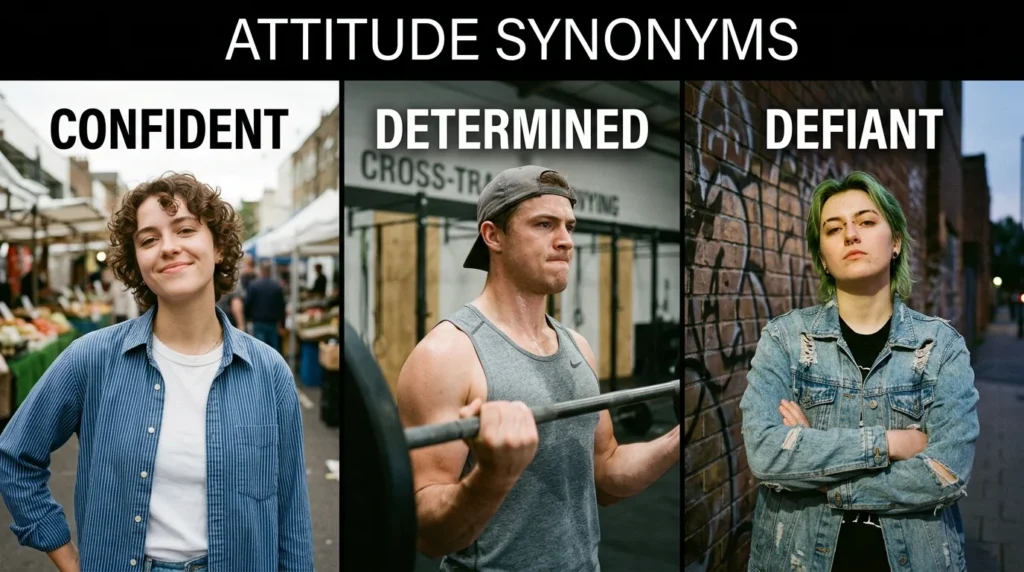
Quick Answer
The closest synonyms for attitude include mindset, outlook, perspective, viewpoint, approach, stance, disposition, frame of mind, position, manner, demeanor, posture, standpoint, point of view, and way of thinking. For a positive attitude, words such as optimism, enthusiasm, confidence, or positivity may work better. For negative behavior, hostility, arrogance, defiance, or disrespect may be more precise.
Quick Synonym List
- Mindset
- Outlook
- Perspective
- Viewpoint
- Point of view
- Approach
- Stance
- Position
- Standpoint
- Disposition
- Frame of mind
- Way of thinking
- Manner
- Demeanor
- Posture
- Bearing
- Temperament
- Opinion
- Feeling
- Position
- Slant
- Angle
- Philosophy
- Orientation
- Approach
- Behavior
- Conduct
- Air
- Confidence
- Positivity
- Optimism
- Enthusiasm
- Hostility
- Defiance
- Arrogance
- Disrespect
Not all of these are interchangeable. Cambridge’s thesaurus groups words such as outlook, frame of mind, approach, viewpoint, point of view, perspective, stance, standpoint, position, and slant with the opinion-based meaning of attitude.

Closest Synonyms
Mindset
Meaning: A person’s established way of thinking about something.
Tone: Neutral, professional
Best for: Beliefs, habits of thought, personal development, work, learning
Example:
A growth mindset can change how students respond to challenges.
How it differs: Mindset emphasizes a person’s habitual way of thinking rather than a single opinion.
Interchangeability: Usually interchangeable when attitude refers to someone’s general way of thinking.
Outlook
Meaning: A person’s general view of life, the future, or a situation.
Tone: Neutral
Best for: Life, future expectations, general perspectives
Example:
She has a positive outlook on life.
How it differs: Outlook often describes someone’s broad perspective, especially their expectations about the future.
Interchangeability: Usually interchangeable in broad contexts.
Perspective
Meaning: A particular way of viewing or understanding something.
Tone: Neutral/professional
Best for: Problems, experiences, opinions, analysis
Example:
His perspective on the issue changed after hearing both sides.
How it differs: Perspective focuses on how someone sees or interprets something.
Interchangeability: Context-dependent.
Viewpoint
Meaning: A particular opinion or way of considering an issue.
Tone: Neutral
Best for: Discussions, opinions, debates, essays
Example:
The article presents several viewpoints on the issue.
How it differs: Viewpoint is more directly about an opinion or position than someone’s overall behavior.
Interchangeability: Context-dependent.
Approach
Meaning: A way of dealing with or thinking about a problem or situation.
Tone: Neutral/professional
Best for: Work, problems, strategies, decisions
Example:
Her positive approach to difficult tasks impressed the team.
How it differs: Approach emphasizes how someone handles something, rather than simply what they think.
Interchangeability: Sometimes.
Stance
Meaning: A clearly expressed position on an issue.
Tone: Formal/professional
Best for: Debates, policies, public statements, academic writing
Example:
The organization has taken a firm stance on the issue.
How it differs: Stance is more specific and usually refers to a stated position.
Interchangeability: Context-dependent.
Disposition
Meaning: A person’s natural tendency, mood, or general character.
Tone: Formal
Best for: Describing personality and temperament
Example:
She has a calm and friendly disposition.
How it differs: Disposition can describe an enduring personality tendency rather than an opinion about a particular subject.
Interchangeability: Sometimes.
Frame of Mind
Meaning: A person’s mental or emotional state at a particular time.
Tone: Neutral
Best for: Temporary feelings, moods, readiness
Example:
I wasn’t in the right frame of mind to make a decision.
How it differs: Frame of mind often describes a temporary state rather than a stable attitude.
Interchangeability: Sometimes.
Point of View
Meaning: A particular way of considering or understanding something.
Tone: Neutral
Best for: Opinions, discussions, essays, storytelling
Example:
From my point of view, the decision was reasonable.
How it differs: It focuses on someone’s perspective or opinion rather than their behavior.
Interchangeability: Context-dependent.
Demeanor
Meaning: The way a person looks, acts, or behaves, especially in social situations.
Tone: Formal
Best for: Professional, descriptive, and character writing
Example:
His calm demeanor helped reassure the customers.
How it differs: Demeanor describes observable behavior and appearance, while attitude can refer to an internal feeling or opinion.
Interchangeability: Usually not.
Formal and Professional Alternatives
Some alternatives work especially well in academic, workplace, and professional writing.
| Alternative | Meaning | Tone | Best Use | Can Replace “Attitude”? |
|---|---|---|---|---|
| Perspective | Way of viewing something | Professional | Analysis | Sometimes |
| Stance | Position on an issue | Formal | Policies, debates | Sometimes |
| Viewpoint | Opinion or way of seeing something | Neutral/formal | Essays, discussions | Sometimes |
| Disposition | Natural tendency or temperament | Formal | Personality | Sometimes |
| Approach | Way of dealing with something | Professional | Work, problems | Sometimes |
| Standpoint | Position from which something is considered | Formal | Analysis | Sometimes |
| Position | Opinion or stated view | Formal | Debates, business | Sometimes |
| Orientation | General direction or approach | Professional | Business, education | Context-dependent |
| Demeanor | Outward manner or behavior | Formal | Professional descriptions | Rarely |
| Philosophy | Set of guiding beliefs | Formal | Life, work, leadership | Context-dependent |
Stance
Use stance when you mean a clearly held position:
The company changed its stance on remote work.
This is more precise than attitude when the person’s position has been explicitly stated.
Perspective
Use perspective when you want to emphasize someone’s way of understanding a situation:
The experience gave her a new perspective on leadership.
Approach
Use approach when attitude influences the way someone handles a task:
His approach to customer service is thoughtful and practical.
Neutral and Everyday Alternatives
For ordinary conversation and general writing, these are often the most natural:
- Mindset
- Outlook
- Perspective
- Viewpoint
- Approach
- Way of thinking
- Point of view
- Frame of mind
- Manner
- Behavior
Examples:
She has a positive attitude.
→ She has a positive outlook.
His attitude toward learning has changed.
→ His mindset toward learning has changed.
I understand your attitude toward the situation.
→ I understand your point of view.
Casual Alternatives
When attitude means difficult, disrespectful, or overly confident behavior, casual language changes the meaning.
Sass
Sass describes cheeky, disrespectful, or boldly confident behavior.
He gave his teacher some serious sass.
It is informal and should not be used as a neutral synonym for every meaning of attitude.
Manner
Manner describes the way someone behaves or communicates.
She spoke in a friendly manner.
Air
Air can describe the impression or manner someone gives off.
He had an air of confidence.
Behavior
Behavior refers directly to what someone does.
His behavior toward the staff was inappropriate.
It is broader than attitude and does not necessarily describe someone’s underlying feelings or opinions.
Attitude vs. Near Synonyms
Attitude vs. Mindset
Attitude can refer to a person’s feelings or opinions about a particular subject.
Mindset usually refers to a more established pattern of thinking.
Her attitude toward the project is positive.
Her mindset encourages her to see challenges as opportunities.
Attitude vs. Outlook
Outlook is usually broader.
He has a positive outlook on life.
You can also say:
He has a positive attitude toward work.
The first concerns his general view of life; the second focuses on his feelings about work.
Attitude vs. Perspective
Perspective emphasizes how someone sees or interprets something.
We have different perspectives on the problem.
Attitude can include the emotional response toward that problem.
Attitude vs. Stance
Stance is a specific position on an issue.
The senator took a firm stance on the proposal.
Attitude is broader and can describe feelings, opinions, and behavior.
Attitude vs. Demeanor
Demeanor describes outward behavior.
Her professional demeanor impressed the clients.
Attitude can describe something internal that may not be immediately visible.
Attitude vs. Behavior
Behavior is what a person does.
Attitude is more about what a person thinks or feels and how that may affect behavior.
His attitude toward the job is negative.
His behavior at work has become disruptive.
Comparison Table
| Word | Core Meaning | Tone | Strength | Best Use | Interchangeable? |
|---|---|---|---|---|---|
| Attitude | Feelings, opinions, or way of behaving | Neutral | Broad | General use | — |
| Mindset | Established way of thinking | Neutral | Moderate | Personal development | Usually |
| Outlook | General view of life or future | Neutral | Moderate | General perspective | Usually |
| Perspective | Way of viewing something | Neutral | Moderate | Analysis | Sometimes |
| Viewpoint | Particular opinion | Neutral | Moderate | Discussion | Sometimes |
| Approach | Way of dealing with something | Professional | Moderate | Work, problems | Sometimes |
| Stance | Position on an issue | Formal | Strong | Debates | Sometimes |
| Disposition | Natural temperament | Formal | Moderate | Personality | Sometimes |
| Demeanor | Outward behavior | Formal | Moderate | Professional settings | Rarely |
| Position | Stated opinion | Formal | Strong | Issues, policies | Sometimes |
| Frame of mind | Current mental state | Neutral | Moderate | Mood, readiness | Sometimes |
| Behavior | Observable actions | Neutral | Moderate | Conduct | Rarely |
| Point of view | Personal way of seeing something | Neutral | Moderate | Opinions | Sometimes |
| Temperament | Natural emotional character | Formal | Moderate | Personality | Rarely |
How to Choose the Right Alternative
Choose mindset for a pattern of thinking
She has a problem-solving mindset.
Choose outlook for a general view of life or the future
He has an optimistic outlook.
Choose perspective for a way of understanding something
The experience changed her perspective.
Choose viewpoint for an opinion
Everyone is entitled to their own viewpoint.
Choose stance for a clearly stated position
The organization has a strong stance on the issue.
Choose approach for the way someone handles something
We need a different approach to the problem.
Choose demeanor for outward behavior
Her calm demeanor made the interview easier.
Choose disposition for natural temperament
He has a cheerful disposition.
Sentence Transformations
1. Positive attitude
Original:
She has a positive attitude toward work.
Alternative:
She has a positive outlook toward work.
Best fit: Outlook works when emphasizing her general perspective.
2. Learning
Original:
His attitude toward learning has changed.
Alternative:
His mindset toward learning has changed.
Best fit: Mindset emphasizes a change in his way of thinking.
3. Problem-solving
Original:
We need to change our attitude toward the problem.
Alternative:
We need to change our approach to the problem.
Best fit: Approach works when the focus is on how the problem will be handled.
4. Public position
Original:
The organization has a different attitude toward the proposal.
Alternative:
The organization has a different stance on the proposal.
Best fit: Stance is more precise for a formal position.
5. Opinion
Original:
I respect your attitude toward the issue.
Alternative:
I respect your perspective on the issue.
Best fit: Perspective emphasizes the person’s way of viewing the issue.
6. Professional behavior
Original:
Her attitude during the meeting was professional.
Alternative:
Her demeanor during the meeting was professional.
Best fit: Demeanor focuses on observable behavior.
7. General life view
Original:
His attitude toward life is optimistic.
Alternative:
His outlook on life is optimistic.
Best fit: Outlook is especially natural for a general view of life.
8. Current emotional state
Original:
I wasn’t in the right attitude to discuss the issue.
Alternative:
I wasn’t in the right frame of mind to discuss the issue.
Best fit: Frame of mind is more natural for a temporary mental or emotional state.
Grammar and Usage
Attitude is a noun and commonly appears in these structures:
- attitude toward something
- attitude to something
- attitude about something
- positive attitude
- negative attitude
- attitude problem
- change in attitude
- attitude toward work
- attitude toward learning
- attitude toward life
Both attitude toward and attitude to are established constructions. American English commonly uses toward, while towards is also standard English.
“Attitude” can describe behavior
In informal American English, saying someone “has an attitude” can imply that the person is being unhelpful, disrespectful, or difficult.
Don’t give me that attitude.
This meaning is different from:
She has a positive attitude toward her work.
The first describes behavior; the second describes an opinion or mindset.
Common Mistakes
1. Treating every synonym as interchangeable
Mindset, perspective, stance, and demeanor have different meanings. Choose based on what you actually want to describe.
2. Using “stance” for a general mood
She has a happy stance.
This is unnatural if you mean she is generally positive.
Better:
She has a positive outlook.
3. Using “demeanor” for an opinion
His demeanor toward the proposal changed.
If you mean his opinion changed, attitude, viewpoint, or stance may be better.
4. Confusing attitude with behavior
Someone’s behavior can reflect their attitude, but the two words do not mean exactly the same thing.
5. Using “outlook” for a specific policy position
For a clearly stated position, stance or position is usually more precise.
6. Using “mindset” for a temporary mood
If you mean someone’s current mental state, frame of mind may be more natural.
7. Assuming “positive” is always implied
Attitude itself is neutral. You need context or an adjective such as positive, negative, respectful, hostile, optimistic, or professional to show the type of attitude.
Commonly Confused Words
Attitude vs. Aptitude
Attitude = a way of thinking or feeling.
Aptitude = a natural ability or talent.
She has a positive attitude toward math.
She has a strong aptitude for math.
Attitude vs. Personality
Personality refers to the broader pattern of characteristics that make someone who they are.
Attitude is more specific and often relates to a subject, person, or situation.
Attitude vs. Opinion
An opinion is a belief or judgment about something.
An attitude can include an opinion but may also involve feelings and behavior.
When Not to Use an Alternative
Sometimes attitude is the most natural word.
Use attitude when you mean a combination of someone’s feelings, opinions, and resulting behavior toward something or someone. Cambridge specifically defines the common sense of the word in terms of how someone thinks or feels and how that affects behavior.
For example:
His attitude toward his coworkers has changed.
Replacing attitude with perspective may focus too much on his thoughts. Replacing it with demeanor may focus too much on his outward behavior.
The original word can be the most accurate choice when you intentionally want to include both.
Writing Tips
Match the synonym to the meaning
Ask yourself what you really mean:
- Way of thinking → mindset
- General view → outlook
- Way of seeing something → perspective
- Opinion → viewpoint
- Formal position → stance
- Way of handling something → approach
- Outward behavior → demeanor
- Natural temperament → disposition
Avoid vague substitutions
Don’t replace attitude simply to avoid repetition. A more specific word is useful only when it adds meaning.
Use stronger words when the context supports them
If someone is openly hostile, hostility may be more precise than “negative attitude.”
If someone is unwilling to cooperate, resistance or defiance may be more informative than simply saying they have a “bad attitude.”
FAQs
1. What is the best synonym for attitude?
There is no single best synonym for every context. Mindset, outlook, perspective, viewpoint, approach, and stance are among the most useful alternatives, but each emphasizes a different meaning.
2. What is a positive synonym for attitude?
Depending on the context, positive alternatives include outlook, mindset, optimism, positivity, enthusiasm, confidence, and disposition. The best choice depends on whether you mean someone’s thinking, mood, or behavior.
3. What is a negative synonym for attitude?
Depending on the behavior or feeling involved, alternatives include hostility, arrogance, defiance, disrespect, resentment, negativity, and cynicism. These are more specific than negative attitude and should only be used when the context supports them.
4. What is a professional word for attitude?
Useful professional alternatives include perspective, approach, stance, disposition, viewpoint, position, and orientation. The right word depends on the specific meaning.
5. What is another word for attitude in writing?
For general writing, useful alternatives include mindset, outlook, perspective, viewpoint, approach, and way of thinking. For formal writing, stance, position, standpoint, or disposition may be appropriate.
6. What is the difference between attitude and mindset?
Attitude can describe someone’s feelings or opinions about a particular subject. Mindset usually describes a more established pattern or style of thinking.
7. What is the difference between attitude and perspective?
Attitude can include feelings, opinions, and behavior toward something. Perspective mainly describes how someone views or understands something.
Editor’s Choice
For different writing needs, these are useful choices:
- Mindset — for a person’s established way of thinking
- Outlook — for a general view of life or the future
- Perspective — for a particular way of seeing an issue
- Stance — for a clear position on an issue
- Demeanor — for outward behavior
These are use-case choices, not a ranking. The right word depends on the meaning you need.
Key Takeaways
- Attitude can refer to feelings, opinions, ways of thinking, or behavior toward something or someone.
- Mindset, outlook, perspective, viewpoint, and approach are useful alternatives for different kinds of thinking.
- Stance and position work well for clearly stated views on an issue.
- Demeanor, manner, and behavior are better when you mean observable conduct rather than an internal opinion.
- Always choose a synonym based on the exact meaning you want instead of replacing attitude simply for variety.
Internal Link Opportunities
- Synonyms for mindset — natural companion topic for the thinking-related meaning of attitude.
- Synonyms for perspective — supports the viewpoint and interpretation sense.
- Synonyms for outlook — useful for positive, negative, and future-oriented attitudes.
- Synonyms for behavior — helps distinguish actions from attitudes.
- Synonyms for approach — useful for workplace and problem-solving contexts.
- Synonyms for opinion — explores the belief-related side of attitude.
- Synonyms for personality — helps explain the difference between personality and attitude.
- Synonyms for confident — useful for describing positive or assertive attitudes.