
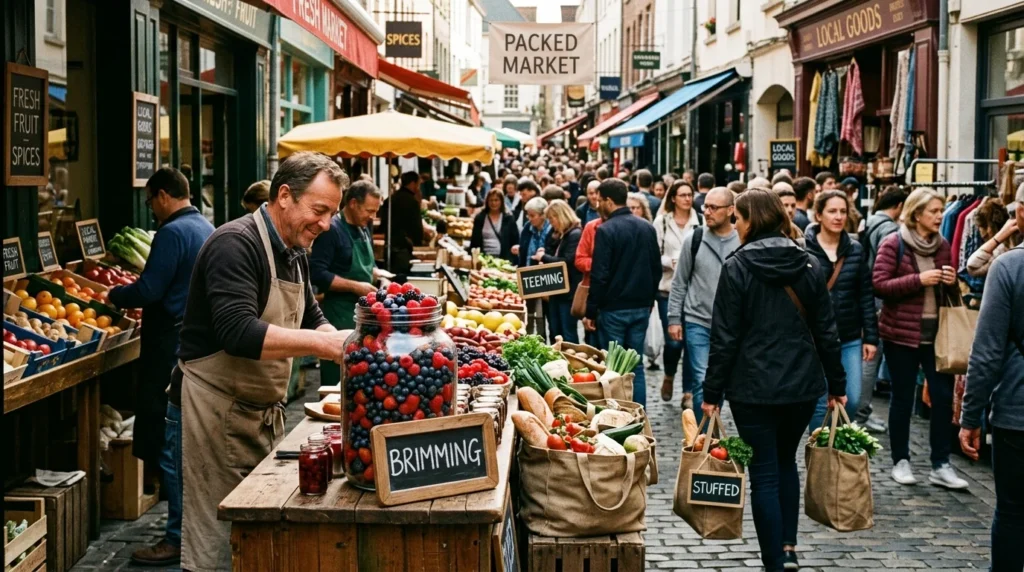
Quick Answer
Useful synonyms for filled include full, packed, crowded, loaded, occupied, stuffed, brimming, overflowing, crammed, teeming, saturated, replete, abundant, permeated, suffused, and complete. The best choice depends on what is filled: a container may be full, a room crowded, a schedule occupied, a glass brimming, or an atmosphere permeated with something.
Quick Synonym List
- Full — containing a lot or as much as possible
- Packed — very full, often with people or things
- Crowded — containing too many people or things
- Loaded — carrying or containing a large amount
- Stuffed — filled tightly
- Crammed — filled by fitting things closely together
- Brimming — filled almost to the top
- Overflowing — so full that contents extend beyond the container
- Bursting — extremely full
- Chock-full — completely full; informal
- Occupied — filled or being used, especially space or time
- Engaged — occupied or unavailable
- Teeming — filled with large numbers of people or living things
- Abounding — containing or having plenty of something
- Replete — abundantly filled or supplied; formal
- Rich in — containing a lot of something desirable
- Saturated — completely filled or soaked
- Permeated — spread throughout
- Suffused — filled or spread with a quality, color, or feeling
- Infused — filled with a particular quality or element
- Laden — heavily loaded or filled
- Awash — covered or filled in large amounts
- Alive with — full of activity, energy, or movement
- Rife with — filled with something, usually undesirable
- Overflowing with — filled abundantly with something
- Full of — containing a lot of something
- Filled to the brim — completely filled to the top
- Taken — occupied or unavailable
- Booked — fully reserved
- Fulfilled — completed or satisfied, in specific contexts
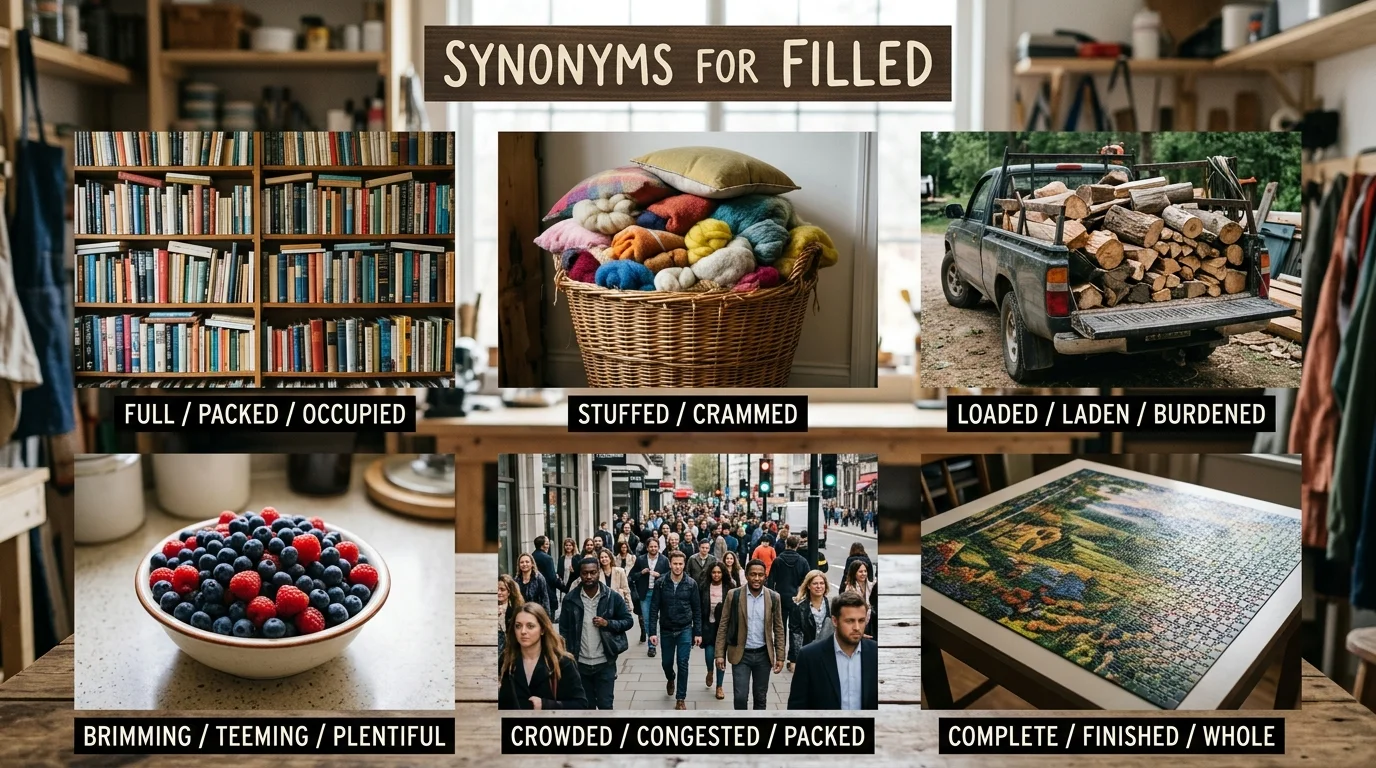
Closest Synonyms
Full
Meaning: Containing as much as possible or a large amount.
How it differs: Full is the most general adjective related to filled. Cambridge distinguishes full as an adjective meaning that something contains a lot, while filled is the -ed form of the verb fill.
Tone: Neutral
Best for: Containers, rooms, schedules, experiences, and abstract descriptions.
Example:
The room was filled with books.
→ The room was full of books.
Watch out: Full often describes a state, while filled can emphasize the action or result of filling.
Interchangeability: Usually interchangeable when describing a state.
Packed
Meaning: Very full, with little space remaining.
Tone: Neutral
Best for: Rooms, vehicles, bags, schedules, and events.
Example:
The stadium was filled with fans.
→ The stadium was packed with fans.
Watch out: Packed emphasizes density and lack of space.
Interchangeability: Usually interchangeable in crowd or space contexts.
Crowded
Meaning: Filled with many people or things, often leaving too little room.
Tone: Neutral
Best for: Streets, rooms, stores, transportation, and public places.
Example:
The restaurant was filled with customers.
→ The restaurant was crowded with customers.
Watch out: Crowded can imply discomfort or excessive numbers.
Interchangeability: Context-dependent.
Loaded
Meaning: Filled or supplied with a large amount of something.
Tone: Neutral
Best for: Vehicles, equipment, computers, dishes, and figurative descriptions.
Example:
The truck was filled with supplies.
→ The truck was loaded with supplies.
Watch out: Loaded often suggests that something has been deliberately supplied or burdened with a quantity of something.
Interchangeability: Context-dependent.
Stuffed
Meaning: Filled tightly or completely.
Tone: Neutral/Informal
Best for: Bags, containers, food, furniture, and informal descriptions.
Example:
The drawer was filled with clothes.
→ The drawer was stuffed with clothes.
Watch out: Stuffed strongly suggests that something has been packed tightly.
Interchangeability: Context-dependent.
Brimming
Meaning: Filled almost to the top.
Tone: Descriptive
Best for: Cups, glasses, containers, and figurative emotions.
Example:
The cup was filled with water.
→ The cup was brimming with water.
Watch out: Brimming usually suggests a level close to the top.
Interchangeability: Context-dependent.
Overflowing
Meaning: So full that the contents spread beyond the container or limits.
Tone: Descriptive
Best for: Containers, emotions, crowds, and figurative writing.
Example:
The basket was filled with flowers.
→ The basket was overflowing with flowers.
Watch out: Overflowing is stronger than ordinary filled.
Interchangeability: Context-dependent.
Occupied
Meaning: Filled or being used, especially in relation to space, time, rooms, or positions.
Tone: Neutral/Professional
Best for: Seats, rooms, schedules, positions, and time.
Example:
All the seats were filled.
→ All the seats were occupied.
Watch out: Occupied focuses on use or availability rather than physical contents.
Interchangeability: Usually interchangeable for seats, rooms, and similar spaces.
Formal and Professional Alternatives
| Alternative | Meaning | Tone | Best Context |
|---|---|---|---|
| Replete | Abundantly supplied or filled | Formal | Academic/formal writing |
| Saturated | Completely filled or soaked | Technical | Science, data, markets |
| Permeated | Spread throughout | Formal | Atmosphere, ideas, qualities |
| Suffused | Filled or spread with a quality | Literary/Formal | Emotions, light, color |
| Abounding | Existing in large amounts | Formal | Academic/descriptive writing |
| Laden | Heavily loaded or filled | Formal | Objects, descriptions |
| Infused | Filled with a quality or element | Formal | Ideas, qualities, flavors |
| Occupied | Filled or in use | Professional | Space, time, positions |
| Well-stocked | Supplied with plenty of something | Professional | Businesses, supplies |
| Well-supplied | Provided with sufficient resources | Professional | Organizations, resources |
Replete
Replete means abundantly supplied or filled with something.
The report is replete with useful examples.
It is more formal than filled with and works especially well in academic or professional prose.
Interchangeability: Usually interchangeable in abstract contexts, but not with physical containers.
Saturated
Saturated means completely filled, soaked, or supplied to a maximum level.
The soil was saturated with water.
It is particularly useful in technical and scientific writing.
Watch out: It often implies a limit or maximum capacity.
Permeated
Permeated means spread throughout something.
The room was permeated with the smell of coffee.
It is useful when something intangible, such as a smell, feeling, or influence, exists throughout an environment.
Suffused
Suffused means filled or spread with a particular quality, color, or emotion.
The sky was suffused with pink light.
This is more literary than ordinary filled.
Abounding
Abounding means existing in large quantities.
The region is abounding in wildlife.
It is usually followed by in rather than simply replacing filled with.
Laden
Laden means heavily loaded or carrying a large amount.
The branches were laden with fruit.
It is especially natural when describing something physically carrying a heavy quantity.
Neutral and Everyday Alternatives
Full
Use full when you simply mean that there is little or no empty space.
The bottle is filled with water.
The bottle is full of water.
Packed
Use packed when many people or things are fitted into a limited space.
The train was packed with passengers.
Occupied
Use occupied for spaces, seats, rooms, time, or positions that are being used.
All the seats were occupied.
Loaded
Use loaded when something has been supplied with or carrying a large quantity.
The truck was loaded with boxes.
Filled with
Sometimes the best alternative is a phrase rather than a single word.
The room was filled with laughter.
Possible alternatives include:
The room was full of laughter.
The room was alive with laughter.
Laughter permeated the room.
Each creates a slightly different effect.
Casual Alternatives
For informal writing and conversation, these options can sound natural:
- Packed
- Stuffed
- Jam-packed
- Chock-full
- Loaded
- Full of
- Swarming with
- Buzzing with
- Alive with
Jam-packed
Jam-packed means extremely full.
The schedule was jam-packed.
It is strongly informal and works well in conversation and casual writing.
Chock-full
Chock-full means completely full of something.
The book is chock-full of useful ideas.
It is informal and expressive.
Buzzing with
Buzzing with means full of energy, activity, or conversation.
The café was buzzing with customers.
It does not simply mean physically full.
Filled vs. Near Synonyms
Filled vs. Full
Filled and full are closely related, but their grammar differs.
- The glass is full.
- She filled the glass.
Full is an adjective. Filled is commonly the past participle of fill and can function adjectivally.
Filled vs. Packed
Filled is neutral. Packed suggests that there is very little room left.
The box was filled with books.
The box was packed with books.
The second sentence suggests the books were fitted closely together.
Filled vs. Crowded
Crowded usually involves people or things occupying a limited space.
The room was filled with people.
The room was crowded.
The second focuses more strongly on lack of space.
Filled vs. Occupied
Occupied means a space, position, or period of time is being used.
Every seat was filled.
Every seat was occupied.
But occupied does not normally mean physically containing a substance.
Filled vs. Brimming
Brimming means almost completely full, especially to the top.
The glass was filled with water.
The glass was brimming with water.
The second gives a stronger visual impression.
Filled vs. Saturated
Saturated suggests complete absorption or maximum concentration.
The sponge was filled with water.
The sponge was saturated with water.
The second implies that it has absorbed as much water as it can.
Comparison Table
| Alternative | Relationship | Can Replace “Filled”? | Tone | Best Context |
|---|---|---|---|---|
| Full | Closest general alternative | Usually | Neutral | Containers, spaces |
| Packed | Stronger fullness | Often | Neutral | Crowds, schedules |
| Crowded | Space-related alternative | Sometimes | Neutral | People, places |
| Loaded | Quantity/carrying alternative | Sometimes | Neutral | Vehicles, objects |
| Stuffed | Tightly filled | Sometimes | Informal | Containers, bags |
| Brimming | Nearly full | Sometimes | Descriptive | Containers, emotions |
| Overflowing | More than full | Sometimes | Descriptive | Containers, emotions |
| Occupied | Space/use alternative | Often | Professional | Seats, rooms, schedules |
| Replete | Abundantly supplied | Sometimes | Formal | Abstract writing |
| Saturated | Completely filled/soaked | Context-dependent | Technical | Materials, markets |
| Permeated | Spread throughout | Context-dependent | Formal | Smells, feelings, ideas |
| Suffused | Filled with a quality | Context-dependent | Literary | Light, color, emotion |
| Teeming | Full of many living things/people | Sometimes | Descriptive | Places, nature |
| Crammed | Tightly filled | Often | Neutral | Spaces, containers |
| Chock-full | Completely full | Often | Informal | Casual writing |
How to Choose the Right Alternative
If a container has no empty space
Use:
- full
- filled
- stuffed
- packed
Example:
The box was full of books.
If a place has many people
Use:
- crowded
- packed
- teeming
- swarming with
Example:
The market was crowded with shoppers.
If something is almost overflowing
Use:
- brimming
- overflowing
- bursting
Example:
Her eyes were brimming with tears.
If something is being used
Use:
- occupied
- taken
- booked
Example:
All the seats were occupied.
If something contains a large amount
Use:
- loaded
- laden
- replete
- abundant
Example:
The shelves were loaded with supplies.
If a feeling or quality exists throughout something
Use:
- permeated
- suffused
- infused
- filled with
Example:
The room was filled with excitement.
Sentence Transformations
- Original:
The room was filled with people.
→ The room was crowded with people. - Original:
The box was filled with books.
→ The box was packed with books. - Original:
The glass was filled with water.
→ The glass was full of water. - Original:
The schedule was filled with meetings.
→ The schedule was packed with meetings. - Original:
All the seats were filled.
→ All the seats were occupied. - Original:
The basket was filled with flowers.
→ The basket was overflowing with flowers. - Original:
The glass was filled almost to the top.
→ The glass was brimming with water. - Original:
The truck was filled with supplies.
→ The truck was loaded with supplies. - Original:
The forest was filled with birds.
→ The forest was teeming with birds. - Original:
The room was filled with the smell of roses.
→ The room was permeated with the smell of roses. - Original:
The article was filled with useful information.
→ The article was replete with useful information. - Original:
The sky was filled with golden light.
→ The sky was suffused with golden light.
Grammar and Usage
Filled as the past participle of “fill”
Filled is the past tense and past participle of fill.
- She filled the bottle.
- They filled the room.
- The room was filled with music.
Cambridge defines fill as making something full, using empty space, putting a substance into a space, or providing something needed.
Filled with
The pattern filled with + noun is extremely common.
- filled with water
- filled with people
- filled with joy
- filled with fear
- filled with light
- filled with information
The phrase can describe both physical contents and abstract feelings or qualities.
Filled + noun
Filled can also describe something containing a particular substance or material.
- a water-filled container
- a smoke-filled room
- a flower-filled garden
- a detail-filled report
Compound forms with -filled are common when something is characterized by a large amount of a specified thing.
Filled vs. full
A useful grammar distinction is:
The bottle is full.
versus:
She filled the bottle.
Full describes the state. Filled often describes the result of an action.
Filled with emotions
Filled with works naturally with strong emotions:
- filled with joy
- filled with anger
- filled with fear
- filled with excitement
- filled with gratitude
Cambridge specifically notes the use of filled with as an adjective-like construction for strong emotions.
Common Mistakes
1. Assuming “full” and “filled” are always identical
They are closely related, but their grammatical roles differ.
- The room is full.
- They filled the room.
2. Using “crowded” for everything
Crowded normally suggests too many people or things in a limited space. It is not a general synonym for every use of filled.
3. Using “packed” when the space is only partly occupied
Packed implies a high degree of fullness.
4. Confusing “filled” with “fulfilled”
Filled means made full or supplied.
Fulfilled means completed, achieved, or satisfied.
- The bottle was filled with water.
- She fulfilled her promise.
5. Using “brimming” without the idea of near-fullness
Brimming suggests that something is almost at the top or overflowing.
6. Using “occupied” for physical contents
A room can be occupied, but water does not normally “occupy” a glass in the same sense that a person occupies a room.
7. Using formal alternatives in simple writing
Words such as replete, suffused, and permeated can sound unnatural when full or filled would be clearer.
8. Treating every “filled with” phrase as physical
English commonly uses filled with metaphorically:
filled with hope
filled with excitement
The word can describe emotions, sounds, smells, and other abstract experiences.
Commonly Confused Words
Filled vs. Fulfilled
Filled = made full or occupied.
The cup was filled with tea.
Fulfilled = completed or satisfied.
She fulfilled her responsibilities.
Filled vs. Full
Filled often emphasizes the action or resulting state.
Full describes the condition of containing a lot or as much as possible.
Filled vs. Occupied
Filled is broader. Occupied focuses on something being used or taken.
The seats were filled.
The seats were occupied.
Filled vs. Crowded
Filled is neutral. Crowded often implies that there are many people or things and insufficient space.
Filled vs. Packed
Packed suggests tight or dense filling.
The suitcase was packed with clothes.
When Not to Use an Alternative
Sometimes filled is better than its synonyms because it is neutral and precise.
For example:
The form is filled with information.
Replacing it with stuffed with information would sound informal and possibly negative.
Similarly:
The room was filled with sunlight.
is natural, while:
The room was occupied by sunlight.
changes the meaning and sounds unnatural.
Do not choose replete, suffused, permeated, or saturated simply because they sound more sophisticated. Each carries a specific meaning or tone.
Writing Tips
- Use full for the simplest everyday description.
- Use packed when something is very full.
- Use crowded for places with many people or objects.
- Use occupied for spaces, seats, positions, and time.
- Use brimming when something is nearly full to the top.
- Use overflowing when something goes beyond its normal capacity.
- Use loaded for things carrying or containing a large amount.
- Use teeming for places filled with large numbers of people or living things.
- Use replete for formal writing about abundant content.
- Use permeated for smells, feelings, influences, or qualities spread throughout something.
- Keep filled when you want a neutral word that works for both physical and abstract meanings.
FAQs
1. What is the best synonym for “filled”?
Full is the closest general alternative, but the best choice depends on context. Packed, crowded, occupied, brimming, loaded, saturated, and replete each express a more specific kind of fullness.
2. What is another word for “filled with”?
Common alternatives include full of, packed with, loaded with, brimming with, overflowing with, replete with, permeated with, and teeming with.
3. What is a synonym for “filled” in a room?
Depending on the meaning, use full, crowded, packed, occupied, or teeming.
- The room was full.
- The room was crowded.
- The room was packed with guests.
4. What is a formal synonym for “filled”?
Useful formal alternatives include replete, saturated, permeated, suffused, infused, and abounding, depending on the context.
5. What is a synonym for “filled with happiness”?
Natural choices include full of happiness, filled with joy, brimming with happiness, overflowing with joy, and radiant with happiness.
6. What is the difference between “filled” and “full”?
Full is an adjective describing a state, while filled is the past participle of fill and often emphasizes the action or resulting state.
7. What is a synonym for “filled” in formal writing?
Replete with is often useful when something contains a large amount of information or features. Permeated with and suffused with work for qualities, emotions, smells, or influences.
Editor’s Choice
Choose based on the kind of fullness you want to express:
- General: full
- Very full: packed
- Many people: crowded
- No longer available: occupied
- Almost overflowing: brimming
- Beyond capacity: overflowing
- Large quantity: loaded
- Formal abundance: replete
- Spread throughout: permeated
- Literary quality or emotion: suffused
These are use-case choices rather than universal replacements.
Key Takeaways
- Filled can describe physical contents, occupied spaces, emotions, qualities, and more.
- Full is the closest general alternative, but it does not fit every grammatical structure.
- Packed, crowded, occupied, and loaded add specific meanings about density, people, use, or quantity.
- Brimming, overflowing, and bursting express stronger degrees of fullness.
- For formal or descriptive writing, replete, permeated, suffused, and saturated can add precision when their specific meanings fit.
Internal Link Opportunities
| Anchor Text | Suggested Topic | Why It Fits |
|---|---|---|
| synonyms for full | Synonyms for Full | Covers the closest general alternative to filled. |
| synonyms for crowded | Synonyms for Crowded | Expands the people-and-space meaning of filled. |
| synonyms for packed | Synonyms for Packed | Covers dense or extremely full spaces. |
| synonyms for occupied | Synonyms for Occupied | Supports the space, time, and availability meaning. |
| synonyms for abundant | Synonyms for Abundant | Connects with the idea of having a large amount. |
| synonyms for complete | Synonyms for Complete | Useful for distinguishing filled from completion-related meanings. |
| full vs. filled | Full vs. Filled: Grammar and Usage | Directly supports one of the most important distinctions. |
| synonyms for overflowing | Synonyms for Overflowing | Explores stronger forms of fullness. |