
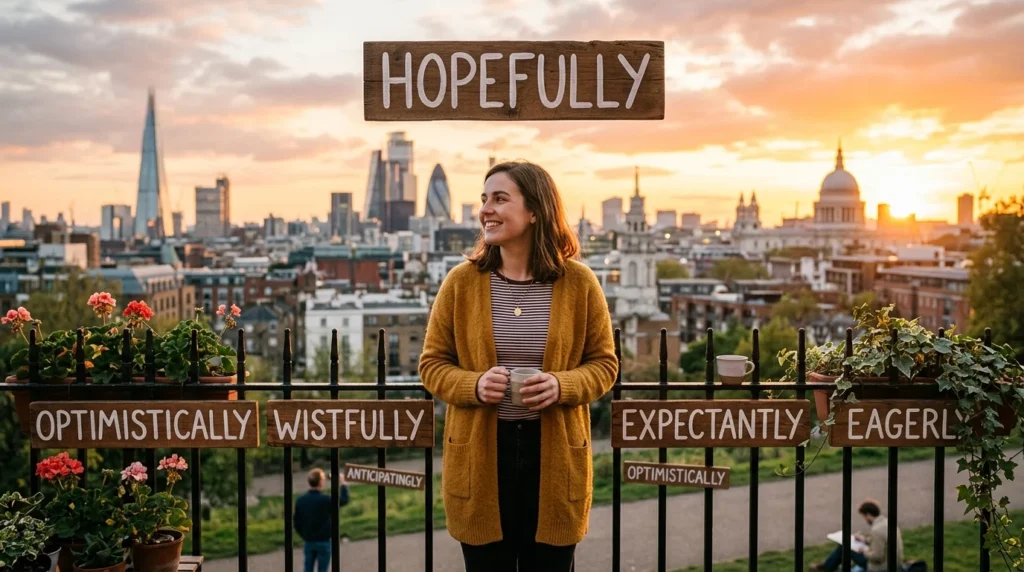
Quick Synonym List
- Optimistically
- Expectantly
- Confidently
- Sanguinely
- With hope
- In hope
- With optimism
- With anticipation
- I hope
- We hope
- It is hoped
- If all goes well
- With any luck
- If we’re lucky
- All being well
- Assuming all goes well
- God willing
- As hoped
- One hopes
- Let us hope
- Hopefully enough
- Favorably
- Positively
- Expectantly
- Wishfully
- Trustingly
- In anticipation
- With good expectations
- With optimism
- If everything works out
Note: These are not perfect synonyms in every sentence. Hopefully can express either a person’s hopeful manner or a speaker’s hope about a future event, so the replacement should match the intended meaning.

Closest Synonyms
Optimistically
Meaning: In a hopeful and positive way.
How it differs: Optimistically emphasizes a positive expectation or outlook, while hopefully can simply express a desired outcome.
Tone: Neutral to formal.
Best for: Attitudes, predictions, and expectations.
Example:
She looked optimistically toward the future.
Relationship: Usually interchangeable when hopefully describes someone’s manner.
Expectantly
Meaning: In a way that shows you expect or anticipate something.
How it differs: Expectantly suggests waiting for something to happen.
Tone: Neutral.
Best for: People waiting for news, results, answers, or events.
Example:
The students waited expectantly for the results.
Watch out: It does not simply mean “I hope.”
Confidently
Meaning: In a way that shows confidence that something will happen or succeed.
Tone: Neutral to professional.
Example:
She confidently predicted that the project would succeed.
Watch out: This is stronger than hopefully. Someone can be hopeful without being confident.
With Hope
Meaning: In a hopeful manner or while hoping for a positive outcome.
Tone: Neutral.
Example:
He looked toward the future with hope.
Relationship: Close in meaning when hopefully describes a person’s attitude.
With Optimism
Meaning: In a positive and hopeful way.
Tone: Neutral to formal.
Example:
The team approached the challenge with optimism.
Watch out: This works especially well after verbs such as approach, face, view, and look.
With Anticipation
Meaning: While looking forward to something expected to happen.
Tone: Neutral/formal.
Example:
The audience waited with anticipation.
Watch out: Anticipation can express excitement or expectation rather than hope specifically.
Formal and Professional Alternatives
It Is Hoped
Meaning: A formal way to say that someone hopes something will happen.
Tone: Formal.
Best for: Reports, official statements, academic writing, and formal announcements.
Example:
It is hoped that the new program will improve access to education.
Relationship: Phrase-level alternative.
If All Goes Well
Meaning: If circumstances develop as expected.
Tone: Neutral.
Example:
If all goes well, we should finish the project by Friday.
How it differs: This focuses on favorable circumstances rather than directly expressing someone’s hope.
All Being Well
Meaning: If everything happens as expected.
Tone: Neutral to formal; somewhat more common in British English than American English.
Example:
All being well, the repairs will be finished tomorrow.
American English note: If all goes well is usually more natural for a U.S. audience.
Assuming All Goes Well
Meaning: On the condition that there are no major problems.
Tone: Professional.
Example:
Assuming all goes well, the new system will launch next month.
Watch out: This expresses a condition, not simply a wish.
With Good Expectations
Meaning: With the belief or hope that something positive will happen.
Tone: Formal.
Example:
The organization entered the new year with good expectations.
Watch out: This phrase is less natural than with optimism in many situations.
As Hoped
Meaning: In the way that was desired or expected.
Tone: Neutral/formal.
Example:
The treatment worked as hoped.
Relationship: Context-dependent rather than a direct replacement for hopefully.
Neutral and Everyday Alternatives
I Hope
Meaning: A direct way to express your desire for something to happen.
Tone: Neutral, natural, conversational.
Example:
I hope we get there on time.
Relationship: One of the clearest alternatives to sentence-initial hopefully.
Compare:
Hopefully, we get there on time.
I hope we get there on time.
The second version clearly identifies who has the hope.
We Hope
Meaning: Expresses the hopes of a group.
Tone: Neutral.
Example:
We hope you enjoy the event.
Best for: Emails, announcements, customer communication, and everyday speech.
With Any Luck
Meaning: If circumstances are favorable.
Tone: Conversational.
Example:
With any luck, we’ll finish before dinner.
Watch out: This emphasizes favorable circumstances or chance, not necessarily personal hope.
If We’re Lucky
Meaning: If circumstances happen to work in our favor.
Tone: Conversational.
Example:
If we’re lucky, we’ll find a parking space nearby.
Relationship: Context-dependent.
One Hopes
Meaning: A somewhat detached way of expressing hope.
Tone: Formal or literary.
Example:
One hopes that the situation will improve.
Watch out: It can sound distant or old-fashioned in casual American English.
Let Us Hope
Meaning: An invitation or statement expressing hope.
Tone: Formal, serious, sometimes dramatic.
Example:
Let us hope the weather improves tomorrow.
Casual Alternatives
With Any Luck
This is one of the most natural conversational alternatives to hopefully when the desired result depends partly on circumstances.
With any luck, we’ll make it home before dark.
If We’re Lucky
This has a similar meaning but sounds more casual.
If we’re lucky, the tickets will still be available.
If Everything Works Out
Meaning: If the situation develops successfully.
Tone: Casual and conversational.
Example:
If everything works out, I’ll start the new job next month.
If Things Go Well
Meaning: If there are no significant problems.
Tone: Conversational.
Example:
If things go well, we’ll finish early.
God Willing
Meaning: If circumstances permit or according to God’s will.
Tone: Religious, traditional, or culturally marked.
Example:
God willing, we’ll see each other again soon.
Watch out: Because of its religious meaning, it is not a neutral substitute for hopefully in every context.
Hopefully vs. Near Synonyms
The biggest distinction is between hope, optimism, expectation, and luck.
- Hopefully → expresses hope for a desired outcome.
- Optimistically → expresses a positive outlook.
- Expectantly → shows anticipation.
- Confidently → shows strong belief that something will happen.
- With any luck → suggests that success depends partly on chance.
- If all goes well → focuses on favorable circumstances.
- I hope → directly identifies the person who has the hope.
- It is hoped → gives the sentence a formal, impersonal tone.
- Wishfully → suggests a desire that may be unrealistic.
- God willing → adds a religious dimension.
Cambridge lists optimistically, confidently, and expectantly among related synonyms for the “in a hopeful manner” sense, while other thesaurus sources distinguish phrases such as it is hoped and all being well for the sentence-level sense.
Comparison Table
| Alternative | Relationship | Can Replace Hopefully? | Tone | Best Context |
|---|---|---|---|---|
| Optimistically | Close synonym | Usually | Neutral/formal | Positive outlook |
| Expectantly | Near synonym | Sometimes | Neutral | Waiting or anticipation |
| Confidently | Related | Sometimes | Professional | Strong expectation |
| With hope | Close phrase | Usually | Neutral | Hopeful attitude |
| I hope | Close phrase | Usually | Neutral | Direct personal hope |
| We hope | Close phrase | Usually | Neutral/professional | Group communication |
| It is hoped | Formal equivalent | Usually | Formal | Reports/statements |
| With any luck | Contextual alternative | Sometimes | Conversational | Favorable chance |
| If all goes well | Contextual alternative | Sometimes | Neutral | Plans/conditions |
| If we’re lucky | Contextual alternative | Sometimes | Casual | Chance |
| All being well | Contextual alternative | Sometimes | Formal/neutral | Future plans |
| Wishfully | Near synonym | Rarely | Neutral | Unrealistic hopes |
| God willing | Phrase-level alternative | Sometimes | Religious | Faith/culture |
| Let us hope | Phrase-level alternative | Usually | Formal | Serious statements |
| One hopes | Phrase-level alternative | Usually | Formal | Detached writing |
How to Choose the Right Alternative
Use “I hope” for clear personal meaning
Instead of:
Hopefully, I’ll pass the exam.
You can write:
I hope I’ll pass the exam.
This makes the source of the hope explicit.
Use “optimistically” for someone’s attitude
She approached the challenge optimistically.
Here, hopefully could work, but optimistically more clearly describes her positive attitude.
Use “expectantly” for anticipation
The children looked expectantly at their teacher.
This means they were waiting for something to happen.
Use “with any luck” when chance matters
With any luck, we’ll finish before noon.
This suggests that circumstances or chance will affect the outcome.
Use “if all goes well” for plans
If all goes well, construction will finish in June.
This emphasizes the condition required for the desired result.
Use “it is hoped” in formal writing
It is hoped that the findings will contribute to future research.
This is more formal and impersonal than hopefully.
Sentence Transformations
- Hopefully, we’ll arrive before dark.
→ I hope we’ll arrive before dark. - Hopefully, the weather will improve.
→ With any luck, the weather will improve. - Hopefully, the project will be completed on time.
→ If all goes well, the project will be completed on time. - She looked hopefully at the doctor.
→ She looked expectantly at the doctor. - He approached the problem hopefully.
→ He approached the problem optimistically. - Hopefully, the new plan will succeed.
→ It is hoped that the new plan will succeed. - Hopefully, we’ll find a solution soon.
→ If we’re lucky, we’ll find a solution soon. - Hopefully, everything will work out.
→ I hope everything will work out. - They waited hopefully for the announcement.
→ They waited expectantly for the announcement. - Hopefully, we can finish the work today.
→ If everything works out, we can finish the work today.
Grammar and Usage
Hopefully is an adverb. It has two major uses.
1. Hopefully = “I/we hope that”
This is the common sentence-level use:
Hopefully, the package will arrive tomorrow.
Here, hopefully expresses the speaker’s hope about the entire situation. Cambridge explicitly gives this use as meaning what the speaker would like to happen.
2. Hopefully = “in a hopeful manner”
Here, hopefully describes how someone does something:
She asked hopefully whether any seats were available.
This use describes the manner of the person’s action.
Hopefully at the beginning of a sentence
Hopefully, we’ll finish early.
This is standard modern American English. Oxford notes that this sentence-level use is the most common meaning, although some people still object to it because of older usage preferences.
“Hopefully” vs. “I hope”
Both can be correct:
Hopefully, she will call tomorrow.
I hope she will call tomorrow.
The second version is more explicit about who has the hope. The first is shorter and very common.
Common Mistakes
1. Thinking “hopefully” is always the same as “optimistically”
It isn’t.
Hopefully, we’ll win.
expresses a desired result.
She spoke optimistically about the team’s chances.
describes a positive attitude.
2. Using “confidently” when you only mean “hopefully”
Confidently suggests a stronger belief.
Hopefully, it will work.
does not necessarily mean:
Confidently, it will work.
The second idea implies much greater certainty.
3. Confusing “hopefully” with “expectantly”
Expectantly suggests that someone is waiting for something.
The audience waited expectantly.
It does not simply mean “I hope.”
4. Using “with any luck” when luck is irrelevant
With any luck, we’ll get there on time.
suggests that circumstances or chance matter.
For a simple personal wish, I hope may be clearer.
5. Assuming “hopefully” is grammatically incorrect
The sentence-level use of hopefully has been criticized by some style authorities, but major modern dictionaries recognize it as standard usage. Oxford identifies it as the most common use, and American dictionary sources document it as established usage.
6. Using “God willing” as a neutral substitute
God willing has religious or culturally specific meaning. It is not appropriate in every professional or secular context.
7. Overusing “hopefully”
Repeating hopefully in every sentence can make writing sound repetitive or uncertain.
Instead, vary your phrasing:
I hope…
If all goes well…
With any luck…
We expect…
It is hoped that…
When Not to Use an Alternative
Sometimes hopefully is the clearest choice.
Use it when:
- You want a short way to express a positive hope.
- The subject of the hope is obvious from context.
- You are writing naturally in modern American English.
- You do not need to emphasize certainty or probability.
- A longer phrase would make the sentence unnecessarily wordy.
For example:
Hopefully, we’ll see you next week.
is natural and concise.
Replacing it with:
It is hoped that we will see you next week.
makes the sentence much more formal and impersonal without adding useful meaning.
Writing Tips
- Use hopefully for a concise expression of hope.
- Use I hope when you want to make the speaker’s feeling explicit.
- Use optimistically when describing a positive attitude.
- Use expectantly when someone is waiting for something.
- Use confidently when the expectation is strong.
- Use with any luck when success depends partly on chance.
- Use if all goes well when describing a favorable condition.
- Use it is hoped for formal, impersonal writing.
- Use wishfully when the hope seems unrealistic or idealized.
- Avoid replacing hopefully with a synonym simply for variety if the original word is the most natural choice.
FAQs
What is the closest synonym for hopefully?
Optimistically is one of the closest synonyms when hopefully means “in a hopeful manner.” For the sentence-level meaning, I hope, it is hoped, and if all goes well can be useful depending on context.
What is a formal synonym for hopefully?
It is hoped is a clear formal alternative. Optimistically and expectantly can also work when they match the intended meaning.
What is a professional alternative to hopefully?
For professional writing, consider it is hoped, if all goes well, with optimism, or we hope, depending on the sentence.
For example:
We hope to complete the project by Friday.
is usually clearer than forcing a more elaborate synonym.
Is “hopefully” the same as “optimistically”?
Not exactly. Hopefully usually expresses a desired outcome, while optimistically describes a positive or confident outlook.
What can I say instead of “hopefully” in an email?
Good options include I hope, we hope, with any luck, or if all goes well.
For example:
I hope you have a great weekend.
is warmer and more direct than simply beginning with hopefully.
Is “hopefully” grammatically correct?
Yes. Modern dictionaries recognize hopefully as a standard adverb meaning both “in a hopeful manner” and, in sentence-level use, “it is hoped.” Some style traditions have objected to the second use, but it is now widely established.
What is the opposite of hopefully?
There is no single exact opposite in every context. Depending on the meaning, contrasts might include pessimistically, hopelessly, doubtfully, unfortunately, or without hope.
Editor’s Choice
Choose based on the situation rather than treating one alternative as universally best:
- For everyday writing: I hope
- For a positive attitude: optimistically
- For anticipation: expectantly
- For uncertain favorable circumstances: with any luck
- For formal writing: it is hoped
Key Takeaways
- Hopefully has two main meanings: “in a hopeful way” and “it is hoped.”
- Optimistically, expectantly, and confidently work best when describing someone’s attitude or manner.
- I hope is a clear, natural alternative when you want to identify who has the hope.
- With any luck and if all goes well emphasize favorable circumstances rather than hope itself.
- In modern American English, sentence-initial hopefully is a standard and widely accepted usage.
Internal Link Opportunities
| Anchor Text | Suggested Topic | Why It Fits |
|---|---|---|
| synonyms for hope | Synonyms for Hope | Covers the noun and verb behind hopefully |
| synonyms for optimistic | Synonyms for Optimistic | Directly connects to one of the closest alternatives |
| synonyms for confident | Synonyms for Confident | Helps distinguish confidence from hope |
| synonyms for expect | Synonyms for Expect | Explains expectation versus hope |
| synonyms for wish | Synonyms for Wish | Useful for understanding desire and uncertainty |
| synonyms for positive | Synonyms for Positive | Connects with optimistic attitudes |
| synonyms for likely | Synonyms for Likely | Helps distinguish probability from hope |