

Quick Answer: What Are Synonyms for Catalyst?
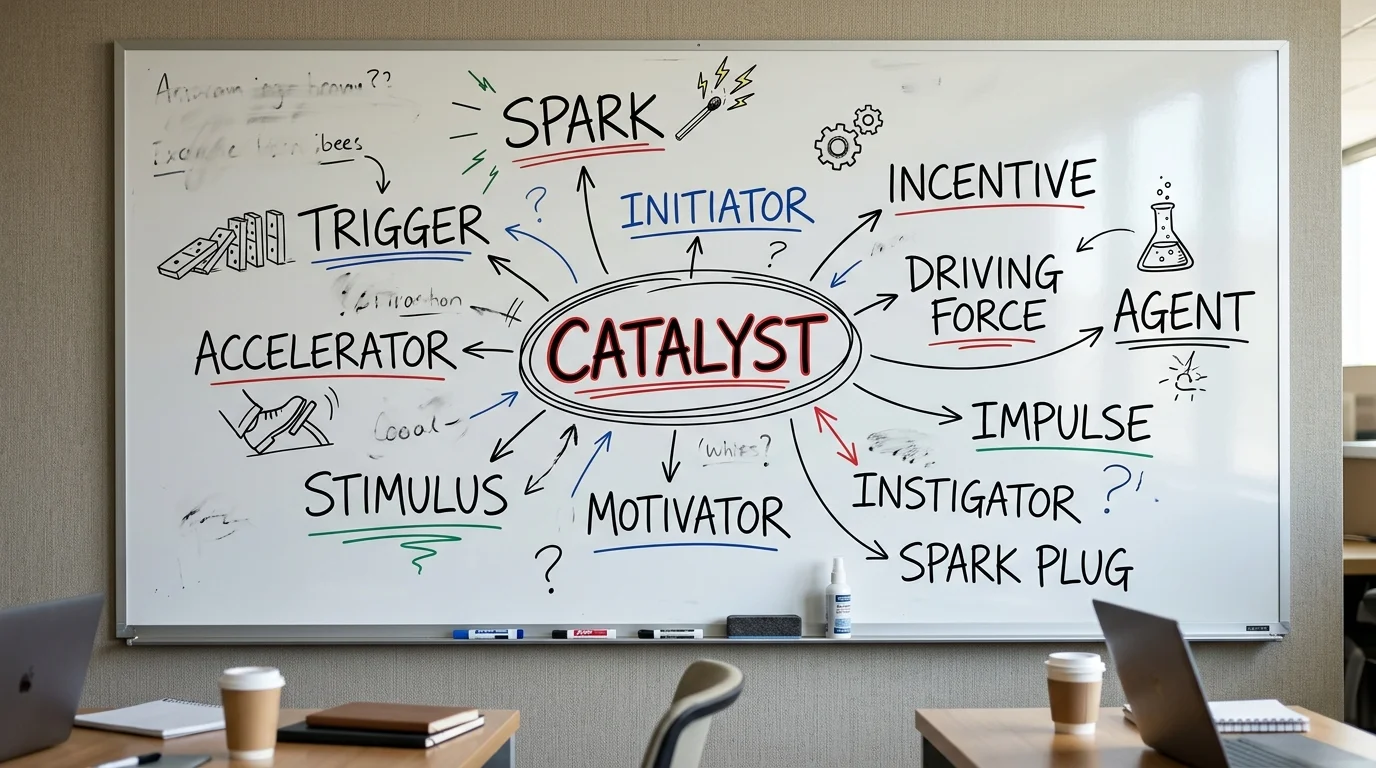
Common synonyms for catalyst include trigger, stimulus, impetus, driving force, spark, instigator, motivator, incentive, influence, cause, source, agent of change, turning point, and accelerator. Some are close synonyms, while others emphasize a particular aspect of the original idea, such as starting something, motivating action, or speeding up change.
Quick List of Synonyms for Catalyst
Here are useful alternatives, grouped by meaning:
Closest General Alternatives
- trigger
- stimulus
- impetus
- driving force
- instigator
- motivator
- accelerator
- influence
- cause
- agent of change
Alternatives for Something That Starts Change
- trigger
- spark
- turning point
- starting point
- initiator
- instigator
- cause
- precipitant
- prompting factor
Alternatives for Something That Encourages Action
- motivation
- motivator
- incentive
- encouragement
- inspiration
- stimulus
- impetus
- encouragement factor
Alternatives for Something That Speeds Up Change
- accelerator
- driving force
- impetus
- stimulus
- boost
- engine
- propellant
- force
Alternatives for a Person Who Causes Change
- instigator
- initiator
- motivator
- leader
- influencer
- change agent
- driver
- advocate
- reformer
Closest Synonyms for Catalyst
1. Trigger
Trigger is one of the closest everyday alternatives to catalyst. It describes something that causes an event or change to begin.
The announcement was a catalyst for major changes.
→ The announcement was a trigger for major changes.
Tone: Neutral
Best for: Events, reactions, sudden changes, social situations
Interchangeability: Usually interchangeable when emphasizing what started something
A trigger often suggests a more immediate cause, while catalyst can emphasize the process of accelerating change.
2. Stimulus
A stimulus is something that encourages activity, development, thought, or response.
The investment acted as a catalyst for economic growth.
→ The investment provided a stimulus for economic growth.
Tone: Formal/academic
Best for: Economics, science, education, psychology, policy
Interchangeability: Often, but not always
Stimulus focuses more on encouraging a response than on accelerating a transformation.
3. Impetus
Impetus means something that gives an activity or process energy or motivation to begin or continue.
The report provided the impetus for reform.
Tone: Formal
Best for: Business, academic writing, policy, reform
Interchangeability: Usually interchangeable in figurative contexts
Impetus is particularly useful when you want to emphasize motivation or momentum.
4. Driving Force
A driving force is a person, idea, factor, or influence that strongly pushes something forward.
Technology was a driving force behind the industry’s growth.
Tone: Neutral/professional
Best for: Business, technology, social change, economics
Interchangeability: Often interchangeable
Unlike catalyst, driving force suggests sustained influence, not necessarily a single event that starts change.
5. Spark
A spark is something that starts an activity, reaction, idea, or movement.
The incident became a spark for public discussion.
Tone: Neutral/conversational
Best for: Social change, creativity, conflict, inspiration
Interchangeability: Context-dependent
Spark is more vivid and informal than catalyst. It often suggests the small beginning of something larger.
6. Instigator
An instigator is a person or thing that causes something to happen, especially an action or event.
She was the instigator of the campaign.
Tone: Neutral to negative
Best for: Conflict, movements, events, actions
Interchangeability: Context-dependent
Be careful: instigator can suggest that someone deliberately started trouble or conflict, while catalyst is generally more neutral.
7. Accelerator
An accelerator is something that makes a process happen faster.
The new technology became an accelerator of digital transformation.
Tone: Professional/technical
Best for: Business, technology, development, scientific contexts
Interchangeability: Often when emphasizing speed
Accelerator focuses specifically on increasing the rate of change.
Formal and Professional Synonyms for Catalyst
In professional, academic, and analytical writing, these alternatives can work well:
- impetus
- stimulus
- driving force
- accelerator
- precipitant
- contributing factor
- motivating factor
- initiating factor
- agent of change
- change agent
- influential factor
Example
Original:
The new strategy was a catalyst for organizational change.
Professional alternatives:
The new strategy provided the impetus for organizational change.
The new strategy became a driving force behind organizational change.
The new strategy served as an accelerator of organizational change.
Each version has a slightly different emphasis.
Neutral and Everyday Alternatives
For general readers, simpler words often work better than catalyst.
Useful choices include:
- trigger
- cause
- spark
- reason
- influence
- motivation
- push
- starting point
- turning point
- driving force
For example:
Her advice was a catalyst for my decision.
Could become:
Her advice was the reason I made the decision.
Or:
Her advice prompted me to make the decision.
The simpler version may be clearer when the audience doesn’t need the more abstract word catalyst.
Alternatives for a Person Who Acts as a Catalyst
When catalyst refers to a person who causes or encourages change, different words may be more precise.
Change Agent
A change agent is someone who actively helps bring about change.
The manager became a change agent within the organization.
Best for: Business, leadership, organizational development
Initiator
An initiator is someone who starts an action or process.
She was the initiator of the project.
Best for: Projects, campaigns, programs
Instigator
An instigator is someone who causes an action or event to happen.
He was the instigator of the dispute.
Best for: Conflict or deliberate action
Caution: This word can have a negative meaning.
Motivator
A motivator is someone or something that encourages people to act.
Her teacher was a major motivator in her academic development.
Best for: Education, personal development, leadership
Influencer
An influencer is someone who affects people’s opinions, choices, or behavior.
The scientist became an important influencer in the public debate.
Best for: Social discussions, media, public opinion
An influencer isn’t necessarily a catalyst, because influence can be gradual and may not cause a specific change.
Alternatives for an Event That Acts as a Catalyst
When an event causes a major change, these expressions can be especially useful:
- trigger
- turning point
- spark
- precipitating event
- pivotal event
- defining moment
- starting point
- critical event
- initiating event
Example
The discovery was a catalyst for further research.
Possible alternatives:
The discovery was a turning point in the research.
The discovery triggered further research.
The discovery became a starting point for further research.
The best choice depends on whether you want to emphasize cause, importance, or beginning.
Alternatives for an Idea That Acts as a Catalyst
When an idea leads to action or change, consider:
- inspiration
- stimulus
- impetus
- motivation
- spark
- influence
- prompting idea
- guiding idea
- source of inspiration
Example
The book was a catalyst for new ideas.
Possible rewrite:
The book was a source of inspiration for new ideas.
Or:
The book sparked new ideas.
The second version is shorter and more natural in everyday writing.
Comparison Table: Synonyms for Catalyst
| Alternative | Relationship | Can Replace Catalyst? | Tone | Best Context |
|---|---|---|---|---|
| trigger | Close synonym | Often | Neutral | Events and change |
| stimulus | Near synonym | Often | Formal | Economics, science |
| impetus | Close synonym | Often | Formal | Reform and action |
| driving force | Near synonym | Often | Professional | Business and development |
| spark | Contextual alternative | Often | Conversational | Ideas and movements |
| instigator | Contextual alternative | Sometimes | Neutral/negative | Actions and conflict |
| accelerator | Near synonym | Often | Technical | Speeding up change |
| motivator | Near synonym | Sometimes | Neutral | People and behavior |
| incentive | Related term | Sometimes | Neutral | Decisions and action |
| influence | Broader term | Sometimes | Neutral | People and ideas |
| cause | Broader term | Sometimes | Neutral | General explanations |
| turning point | Contextual alternative | Sometimes | Neutral | Major events |
| change agent | Close contextual alternative | Often | Professional | Organizational change |
| precipitant | Near synonym | Often | Formal | Events and reactions |
Second Comparison Table
| Word/Phrase | Meaning | Tone | Strength | Best Use | Interchangeable? |
|---|---|---|---|---|---|
| catalyst | Causes or speeds change | Neutral/formal | Strong | General and professional | — |
| trigger | Starts a reaction or event | Neutral | Strong | Events | Often |
| stimulus | Encourages a response | Formal | Moderate | Academic/scientific | Sometimes |
| impetus | Provides motivation or momentum | Formal | Strong | Reform/action | Often |
| driving force | Strongly pushes something forward | Professional | Strong | Business/change | Often |
| spark | Starts something that may grow | Conversational | Moderate | Ideas/movements | Sometimes |
| accelerator | Speeds up a process | Technical | Strong | Technology/business | Often |
| instigator | Causes an event to happen | Neutral/negative | Strong | Conflict/actions | Sometimes |
| motivator | Encourages action | Neutral | Moderate | People/behavior | Sometimes |
| turning point | Marks a major change | Neutral | Strong | History/life/events | Sometimes |
Catalyst vs. Trigger
These two words are close, but they are not identical.
A trigger usually causes something to begin or happen.
A catalyst can start change but often also suggests that the change becomes faster or more significant.
The announcement triggered protests.
The announcement became a catalyst for political reform.
The first sentence focuses on the immediate reaction. The second focuses on broader change.
Catalyst vs. Impetus
Both words can describe something that encourages change.
Catalyst emphasizes causing or accelerating change.
Impetus emphasizes motivation or momentum.
The crisis was a catalyst for reform.
The crisis gave the government the impetus to reform the system.
They overlap, but impetus often sounds more formal.
Catalyst vs. Stimulus
A stimulus encourages a response or activity.
A catalyst causes or accelerates change.
For example:
Lower interest rates provided a stimulus for investment.
The new technology was a catalyst for industrial change.
Stimulus is especially common in economics, psychology, and science.
Catalyst vs. Driving Force
A driving force is usually a powerful factor that continues to push a process forward.
A catalyst may be a single event that starts or accelerates the process.
The discovery was a catalyst for change.
Innovation remains a driving force behind the industry.
The first suggests a specific cause. The second suggests ongoing influence.
Catalyst vs. Cause
A cause is anything that produces an effect.
A catalyst is more specific. It often describes something that initiates or accelerates a process of change.
So, every catalyst can function as a cause in a broad sense, but not every cause is a catalyst.
Catalyst vs. Turning Point
A turning point is an event or moment that marks a major change in direction.
A catalyst is something that helps cause that change.
The meeting was a catalyst for reform.
The meeting was a turning point in the negotiations.
The first focuses on what caused change. The second focuses on the significance of the moment.
Sentence Transformations
1. Trigger
Original:
The discovery was a catalyst for further research.
Better Alternative:
The discovery triggered further research.
Why: Triggered is concise and emphasizes that the discovery started the activity.
2. Impetus
Original:
The crisis became a catalyst for reform.
Better Alternative:
The crisis provided the impetus for reform.
Why: Impetus emphasizes the motivation behind the reform.
3. Driving Force
Original:
Technology has been a catalyst for economic growth.
Better Alternative:
Technology has been a driving force behind economic growth.
Why: Driving force emphasizes sustained influence.
4. Spark
Original:
The article became a catalyst for public discussion.
Better Alternative:
The article sparked public discussion.
Why: Sparked is more concise and vivid.
5. Accelerator
Original:
The investment acted as a catalyst for digital transformation.
Better Alternative:
The investment accelerated digital transformation.
Why: The verb accelerated directly expresses faster change.
6. Motivator
Original:
Her teacher was a catalyst for her academic success.
Better Alternative:
Her teacher was a major motivator in her academic development.
Why: Motivator is more precise when the person encouraged her effort.
7. Change Agent
Original:
The manager became a catalyst for organizational change.
Better Alternative:
The manager became a change agent within the organization.
Why: Change agent specifically describes someone who actively promotes change.
8. Turning Point
Original:
The agreement was a catalyst for a new phase in the negotiations.
Better Alternative:
The agreement was a turning point in the negotiations.
Why: Turning point emphasizes the importance of the event rather than its causal role.
9. Stimulus
Original:
The policy served as a catalyst for investment.
Better Alternative:
The policy provided a stimulus for investment.
Why: Stimulus fits economic and policy discussions.
10. Cause
Original:
The new evidence was a catalyst for the investigation.
Better Alternative:
The new evidence prompted the investigation.
Why: Prompted naturally expresses the immediate reason an investigation began.
Grammar and Usage of Catalyst
Catalyst is primarily a countable noun.
Common Patterns
a catalyst for + noun
The event was a catalyst for change.
The invention became a catalyst for innovation.
a catalyst for + -ing activity
The policy was a catalyst for improving public services.
a catalyst in + process/area
The organization played a role as a catalyst in economic development.
act as a catalyst
Education can act as a catalyst for social change.
serve as a catalyst
The discovery served as a catalyst for further research.
become a catalyst
The decision became a catalyst for reform.
Catalyst for vs. Catalyst of
Catalyst for is usually the most natural construction when describing the change that follows.
a catalyst for change
a catalyst for innovation
a catalyst for growth
Catalyst of can occur in specialized or formal writing, but catalyst for is generally the safer choice.
Common Collocations With Catalyst
Some natural combinations include:
- catalyst for change
- catalyst for growth
- catalyst for innovation
- catalyst for reform
- catalyst for development
- catalyst for transformation
- catalyst for action
- catalyst for progress
- catalyst for improvement
- catalyst for debate
- catalyst for discussion
- catalyst for recovery
- catalyst for economic growth
- catalyst for social change
- catalyst for technological advancement
These combinations are common because catalyst frequently describes something that starts or accelerates a broader process.
Scientific Meaning of Catalyst
In chemistry, a catalyst is a substance that increases the rate of a chemical reaction without being consumed as a reactant.
In this scientific sense, words such as trigger, motivation, or spark are not true synonyms.
Depending on the technical context, related terms may include:
- catalytic agent
- reaction accelerator
- catalyst
- catalytic substance
However, technical writing should normally retain catalyst when it is the precise scientific term.
Common Mistakes With Catalyst
1. Treating Every Cause as a Catalyst
A catalyst is more specific than simply a cause.
If something merely caused an event, cause may be more accurate.
2. Assuming Catalyst Always Means “Trigger”
A catalyst can initiate change, but it can also accelerate an existing process.
3. Using “Instigator” as a Positive Synonym
Instigator can suggest someone deliberately causing conflict or trouble.
For positive change, change agent, initiator, or catalyst may be better.
4. Confusing Catalyst With Motivation
A motivator encourages someone to act. A catalyst can refer to a person, event, idea, or circumstance that produces broader change.
5. Using “Accelerator” When Speed Is Not the Main Idea
If something starts a process but doesn’t necessarily make it faster, trigger or initiator may be more accurate.
6. Using “Turning Point” for Every Catalyst
A turning point is significant because it changes direction. A catalyst is significant because it helps cause or accelerate change.
7. Overusing “Catalyst for Change”
The phrase is natural, but repeating it throughout an article can become vague.
Where appropriate, use more precise verbs:
- prompted
- triggered
- accelerated
- encouraged
- sparked
- drove
- initiated
When Not to Use a Synonym for Catalyst
Keep catalyst when it is the clearest word for something that initiates or accelerates change.
Don’t replace it merely for variety.
For example:
The discovery was a catalyst for medical innovation.
This is concise and precise. Replacing it with cause, influence, or factor may make the meaning less specific.
Use a different word when you want to emphasize a particular aspect:
- trigger → immediate cause
- spark → small beginning
- impetus → motivation or momentum
- accelerator → increased speed
- driving force → sustained influence
- turning point → major change in direction
- motivator → encouragement to act
- change agent → person who actively promotes change
How to Choose the Right Synonym
Ask yourself what role the catalyst plays.
Does it start something?
Use trigger, spark, or initiator.
Does it motivate action?
Use impetus, motivator, or stimulus.
Does it make change happen faster?
Use accelerator.
Does it keep pushing a process forward?
Use driving force.
Is it a person actively creating change?
Use change agent, initiator, or influencer.
Is it a major moment that changes direction?
Use turning point.
Is the context scientific?
Keep catalyst unless a precise technical alternative is appropriate.
FAQs
What is the best synonym for catalyst?
Trigger, impetus, stimulus, driving force, and accelerator are among the closest alternatives. The best choice depends on whether you mean starting, motivating, or speeding up change.
What is a simple synonym for catalyst?
Trigger or cause can be simple alternatives. Spark is also useful in conversational writing.
What is a formal synonym for catalyst?
Impetus, stimulus, precipitant, and driving force can work in formal contexts, depending on the meaning.
What is a synonym for a person who is a catalyst?
Possible choices include change agent, initiator, motivator, influencer, and instigator. Change agent is often the best professional option.
Is “trigger” the same as “catalyst”?
They overlap, but they aren’t always identical. Trigger usually emphasizes starting a reaction or event, while catalyst can emphasize both starting and accelerating change.
What is the opposite of catalyst?
There is no single exact opposite. Depending on the context, possible contrasting ideas include obstacle, barrier, hindrance, inhibitor, deterrent, or constraint.
What is the difference between catalyst and impetus?
A catalyst causes or accelerates change. An impetus provides motivation, energy, or momentum for an action or process.
Related Questions
- What are synonyms for change?
- What are synonyms for trigger?
- What are synonyms for impetus?
- What are synonyms for influence?
- What are synonyms for motivation?
- What are synonyms for driving force?
- What are formal synonyms for catalyst?
- What is the difference between catalyst and trigger?
Editor’s Choice: Best Alternatives for Catalyst
For most writing situations, these are the strongest choices:
- Trigger — best for something that starts an event or reaction.
- Impetus — best for formal writing about motivation or momentum.
- Driving force — best for sustained influence behind change.
- Spark — best for vivid, conversational writing.
- Accelerator — best when the main idea is speeding up change.
The most accurate synonym isn’t always the most sophisticated-sounding one. Choose the word that tells readers exactly how the person, event, idea, or factor produced change.
Key Takeaways
- Catalyst describes something that causes or accelerates change.
- Trigger is a strong everyday alternative when something starts an event.
- Impetus emphasizes motivation, energy, or momentum.
- Driving force suggests a powerful and often sustained influence.
- Choose synonyms based on the specific role of the catalyst rather than replacing the word simply for variety.