

Quick Answer
The closest everyday synonyms for behavior include conduct, actions, activity, conduct, manner, habits, attitude, demeanor, ways, practices, performance, response, reactions, and conduct. However, these words are not interchangeable in every sentence. Conduct is especially useful for formal or ethical contexts, manners for social behavior, habits for repeated patterns, and demeanor for outward appearance or manner.
Quick Synonym List
- Conduct
- Actions
- Activity
- Manner
- Habits
- Attitude
- Demeanor
- Ways
- Practices
- Conduct
- Performance
- Responses
- Reactions
- Interactions
- Treatment
- Approach
- Style
- Character
- Disposition
- Temperament
- Personality
- Customs
- Routines
- Patterns
- Tendencies
- Traits
- Movements
- Gestures
- Manners
- Etiquette
- Decorum
- Conducting oneself
- Way of acting
- Way of behaving
- Course of action
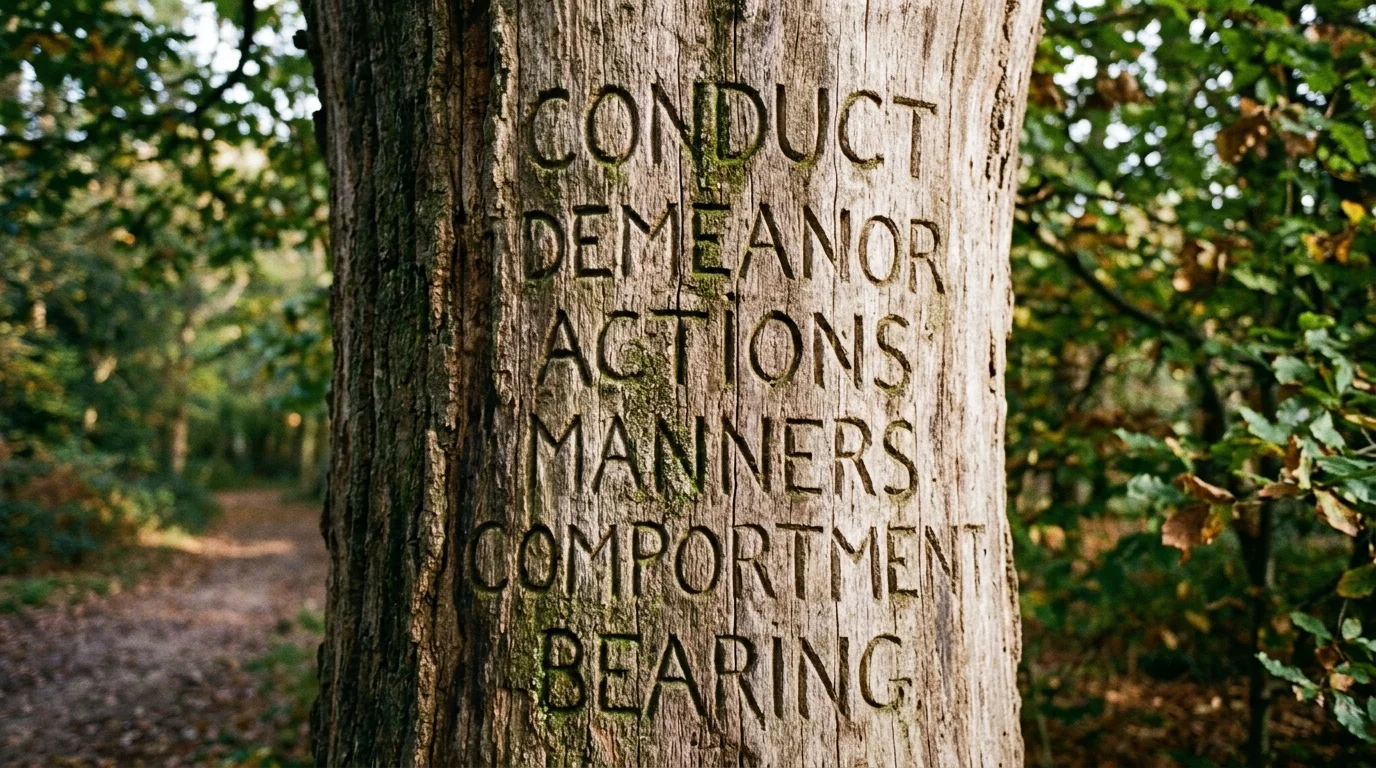
Synonyms for Behavior
Conduct
Conduct is one of the closest synonyms for behavior, especially when discussing how someone acts in relation to rules, standards, or expectations.
It is common in formal, professional, academic, and legal writing.
- The teacher praised the student’s respectful conduct.
- The company has strict rules about employee conduct.
Unlike the broader behavior, conduct often carries an idea of judgment about whether actions are appropriate or inappropriate.
Actions
Actions refers to things someone actually does. It is a direct alternative when behavior means observable acts rather than an overall pattern.
- His actions surprised everyone.
- The study examined children’s behavior after the event.
You can often replace behavior with actions, but not always. Behavior can describe a continuing pattern, while actions usually focuses on specific things someone does.
Activity
Activity refers to what someone or something is doing or the things happening within a particular setting.
- The researchers monitored the animals’ activity.
- Online activity increased during the afternoon.
It works well for physical, digital, biological, or group activity, but it is not a general replacement for behavior in every context.
Manner
Manner describes the way something is done or the way a person acts.
- She spoke in a calm manner.
- His manner was polite and professional.
Manner focuses more on how someone behaves than on the behavior itself.
Habits
Habits are repeated behaviors that a person regularly performs, often without much conscious thought.
- Good study habits can improve learning.
- His eating habits changed after he started exercising.
Habits is more specific than behavior because repetition is central to the meaning.
Attitude
Attitude refers to a person’s way of thinking or feeling about someone or something, often as reflected in their behavior.
- Her positive attitude helped the team.
- His attitude toward criticism was defensive.
An attitude can influence behavior, but the two words are not exact synonyms. Attitude is more about mindset or outlook, while behavior is about actions and responses.
Demeanor
Demeanor describes the outward way a person appears to behave, especially their mood, manner, or bearing.
- The doctor had a calm demeanor.
- His confident demeanor reassured the audience.
It is particularly useful when describing how someone presents themselves to others.
Ways
Ways can refer to a person’s characteristic manner of behaving or doing things.
- He has his own ways of dealing with problems.
- Her friendly ways made people feel welcome.
This is usually more conversational than behavior and often needs a possessive or descriptive phrase.
Practices
Practices refers to customary or established ways of doing something.
- The company changed its hiring practices.
- Traditional farming practices vary by region.
It works best for repeated or established behavior within a person, group, organization, or culture.
Performance
Performance describes how well someone or something carries out a task or functions in a particular setting.
- The researchers studied the athlete’s performance.
- The software showed unusual performance under heavy demand.
It can overlap with behavior in technical or scientific contexts, but it emphasizes how something functions or performs, rather than simply how it acts.
Responses
Responses are reactions to particular situations, events, questions, or stimuli.
- The researchers recorded the participants’ responses.
- Her emotional response was unexpected.
This is useful when behavior is specifically a reaction to something.
Reactions
Reactions describe what someone does, feels, or says in response to an event or stimulus.
- His reaction to the news was surprising.
- The experiment measured the children’s reactions.
Reaction is narrower than behavior because it usually implies something caused the response.
Interactions
Interactions describe how people or groups communicate and behave toward one another.
- The study examined social interactions among students.
- Positive interactions can improve teamwork.
Use this when behavior involves a relationship or exchange between two or more parties.
Treatment
Treatment describes the way someone behaves toward another person or group.
- The employee complained about unfair treatment.
- Children deserve respectful treatment.
It focuses on how one person treats another, rather than behavior in general.
Approach
Approach refers to the way someone deals with a problem, task, person, or situation.
- Her calm approach helped resolve the conflict.
- The manager took a different approach to the problem.
It can overlap with behavior when the emphasis is on a person’s way of handling something.
Style
Style describes a characteristic way of acting, communicating, working, or performing.
- His leadership style is collaborative.
- Her communication style is direct.
It suggests a recognizable pattern or manner rather than behavior in the broadest sense.
Character
Character refers to the qualities that shape a person’s moral or personal nature.
- His character was revealed by how he treated others.
- The experience tested her character.
Character can influence behavior, but it is not a direct synonym. It describes who someone is, rather than simply what they do.
Disposition
Disposition refers to a person’s usual mood, temperament, or tendency to behave in a particular way.
- She has a cheerful disposition.
- His calm disposition made him easy to work with.
It is more focused on a person’s natural tendency than on individual actions.
Temperament
Temperament describes a person’s typical emotional nature and pattern of responding.
- The child has a calm temperament.
- Different animals can have different temperaments.
It is related to behavior but usually refers to an underlying tendency rather than a specific action.
Personality
Personality refers to the combination of characteristics, thoughts, emotions, and tendencies that make a person distinctive.
- Her outgoing personality influences her social behavior.
- His personality affects how he interacts with coworkers.
Personality is broader and deeper than behavior, so it should not be used as a direct replacement in most sentences.
Customs
Customs are traditional or socially accepted ways of behaving within a community or culture.
- Local customs influence social behavior.
- Visitors should respect the customs of the community.
Use customs when behavior is connected to tradition and culture.
Routines
Routines are regular patterns of activities or actions.
- Morning routines can affect productivity.
- The study examined children’s daily routines.
A routine is a repeated sequence, while behavior is much broader.
Patterns
Patterns refers to repeated or recognizable ways of behaving.
- Researchers noticed patterns in the participants’ behavior.
- The child’s behavior showed a recurring pattern.
This is useful when discussing behavior over time rather than a single action.
Tendencies
Tendencies are regular inclinations to behave or respond in a certain way.
- He has a tendency to avoid difficult conversations.
- The study identified aggressive behavioral tendencies.
This word emphasizes what someone is likely to do rather than what they have done once.
Traits
Traits are relatively stable characteristics of a person or other living thing.
- Patience is a valuable personality trait.
- Certain behavioral traits may appear early in development.
Traits can influence behavior, but they describe characteristics rather than actions themselves.
Movements
Movements refers to physical actions or changes in position.
- The camera captured the animal’s movements.
- Researchers tracked the baby’s eye movements.
It is useful when behavior specifically refers to physical activity.
Gestures
Gestures are physical movements used to communicate or express something.
- Her hand gestures showed excitement.
- His facial expressions and gestures communicated confidence.
Gestures are only one part of behavior, so they are not a general substitute.
Manners
Manners refer to socially accepted ways of behaving toward other people.
- The child was praised for having good manners.
- His table manners were excellent.
Manners is especially appropriate for politeness, etiquette, and social behavior.
Etiquette
Etiquette refers to accepted rules or conventions for polite behavior.
- Business etiquette varies across cultures.
- Proper email etiquette can make communication more professional.
It is narrower than behavior because it focuses on social rules and expectations.
Decorum
Decorum refers to behavior that is considered proper, respectful, or socially appropriate.
- The guests maintained proper decorum during the ceremony.
- The meeting required professional decorum.
It is formal and usually carries a strong connection to propriety.
Conducting Oneself
Conducting oneself means behaving or carrying oneself in a particular way.
- She conducted herself professionally during the interview.
- He conducted himself with confidence.
This phrase works well when describing someone’s behavior in a specific situation.
Way of Acting
Way of acting is a straightforward phrase for the manner in which someone behaves.
- His way of acting made people uncomfortable.
- The character’s way of acting changed after the experience.
It is understandable but often less concise than behavior or conduct.
Way of Behaving
Way of behaving directly describes how someone normally acts.
- Her way of behaving was respectful.
- The teacher discussed appropriate ways of behaving in class.
This phrase can be useful when explaining the concept to English learners, although behavior is usually more natural in polished writing.
Course of Action
A course of action is a particular plan or set of actions chosen to deal with a situation.
- The team considered several courses of action.
- His chosen course of action created additional problems.
It is not a direct synonym for behavior. It focuses on a deliberate choice about what to do.
Behavior Has Several Different Meanings
The best synonym depends heavily on what behavior means in the original sentence.
Behavior as the way someone acts
Use conduct, manner, actions, ways, or demeanor.
Her professional behavior impressed the clients.
Possible alternatives:
Her professional conduct impressed the clients.
Her professional demeanor impressed the clients.
The first focuses on standards of conduct, while the second focuses more on how she appeared to others.
Behavior as repeated patterns
Use habits, routines, patterns, practices, or tendencies.
The study examined eating behavior.
Depending on the meaning, you could write:
The study examined eating habits.
The study examined eating patterns.
These alternatives provide more information than the broad word behavior.
Behavior as a reaction
Use response or reaction.
The researchers observed the participants’ behavior after the announcement.
If the focus is specifically on how participants reacted:
The researchers observed the participants’ reactions after the announcement.
Behavior as social interaction
Use manners, etiquette, interactions, or treatment.
The program teaches appropriate social behavior.
You might instead say:
The program teaches good social manners.
This is more precise if the subject is politeness.
Behavior in animals or research
Words such as activity, movements, responses, patterns, and actions may be more precise.
Scientists observed the animal’s behavior.
If they were specifically studying movement:
Scientists observed the animal’s movements.
If they were measuring responses to stimuli:
Scientists measured the animal’s responses.
Synonyms vs. Near Synonyms
| Word | Relationship to Behavior | Can Replace Original? | Best Context |
|---|---|---|---|
| Conduct | Very close synonym | Usually | Formal, ethical, professional |
| Actions | Close alternative | Often | Specific things someone does |
| Manner | Near synonym | Sometimes | How something is done |
| Habits | Narrower term | Context-dependent | Repeated behavior |
| Attitude | Related concept | Sometimes | Mindset or outlook |
| Demeanor | Narrower term | Context-dependent | Outward manner |
| Practices | Contextual alternative | Sometimes | Established ways of doing things |
| Response | Narrower term | Sometimes | Reaction to a stimulus |
| Reactions | Narrower term | Sometimes | Responses to events |
| Manners | Narrower term | Sometimes | Social politeness |
| Etiquette | Narrower term | Rarely | Social rules |
| Personality | Broader related term | Rarely | Personal characteristics |
| Temperament | Related term | Rarely | Emotional nature |
| Patterns | Contextual alternative | Sometimes | Repeated behavior |
| Tendencies | Narrower term | Sometimes | Likely patterns of behavior |
| Treatment | Contextual alternative | Sometimes | How someone treats others |
How to Choose the Right Alternative
Ask what aspect of behavior you are actually describing.
- Use conduct when standards, rules, or ethics matter.
- Use actions when you mean specific things someone did.
- Use manner when you mean how something was done.
- Use habits when the behavior is repeated.
- Use attitude when thoughts or feelings influence the behavior.
- Use demeanor when describing someone’s outward appearance or manner.
- Use practices for established ways of working or operating.
- Use responses or reactions when something caused the behavior.
- Use manners for politeness and social behavior.
- Use etiquette for accepted social rules.
- Use patterns when discussing repeated behavior over time.
- Use tendencies when describing a person’s inclination to behave in a certain way.
- Use treatment when behavior is directed toward another person.
- Use interactions when two or more people are involved.
- Use activity when describing what an animal, person, system, or device is doing.
Sometimes behavior is still the best word. If you are talking broadly about how someone or something acts, replacing it with a narrower synonym can actually make the sentence less accurate.
Sentence Transformations
Original
The teacher was concerned about the student’s behavior.
Alternative
The teacher was concerned about the student’s conduct.
Conduct sounds more formal and suggests that the student’s actions may violate expectations.
Original
The study examined consumer behavior.
Alternative
The study examined consumer habits.
This works if the research focuses on repeated purchasing patterns.
Original
Her behavior during the meeting was professional.
Alternative
Her demeanor during the meeting was professional.
This emphasizes the way she presented herself.
Original
The researchers observed the animal’s behavior.
Alternative
The researchers observed the animal’s activity.
This is more precise if the study focused on what the animal was doing.
Original
His behavior toward his coworkers was respectful.
Alternative
His treatment of his coworkers was respectful.
This puts the focus on how he treated other people.
Original
The child’s behavior changed after the move.
Alternative
The child’s patterns of behavior changed after the move.
This emphasizes a broader change over time.
Original
The experiment changed the participants’ behavior.
Alternative
The experiment changed the participants’ responses.
Use this version if the behavior specifically refers to how participants responded to the experiment.
Original
Good behavior is expected in the classroom.
Alternative
Good conduct is expected in the classroom.
This sounds more formal and emphasizes appropriate standards.
Grammar and Usage
Behavior is usually an uncountable noun in American English.
- The child’s behavior was unusual.
- The researchers studied human behavior.
When referring to different types or patterns, behaviors can also be used, especially in academic, psychological, scientific, or technical writing.
- The study identified several behaviors associated with stress.
Common structures include:
- behavior toward someone — His behavior toward his coworkers was respectful.
- behavior toward something — The system’s behavior toward unexpected inputs was unusual.
- behavior in a situation — Her behavior in class changed.
- behavior of something — Scientists studied the behavior of the species.
- behavioral + noun — behavioral patterns, behavioral changes, behavioral problems, behavioral science
The adjective behavioral is especially useful in academic and professional writing:
- behavioral patterns
- behavioral changes
- behavioral problems
- behavioral research
- behavioral science
Common Mistakes
Treating every synonym as interchangeable
Words such as attitude, personality, habits, and demeanor are related to behavior but have narrower meanings.
Using personality when you mean actions
❌ His personality during the meeting was rude.
✅ His behavior during the meeting was rude.
Personality describes enduring characteristics, while behavior describes how someone acts.
Using attitude when you mean conduct
❌ The company’s attitude violated the safety rules.
✅ The company’s conduct violated the safety rules.
Attitude is about outlook or mindset; conduct concerns actual behavior.
Confusing habits with behavior
A habit is repeated behavior. A single action is not necessarily a habit.
She checked her phone once.
That is an action, not necessarily a habit.
Using manners for all kinds of behavior
Manners applies mainly to social politeness.
His table manners were excellent.
But:
The dog’s behavior was unusual.
Manners would not normally work in the second sentence.
Confusing response with general behavior
A response usually happens because of a particular stimulus or event.
Her response to the criticism was calm.
If you mean her general way of acting, use behavior instead.
Overusing conduct
Conduct is useful, but it can sound formal in everyday conversation.
The child’s behavior was strange.
is usually more natural than:
The child’s conduct was strange.
unless the context is formal or evaluative.
Forgetting the difference between behavior and behavioral
Use behavior as a noun:
The study examined aggressive behavior.
Use behavioral as an adjective:
The study examined behavioral patterns.
Writing Tips
For general writing, behavior is often the clearest choice because it is broad and familiar.
Choose a more specific synonym when it adds useful information. For example, instead of saying:
The study examined student behavior.
you might say:
The study examined student study habits.
if the research concerns repeated study patterns.
Likewise, use conduct when standards matter, demeanor when appearance or manner matters, response when something triggered the behavior, and interactions when people are behaving toward one another.
In formal writing, avoid replacing behavior simply to sound more sophisticated. A precise common word is usually better than an unfamiliar synonym that changes the meaning.
FAQs
What is the closest synonym for behavior?
Conduct is one of the closest synonyms, particularly in formal contexts. Actions is another close alternative when you mean specific things a person does. For everyday writing, behavior itself is often the most natural broad term.
What is another word for good behavior?
Depending on the context, you can use good conduct, proper conduct, good manners, appropriate behavior, decorum, or respectful conduct. Good manners is especially suitable for social politeness.
What is another word for bad behavior?
Possible alternatives include misconduct, improper conduct, unacceptable behavior, inappropriate behavior, wrongdoing, misbehavior, and poor conduct. The best choice depends on how serious or formal the situation is.
Is conduct the same as behavior?
They overlap, but they are not identical in every context. Behavior is broader and can describe any way of acting. Conduct often emphasizes how someone behaves according to rules, standards, or social expectations.
What is a synonym for behavior in psychology?
Depending on the specific context, psychology may use terms such as actions, responses, reactions, patterns, habits, tendencies, conduct, or behavioral patterns. The precise term depends on what is being measured or observed.
What is a synonym for behavior in academic writing?
Conduct, actions, responses, patterns, practices, activity, and behavioral patterns can work in academic writing. The best option depends on the exact meaning rather than formality alone.
What is the difference between behavior and attitude?
Behavior describes what someone does or how they act. Attitude describes their outlook, feelings, or way of thinking about something. An attitude can influence behavior, but the two concepts are different.
Key Takeaways
- Behavior is a broad word for the way a person, animal, group, or system acts.
- Conduct is a strong alternative when rules, standards, or professional behavior matter.
- Actions focuses on specific things someone does, while habits focuses on repeated behavior.
- Demeanor, manners, attitude, personality, and temperament describe related but more specific aspects of behavior.
- The original word behavior is often the clearest choice when you need a broad, neutral term.