
Quick Answer
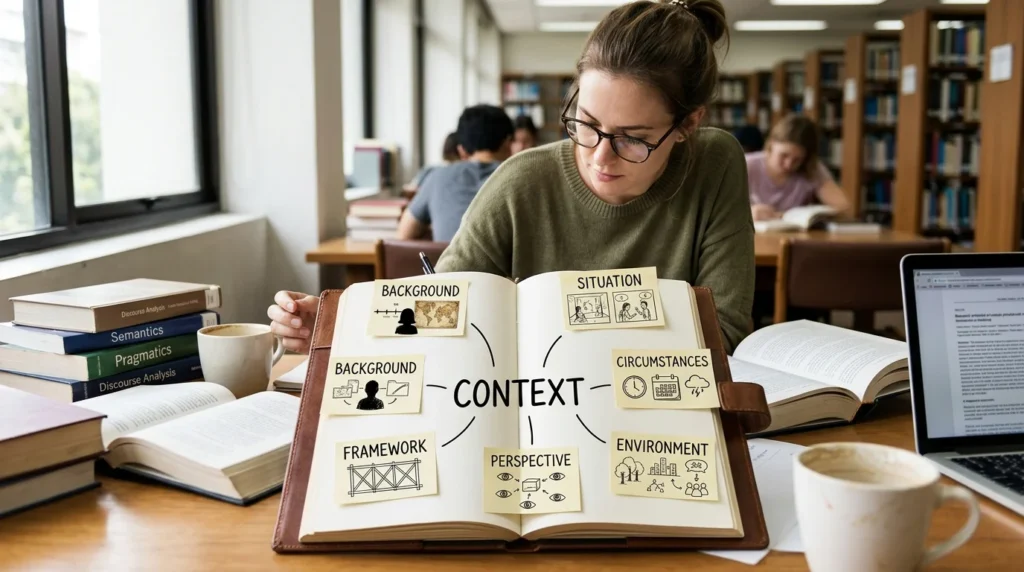
The closest synonyms for context include background, circumstances, setting, situation, environment, conditions, framework, surroundings, perspective, scenario, atmosphere, backdrop, and context of reference. For background information, use background; for surrounding conditions, use circumstances or conditions; for a place or scene, use setting; and for a conceptual structure, use framework.
Quick Synonym List
- Background
- Circumstances
- Setting
- Situation
- Environment
- Conditions
- Framework
- Surroundings
- Perspective
- Scenario
- Atmosphere
- Backdrop
- Milieu
- Climate
- Landscape
- Environment
- Scene
- Position
- Standpoint
- Viewpoint
- Angle
- Reference
- Reference Point
- Bigger Picture
- Larger Picture
- Bigger Context
- Surrounding Factors
- Relevant Information
- Background Information
- Related Information
- External Factors
- Social Setting
- Historical Background
- Cultural Background
- Historical Setting
- Conceptual Framework
- Circumstantial Factors
Synonyms for Context
Background
Background is one of the closest everyday alternatives to context when you mean information that helps someone understand a person, event, idea, or situation.
- The article provides useful context for the debate.
- The article provides useful background for the debate.
Background often refers to information from earlier events or circumstances that explains what is happening now.
Circumstances
Circumstances refers to the conditions or facts surrounding an event or situation.
- We need to consider the context before judging the decision.
- We need to consider the circumstances before judging the decision.
It is especially useful when external conditions influenced what happened.
Setting
Setting describes the place, time, or environment in which something occurs.
- The historical context of the novel is important.
- The historical setting of the novel is important.
Setting is particularly natural for stories, events, social situations, and physical locations.
Situation
Situation refers to the conditions or state of affairs that exist at a particular time.
- The decision makes more sense in its context.
- The decision makes more sense given the situation.
It is a broad everyday alternative, but situation often focuses more on what is happening than on the information used to interpret it.
Environment
Environment refers to the surrounding conditions, people, systems, or physical space in which something exists or develops.
- Children’s behavior is influenced by their social context.
- Children’s behavior is influenced by their social environment.
Use environment when the surroundings themselves have an effect.
Conditions
Conditions are the circumstances or factors that exist at a particular time.
- The decision must be understood in the economic context.
- The decision must be understood under the economic conditions of the time.
This works especially well for economic, political, scientific, environmental, or practical circumstances.
Framework
Framework refers to a structure of ideas, principles, or concepts used to organize or understand something.
- The theory provides a useful context for understanding the findings.
- The theory provides a useful framework for understanding the findings.
Framework is more structured than context and is common in academic and professional writing.
Surroundings
Surroundings refers to the people, places, objects, and conditions around something.
- The meaning changes depending on the context.
- The meaning changes depending on the surroundings.
This is more physical or environmental than the broader word context.
Perspective
Perspective refers to a particular way of viewing or understanding something.
- Historical context changes how we understand the event.
- Historical perspective can change how we understand the event.
These words overlap, but perspective focuses on the viewpoint of the observer rather than the surrounding facts themselves.
Scenario
A scenario is a possible or imagined situation, especially one used for analysis or planning.
- The policy should be examined in the context of economic uncertainty.
- The policy should be examined under this economic scenario.
Scenario is more specific because it describes a particular situation or possible set of events.
Atmosphere
Atmosphere refers to the emotional, social, or physical quality surrounding a place, event, or situation.
- The tense context affected the conversation.
- The tense atmosphere affected the conversation.
Use it when mood or emotional tone matters.
Backdrop
Backdrop refers to the circumstances or broader setting against which something happens.
- The economic crisis provided the context for the reforms.
- The economic crisis formed the backdrop for the reforms.
It is especially useful in descriptive, journalistic, and narrative writing.
Milieu
Milieu refers to the social, cultural, or intellectual environment in which someone or something exists.
- The artist developed within a creative context.
- The artist developed within a creative milieu.
This is more formal and is most useful when discussing cultural or social environments.
Climate
Climate can describe the general social, political, economic, or emotional conditions surrounding a period or situation.
- The political context influenced the decision.
- The political climate influenced the decision.
It suggests an overall prevailing condition rather than specific background facts.
Landscape
Landscape can be used figuratively to describe the overall situation or conditions within a particular field.
- The technology has changed dramatically in this context.
- The technology has changed dramatically in today’s business landscape.
This is common in business, technology, politics, and journalism, but it is more figurative than context.
Scene
Scene refers to the place or situation where something happens.
- The social context of the event matters.
- The social scene surrounding the event matters.
It is more conversational and often works best for social, cultural, artistic, or physical settings.
Position
Position can refer to the circumstances or place from which something is considered.
- The statement needs to be understood in context.
- The statement needs to be understood from its historical position.
This is not a universal synonym. Position is more useful when discussing someone’s standpoint, status, or place within a particular situation.
Standpoint
Standpoint refers to the particular position or viewpoint from which someone considers an issue.
- The decision looks different in this context.
- The decision looks different from this standpoint.
It emphasizes the observer’s position rather than the surrounding circumstances.
Viewpoint
Viewpoint refers to a particular opinion, perspective, or way of looking at something.
- The historical context matters.
- The historical viewpoint of the author also matters.
These words should not be treated as exact synonyms. Context provides surrounding information, while viewpoint expresses a way of seeing or interpreting something.
Angle
Angle refers to a particular way of approaching, presenting, or considering a subject.
- The story needs more context.
- The story needs a different angle.
Use angle when the focus is on a particular approach or perspective.
Reference
Reference can refer to information used to understand or identify something.
- The term is difficult to understand without context.
- The term is difficult to understand without a reference to the earlier discussion.
Reference is narrower and usually refers to a specific source, mention, or point of connection.
Reference Point
A reference point is something used as a basis for comparison, understanding, or judgment.
- Historical events provide important context.
- Historical events provide an important reference point.
This works when the information serves as a basis for interpreting something else.
Bigger Picture
Bigger picture is an informal phrase referring to the broader situation or information surrounding a specific issue.
- We need more context before making a decision.
- We need to understand the bigger picture before making a decision.
It is useful in everyday and workplace communication but is less formal than context.
Larger Picture
Larger picture has a similar meaning to bigger picture and emphasizes the broader circumstances surrounding an issue.
- The report provides the context needed to understand the decision.
- The report helps explain the larger picture.
It is usually more conversational than formal alternatives such as framework or background.
Bigger Context
Bigger context refers to the wider circumstances or information surrounding a specific event, statement, or idea.
- We need to understand the bigger context.
- The comment makes more sense in the bigger context of the discussion.
This is a phrase-level alternative rather than a separate technical synonym.
Surrounding Factors
Surrounding factors refers to the conditions or influences that affect an event, decision, or outcome.
- The decision should be considered in its broader context.
- The decision should be considered alongside the relevant surrounding factors.
It is useful when you want to emphasize causes or influences.
Relevant Information
Relevant information refers to facts or details that help someone understand a subject.
- Additional context was needed.
- Additional relevant information was needed.
This is useful when context specifically means supporting information.
Background Information
Background information refers to facts provided before or alongside a subject to make it easier to understand.
- The article lacks sufficient context.
- The article lacks sufficient background information.
This is especially useful in educational, journalistic, and explanatory writing.
Related Information
Related information refers to facts or details connected to the main subject.
- The document provides useful context.
- The document provides useful related information.
It is broader in some situations and does not necessarily imply that the information helps interpret the main subject.
External Factors
External factors are influences that come from outside the person, system, or event being discussed.
- The decision must be understood in its broader context.
- The decision was influenced by several external factors.
This is useful when context consists mainly of outside influences.
Social Setting
Social setting refers to the social environment in which people interact.
- The meaning of the behavior depends on its social context.
- The meaning of the behavior depends on the social setting.
It is particularly useful for sociology, psychology, communication, and cultural studies.
Historical Background
Historical background refers to past events and conditions that help explain a current subject.
- The conflict cannot be understood without historical context.
- The conflict cannot be understood without its historical background.
This is one of the clearest alternatives when context refers specifically to history.
Cultural Background
Cultural background refers to the traditions, values, beliefs, and social practices that influence how something is understood.
- The phrase has a different meaning in its cultural context.
- The phrase has a different meaning depending on the speaker’s cultural background.
Use this when culture is the main source of relevant context.
Historical Setting
Historical setting describes the time and circumstances in which an event, story, or work takes place.
- The novel’s historical context is important.
- The novel’s historical setting is important.
This is especially useful for literature and history.
Conceptual Framework
A conceptual framework is an organized set of ideas used to understand or analyze a subject.
- The theory provides the context for the research.
- The theory provides the conceptual framework for the research.
It is more specific and structured than context, making it especially useful in academic research.
Circumstantial Factors
Circumstantial factors are conditions surrounding an event that may influence what happened.
- The decision should be viewed in context.
- The decision should be viewed alongside the relevant circumstantial factors.
This phrase works best in formal or analytical writing.
Context Has Several Different Meanings
Context as background information
This is the most common meaning in reading, writing, journalism, and education.
The quote is difficult to understand without context.
Here, background, background information, and relevant information are useful alternatives.
Context as surrounding circumstances
Context can refer to everything surrounding an event that helps explain why it happened.
The decision makes sense in the context of the economic crisis.
Here, circumstances, conditions, situation, and surrounding factors may be better.
Context as a setting
Context can describe the social, historical, cultural, or physical environment in which something occurs.
The behavior is normal in that cultural context.
Possible alternatives include setting, environment, milieu, social setting, and historical setting.
Context as a conceptual framework
In academic writing, context can refer to the broader intellectual structure surrounding a subject.
The findings should be considered within the theoretical context of the study.
Here, framework, conceptual framework, or perspective may be more precise.
Context in language
In linguistics, context refers to the words, sentences, circumstances, or situation surrounding an expression that help determine its meaning.
The meaning of the word depends on its context.
In this case, context is often more precise than general alternatives such as background or situation.
Synonyms vs. Near Synonyms
| Word | Relationship to Context | Can Replace Original? | Best Context |
|---|---|---|---|
| Background | Close synonym | Often | Supporting information |
| Circumstances | Close alternative | Often | Surrounding conditions |
| Setting | Contextual alternative | Often | Place, time, or environment |
| Situation | Near synonym | Often | Current state of affairs |
| Environment | Near synonym | Sometimes | Surrounding conditions |
| Conditions | Contextual alternative | Sometimes | Economic, social, physical conditions |
| Framework | Related alternative | Sometimes | Ideas and analysis |
| Surroundings | Narrower alternative | Sometimes | Physical or social environment |
| Perspective | Related alternative | Sometimes | Way of viewing something |
| Scenario | Contextual alternative | Sometimes | Specific or possible situation |
| Atmosphere | Narrower alternative | Sometimes | Mood or emotional environment |
| Backdrop | Close figurative alternative | Often | Broader circumstances |
| Milieu | Formal alternative | Sometimes | Social or cultural environment |
| Climate | Contextual alternative | Sometimes | General prevailing conditions |
| Landscape | Figurative alternative | Sometimes | Broader field or situation |
| Viewpoint | Related alternative | Rarely | Opinion or perspective |
| Reference Point | Contextual alternative | Sometimes | Basis for comparison |
| Bigger Picture | Phrase-level alternative | Often | Broader understanding |
| External Factors | Narrower alternative | Sometimes | Outside influences |
| Conceptual Framework | Specific alternative | Sometimes | Academic analysis |
How to Choose the Right Alternative
Use background when you mean information needed to understand a subject.
Use circumstances when you mean the conditions surrounding an event.
Use setting when place, time, or environment matters.
Use situation when describing the state of affairs at a particular moment.
Use environment when surrounding conditions influence people, systems, or events.
Use framework when ideas or principles provide a structure for analysis.
Use perspective or viewpoint when you mean a particular way of seeing an issue.
Use scenario when discussing a specific or possible situation.
Use backdrop when describing the broader circumstances behind an event, especially in narrative or journalistic writing.
Use milieu for a particular social, cultural, or intellectual environment.
Use bigger picture in conversational writing when you want to emphasize the broader situation.
If you simply mean the information needed to understand something, context is usually the clearest and most natural choice.
Sentence Transformations
Original
The quote is difficult to understand without context.
Alternative
The quote is difficult to understand without background information.
This makes the meaning of context more explicit.
Original
The decision must be considered in its historical context.
Alternative
The decision must be considered against its historical background.
This works when the focus is on earlier events and developments.
Original
The decision makes sense in the context of the economic crisis.
Alternative
The decision makes sense given the circumstances of the economic crisis.
This emphasizes the conditions surrounding the decision.
Original
The behavior is normal in this cultural context.
Alternative
The behavior is normal in this cultural environment.
This emphasizes the surrounding culture and social conditions.
Original
The study provides context for the findings.
Alternative
The study provides a framework for understanding the findings.
This works when the study offers an organized conceptual structure rather than simply background information.
Original
We need more context before judging the decision.
Alternative
We need to understand the bigger picture before judging the decision.
This is more conversational and emphasizes broader circumstances.
Original
The meaning of the word changes depending on the context.
Alternative
The meaning of the word changes depending on the surrounding language.
This can work in a linguistic discussion when the surrounding words are specifically what determine meaning.
Original
The economic context influenced the company’s decision.
Alternative
The economic conditions influenced the company’s decision.
This is more precise when specific economic conditions are the focus.
Grammar and Usage
Context is usually a countable noun when referring to a particular setting or set of circumstances.
- The historical context is important.
- The word has a different meaning in this context.
- We need to consider several contexts.
Common structures include:
- in context — The quote makes more sense in context.
- in the context of — The decision should be viewed in the context of the economic crisis.
- out of context — The statement was taken out of context.
- within the context of — The study was conducted within the context of modern education.
- context for — The introduction provides context for the discussion.
- context of — The historical context of the event matters.
- context surrounding — The context surrounding the decision was complex.
The adjective contextual means related to context.
- contextual information
- contextual factors
- contextual meaning
- contextual analysis
A useful distinction is:
context = surrounding information or circumstances
contextual = related to those circumstances
Common Mistakes
Treating background and context as exact synonyms
Background usually refers to information that comes before or surrounds a subject. Context can be broader and may include language, circumstances, setting, or relationships.
Confusing context with perspective
Context provides surrounding information. Perspective describes a particular way of viewing or interpreting something.
The historical context explains the event.
The historian’s perspective shapes the interpretation.
Using situation for every meaning of context
Situation describes a state of affairs, but it does not always mean the background information needed to interpret something.
The word has a different meaning depending on its context.
Here, situation is usually less precise.
Confusing setting with context
Setting usually refers to where and when something happens. Context can include much more, such as cultural, historical, linguistic, and social information.
Using environment when you mean background information
Environment describes surrounding conditions, not necessarily explanatory information.
Overusing framework
A framework is an organized structure for understanding or analyzing something. It is not simply any surrounding information.
Confusing context with content
Content is what something contains. Context is the surrounding information that helps explain or interpret it.
The content of the article is factual.
The historical context helps explain why it was written.
Confusing context with context clues
Context clues are specific pieces of information surrounding an unfamiliar word or idea that help a reader determine its meaning. They are one type of contextual information, not a complete synonym for context.
Writing Tips
Use context when you need a broad, neutral term for the information or circumstances surrounding something. It works especially well in academic, professional, educational, and everyday writing.
Choose background when readers need prior information. Use circumstances for surrounding conditions, setting for time and place, and environment when surroundings influence behavior or development.
For analytical writing, framework can be more precise when a structured system of ideas is involved. Perspective is better when the focus is on someone’s viewpoint.
Do not replace context with a narrower word unless the narrower meaning is actually intended. In many sentences, context is more accurate because it can include several kinds of surrounding information at once.
FAQs
What is the closest synonym for context?
Background is one of the closest everyday synonyms when context means information that helps explain a subject. Circumstances, setting, and situation are also close alternatives, depending on the meaning.
What is another word for context in an essay?
Useful alternatives include background, circumstances, framework, setting, perspective, situation, and conditions. The best choice depends on whether you mean supporting information, surrounding conditions, or an analytical structure.
What is a synonym for context in academic writing?
Academic alternatives include background, framework, circumstances, conditions, setting, environment, perspective, and conceptual framework. Framework is especially useful when discussing a structured set of ideas.
What is the difference between context and background?
Background usually refers to information that helps explain a subject, especially information from earlier events or circumstances. Context is broader and can include background, setting, language, culture, relationships, and surrounding conditions.
What is the difference between context and situation?
A situation is the state of affairs at a particular time. Context is the broader information and circumstances that help explain or interpret that situation.
What is the difference between context and setting?
Setting usually describes where and when something happens, particularly in literature or storytelling. Context is broader and can include historical, cultural, social, linguistic, and political circumstances.
What is the difference between context and perspective?
Context consists of surrounding information or circumstances. Perspective is a particular viewpoint or way of interpreting something. Context can influence perspective, but they are not the same.
Key Takeaways
- Context means the surrounding information, circumstances, setting, or conditions that help explain something.
- Background is useful for supporting information, while circumstances focuses on surrounding conditions.
- Setting works best for time, place, and environment; framework is better for structured ideas or analysis.
- Perspective and viewpoint describe ways of seeing something, not the surrounding information itself.
- When no narrower meaning is intended, context is usually the clearest and most flexible choice.