
Quick Answer: What Are the Best Synonyms for Correct?
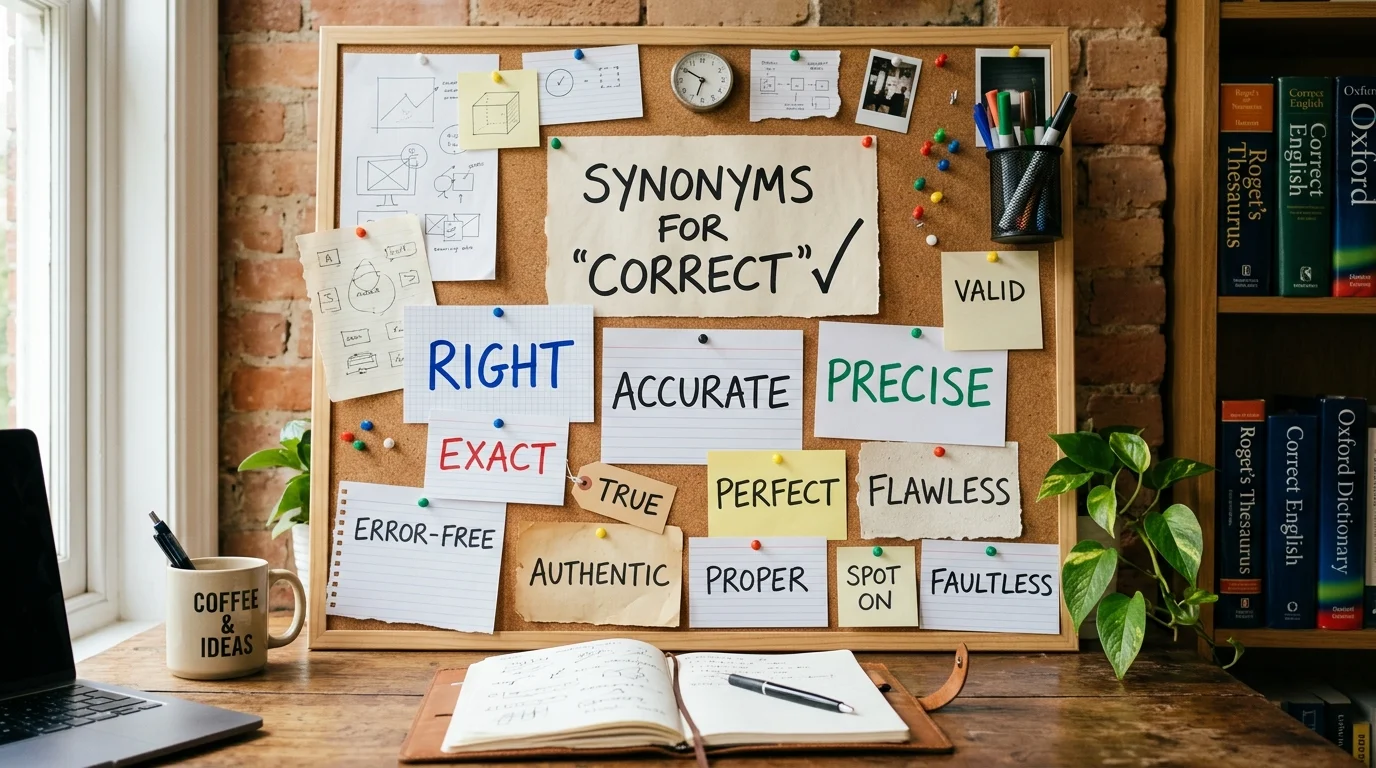
The closest synonyms for correct are right, accurate, exact, true, precise, proper, valid, sound, factual, reliable, appropriate, suitable, legitimate, authentic, error-free, faultless, flawless, and on target. As a verb, useful alternatives include fix, repair, amend, revise, rectify, adjust, edit, remedy, resolve, and improve.
Quick List of Synonyms for Correct
Here are useful alternatives grouped by meaning:
Correct Meaning “Right or True”
- right
- true
- accurate
- factual
- valid
- sound
- reliable
- legitimate
- certain
- exact
Correct Meaning “Free From Error”
- accurate
- error-free
- faultless
- flawless
- mistake-free
- precise
- exact
- perfect
- impeccable
Correct Meaning “Proper or Appropriate”
- proper
- appropriate
- suitable
- fitting
- acceptable
- suitable
- legitimate
- justified
- warranted
- fitting
Correct Meaning “Exact or Precise”
- exact
- precise
- accurate
- definite
- specific
- meticulous
- rigorous
- faithful
- exacting
Correct as a Verb Meaning “Fix”
- fix
- repair
- amend
- revise
- rectify
- remedy
- adjust
- edit
- improve
- resolve
- address
- modify
- revise
- troubleshoot
Closest Synonyms for Correct
Not every synonym has exactly the same meaning. These are among the closest alternatives when correct means “right” or “free from error.”
1. Right
Meaning: Correct, true, or accurate.
Tone: Neutral, everyday
Best for: General conversation and simple statements
Example:
“Your answer is right.”
Difference: Right is usually more conversational than correct. In formal or academic writing, correct or accurate may sound more precise.
2. Accurate
Meaning: Matching the facts or reality without significant error.
Tone: Neutral to formal
Best for: Facts, measurements, information, reports, descriptions
Example:
“The report provides accurate information.”
Difference: Accurate focuses strongly on factual precision. You would not normally use it for every meaning of correct.
3. True
Meaning: In accordance with facts or reality.
Tone: Neutral
Best for: Statements, claims, beliefs, descriptions
Example:
“The statement is true.”
Difference: True focuses on whether something corresponds to reality, while correct can also mean properly done or free from mistakes.
4. Exact
Meaning: Completely precise or matching in every relevant detail.
Tone: Neutral to formal
Best for: Numbers, measurements, locations, times, details
Example:
“Please give me the exact address.”
Difference: Exact is stronger than correct when precision is the main point.
5. Precise
Meaning: Very accurate and clearly defined.
Tone: Neutral to formal
Best for: Measurements, wording, instructions, descriptions
Example:
“Use precise language in the report.”
Difference: Something can be correct without being especially precise. Precise emphasizes exactness.
6. Valid
Meaning: Logically or legally acceptable, sound, or well-founded.
Tone: Formal
Best for: Arguments, reasoning, methods, documents, claims, results
Example:
“That is a valid argument.”
Difference: Valid often concerns whether something meets a standard of logic, law, or accepted procedure.
7. Sound
Meaning: Based on good reasoning or reliable judgment.
Tone: Formal
Best for: Arguments, decisions, reasoning, advice, plans
Example:
“She made a sound decision.”
Difference: Sound does not simply mean factually correct. It often suggests that something is sensible and well-founded.
8. Factual
Meaning: Based on facts rather than opinion or invention.
Tone: Neutral to formal
Best for: Information, statements, descriptions, reports
Example:
“The article contains factual information.”
Difference: Factual describes a relationship to facts, while correct is broader.
Formal and Professional Synonyms for Correct
Some alternatives work particularly well in academic, business, technical, or professional writing.
Accurate
Use accurate for information, data, measurements, records, and descriptions.
“The database contains accurate customer information.”
Precise
Use precise when exact wording, measurements, or details matter.
“The instructions provide precise guidance.”
Valid
Use valid for arguments, methods, conclusions, documents, and reasoning.
“The researchers used a valid testing method.”
Appropriate
Use appropriate when something is suitable for a particular situation.
“Please use the appropriate procedure.”
Proper
Use proper for accepted procedures, methods, conduct, or standards.
“The equipment must be stored using the proper procedure.”
Legitimate
Use legitimate when something is lawful, genuine, or justified.
“The company had a legitimate reason for changing the policy.”
Justified
Use justified when an action, decision, or conclusion has sufficient reason behind it.
“The decision was justified by the available evidence.”
Rigorous
Use rigorous when something follows strict standards or careful methods.
“The study used a rigorous research process.”
Neutral and Everyday Alternatives
For everyday English, you usually don’t need a complicated synonym.
Right
“That’s the right answer.”
Accurate
“Is this information accurate?”
True
“What you said is true.”
Exact
“What’s the exact time?”
Okay
In some contexts, okay can mean acceptable rather than technically correct.
“Is this answer okay?”
Be careful: okay usually means acceptable, not necessarily factually correct.
Proper
“Make sure you use the proper form.”
Proper is useful when correct means suitable or appropriate rather than factually true.
Synonyms for Correct as a Verb
When correct means “to fix something that is wrong,” the alternatives change.
Fix
Tone: Informal to neutral
Example:
“Can you fix this mistake?”
Fix is the most natural everyday alternative.
Repair
Best for: Physical objects, machines, systems
“The technician repaired the damaged equipment.”
Repair usually concerns something damaged or malfunctioning rather than a simple factual error.
Amend
Best for: Documents, laws, policies, statements
“The company amended the policy.”
Amend means to make a change, often to improve or correct something.
Revise
Best for: Writing, plans, documents, academic work
“Please revise the final paragraph.”
Revise usually means changing something after reviewing it. It does not always imply that the original was wrong.
Rectify
Tone: Formal
Meaning: Correct a mistake or problem.
“The company took steps to rectify the error.”
This is a strong formal alternative to correct.
Remedy
Tone: Formal
Meaning: Correct or resolve a problem.
“The new policy was designed to remedy the problem.”
Adjust
Best for: Settings, measurements, positions, plans
“Adjust the settings to the correct level.”
Adjust means to make a small change so something works or fits better.
Edit
Best for: Written material
“Please edit the document before submitting it.”
Edit can include correcting errors, but editing may involve changes beyond simple correction.
Synonyms for Correct Meaning “Proper”
Sometimes correct means “proper, suitable, or socially acceptable.”
Useful alternatives include:
- proper
- appropriate
- suitable
- fitting
- acceptable
- suitable
- legitimate
- justified
- warranted
- conventional
- standard
- appropriate
Example
Original:
“Please use the correct procedure.”
Possible alternatives:
“Please use the proper procedure.”
“Please use the appropriate procedure.”
“Please follow the approved procedure.”
The best choice depends on what you mean. Proper suggests the right way to do something, while approved suggests that an authority has officially accepted it.
Synonyms for Correct Meaning “Accurate”
When correct refers to facts, numbers, information, or measurements, these words are especially useful:
- accurate
- exact
- precise
- factual
- reliable
- truthful
- error-free
- verified
- consistent
- dependable
Example
Original:
“Make sure the information is correct.”
Better alternatives:
“Make sure the information is accurate.”
“Make sure the figures are exact.”
“Make sure the data is verified.”
These aren’t interchangeable in every context. Verified means that someone has checked something, while accurate describes whether it matches reality.
Synonyms for Correct Meaning “Without Mistakes”
When something contains no errors, consider:
- error-free
- faultless
- flawless
- mistake-free
- accurate
- precise
- impeccable
- perfect
- clean
- consistent
Important distinction
Flawless and perfect are stronger than correct. They suggest an absence of defects or imperfections, not merely that something is right.
For example:
“The answer is correct.”
doesn’t necessarily mean:
“The answer is flawless.”
The first says the answer is right. The second makes a much stronger judgment.
Comparison Table: Synonyms for Correct
| Alternative | Relationship | Can Replace Correct? | Tone | Best Context |
|---|---|---|---|---|
| Right | Very close synonym | Usually | Neutral | Everyday speech |
| Accurate | Close synonym | Usually in factual contexts | Neutral/Formal | Facts and data |
| True | Close synonym | Sometimes | Neutral | Statements and claims |
| Exact | Near synonym | Context-dependent | Neutral | Numbers and details |
| Precise | Near synonym | Context-dependent | Formal | Measurements and wording |
| Valid | Contextual synonym | Sometimes | Formal | Arguments and methods |
| Proper | Contextual synonym | Sometimes | Neutral/Formal | Procedures and behavior |
| Appropriate | Contextual synonym | Sometimes | Formal | Situations and choices |
| Sound | Near synonym | Sometimes | Formal | Reasoning and decisions |
| Reliable | Related alternative | Sometimes | Neutral/Formal | Information and systems |
| Fix | Verb alternative | Yes, for some meanings | Informal/Neutral | Problems and mistakes |
| Amend | Verb alternative | Yes, in specific contexts | Formal | Documents and policies |
| Revise | Verb alternative | Sometimes | Neutral/Formal | Writing and plans |
| Rectify | Verb synonym | Usually | Formal | Errors and problems |
| Remedy | Near synonym | Sometimes | Formal | Problems and defects |
Meaning and Strength Comparison
| Word/Phrase | Meaning | Tone | Strength | Best Use | Interchangeable? |
|---|---|---|---|---|---|
| Right | Not wrong | Neutral | Medium | Everyday speech | Often |
| Correct | Free from error | Neutral/Formal | Medium | General use | — |
| Accurate | Factually correct | Neutral/Formal | Medium | Facts and data | Often |
| Exact | Completely precise | Neutral | Strong | Details and numbers | Sometimes |
| Precise | Highly exact | Formal | Strong | Technical writing | Sometimes |
| Proper | Correct according to rules | Neutral/Formal | Medium | Procedures | Context-dependent |
| Valid | Sound or acceptable | Formal | Medium/Strong | Arguments and methods | Context-dependent |
| Flawless | Without defects | Neutral/Formal | Very strong | Performance or quality | Rarely |
| Fix | Make right again | Informal/Neutral | Medium | Problems | As a verb |
| Rectify | Correct a problem | Formal | Strong | Professional writing | As a verb |
| Revise | Change after review | Neutral/Formal | Medium | Writing and plans | Sometimes |
Which Synonym for Correct Should You Choose?
The easiest way to choose is to identify what correct means in your sentence.
For an answer
Use right, correct, or accurate.
“Your answer is correct.”
“Your answer is right.”
For facts
Use accurate or factual.
“The information is accurate.”
For numbers or measurements
Use exact or precise.
“We need the exact measurement.”
For an argument
Use valid, sound, or well-founded.
“She presented a sound argument.”
For behavior or procedure
Use proper, appropriate, or suitable.
“Follow the proper procedure.”
For a document
Use accurate, correct, revised, or amended, depending on the meaning.
“Please submit the revised document.”
For fixing a mistake
Use fix, correct, amend, or rectify.
“Please correct the error.”
“Please rectify the error.”
For writing
Use edit, revise, proofread, or amend depending on the task.
“Please revise the introduction.”
Sentence Transformations
1. Original
“The answer is correct.”
Better alternative:
“The answer is right.”
Why: Right is natural and conversational when discussing an answer.
2. Original
“Please check that the information is correct.”
Better alternative:
“Please check that the information is accurate.”
Why: Accurate is more precise for factual information.
3. Original
“Give me the correct number.”
Better alternative:
“Give me the exact number.”
Why: Exact emphasizes precision.
4. Original
“She gave a correct explanation.”
Better alternative:
“She gave an accurate explanation.”
Why: Accurate emphasizes that the explanation matches the facts.
5. Original
“We need to follow the correct procedure.”
Better alternative:
“We need to follow the proper procedure.”
Why: Proper works naturally when referring to an accepted procedure.
6. Original
“His argument is correct.”
Better alternative:
“His argument is sound.”
Why: Sound emphasizes that the reasoning is sensible and well-founded.
7. Original
“Please correct the mistake.”
Better alternative:
“Please rectify the mistake.”
Why: Rectify provides a more formal tone.
8. Original
“Can you correct this document?”
Better alternative:
“Can you edit this document?”
Why: Edit is more natural when the task involves reviewing and changing written material.
9. Original
“The company corrected the policy.”
Better alternative:
“The company amended the policy.”
Why: Amended is especially suitable for formal policies and official documents.
10. Original
“Make sure the figures are correct.”
Better alternative:
“Make sure the figures are accurate.”
Why: Accurate is the standard choice for numerical information.
Grammar and Usage of Correct
Correct works as both an adjective and a verb.
Correct as an adjective
It usually means right, accurate, proper, or free from error.
“That is the correct answer.”
“She used the correct method.”
“The information is correct.”
Common patterns include:
- correct answer
- correct information
- correct spelling
- correct pronunciation
- correct method
- correct procedure
- correct decision
- correct version
- correct interpretation
- correct response
Correct as a verb
It means to fix something that is wrong.
“Please correct the spelling error.”
“The teacher corrected my answer.”
Common patterns include:
- correct an error
- correct a mistake
- correct a problem
- correct an answer
- correct a sentence
- correct the record
- correct a misunderstanding
- correct a document
Correct someone
You can use correct with a person when you mean to point out or fix an error in what they said or did.
“She politely corrected him.”
Be careful with tone. Correct someone can sound critical if done bluntly. In polite communication, phrases such as “I think the correct information is…” may sound softer.
Common Collocations With Correct
Correct + noun
- correct answer
- correct spelling
- correct grammar
- correct information
- correct version
- correct procedure
- correct method
- correct pronunciation
- correct address
- correct response
- correct decision
- correct interpretation
Verb + correct
- choose the correct
- find the correct
- identify the correct
- provide the correct
- select the correct
- give the correct
- use the correct
- enter the correct
- follow the correct
- verify the correct
Common Mistakes With Synonyms for Correct
1. Treating “right” and “accurate” as identical
They overlap, but their usage differs.
“The answer is right.”
works naturally.
“The temperature reading is accurate.”
is more natural than right in a technical context.
2. Using “exact” for every kind of correctness
Exact means precise, not simply correct.
An answer can be correct without being exact.
3. Using “perfect” when you only mean “correct”
Perfect is much stronger.
“Your answer is correct.”
doesn’t necessarily mean the entire performance was perfect.
4. Using “proper” for factual information
Proper usually means suitable, appropriate, or according to accepted rules.
“Use the proper procedure.”
But:
“The information is accurate.”
is better than the information is proper.
5. Assuming “valid” means factually true
A valid argument follows acceptable reasoning, but valid doesn’t automatically mean that every factual claim within it is true.
6. Using “fix” as a formal replacement everywhere
Fix is common and natural, but it can sound informal in professional writing.
Instead of:
“We need to fix the discrepancy.”
a formal report might say:
“We need to rectify the discrepancy.”
7. Confusing “revise” with “correct”
Revise means to change or improve something after reviewing it. A revision doesn’t necessarily mean the original was wrong.
8. Replacing every use of “correct” with a more sophisticated word
This can make writing less natural. Correct and right are often the clearest choices.
Correct vs. Right
These are the closest everyday alternatives, but they have different styles.
Correct is slightly more formal and is common in education, instructions, technical writing, and professional communication.
“Select the correct answer.”
Right is more conversational.
“You got it right.”
Both are natural, but the context determines which sounds better.
Correct vs. Accurate
Use correct when something is not wrong.
Use accurate when something closely matches facts, measurements, or reality.
“Your answer is correct.”
“The measurement is accurate.”
A measurement can be accurate without being described as correct in every context, and a procedure can be correct without being described as accurate.
Correct vs. Proper
Use correct for things that are right or free from error.
Use proper for things that follow an accepted rule, standard, or expected method.
“That is the correct answer.”
“Use the proper technique.”
Correct vs. Precise
Correct means right.
Precise means exact and carefully defined.
“The answer is correct.”
“The measurement is precise.”
Something can be correct but not especially precise.
Correct vs. Exact
Exact emphasizes complete precision.
“Give me the exact amount.”
You wouldn’t normally replace correct with exact in a sentence such as:
“She made the correct decision.”
Exact decision would change the meaning.
When Not to Use a Synonym for Correct
Sometimes correct is the best word.
Keep correct when:
- the context is simple and direct
- you’re talking about a test answer
- you mean “not wrong”
- the distinction between alternatives could confuse readers
- you need a neutral word
- you’re giving clear instructions
For example:
“Choose the correct answer.”
There is little reason to replace correct with a more complicated word.
Good writing isn’t about avoiding repetition at all costs. If correct is the most accurate word, use it.
Writing Tips: How to Use Synonyms for Correct Naturally
Match the word to the meaning
Don’t choose a synonym simply because it sounds more advanced.
- Facts → accurate
- Numbers → exact
- Measurements → precise
- Answers → right/correct
- Procedures → proper
- Arguments → valid/sound
- Problems → fix/rectify
- Documents → amend/revise/edit
Match the formality
For everyday writing:
“Please fix this mistake.”
For formal writing:
“Please rectify this error.”
Both are grammatical, but they create different impressions.
Don’t confuse variety with precision
Replacing correct with accurate, valid, proper, or exact can actually make a sentence less precise if the new word doesn’t express the intended meaning.
Editor’s Choice: Best Alternatives to Correct
If you need only a few strong choices, start here:
- Right — best everyday alternative
- Accurate — best for facts and information
- Precise — best for exact details
- Proper — best for procedures and accepted methods
- Rectify — best formal verb for fixing an error
Related Questions
- What is a synonym for correct in formal writing?
- What is another word for correct answer?
- What is a professional word for correct?
- What is the difference between correct and accurate?
- What is the difference between correct and right?
- What is another word for correct information?
- What is a synonym for correct a mistake?
- What is a formal word for fix?
- What is another word for precise?
- What is another word for proper?
FAQs
What is the best synonym for correct?
Right is the closest everyday synonym. Accurate is often better when talking about facts or information, while proper works better for procedures and accepted behavior.
What is a formal synonym for correct?
Depending on the context, formal alternatives include accurate, precise, valid, proper, sound, legitimate, justified, and rectified. No single formal synonym works in every sentence.
What is a synonym for correct in academic writing?
Accurate, precise, valid, sound, and well-founded can work well in academic writing, depending on the meaning. For example, you can describe data as accurate and an argument as sound.
What is a synonym for correct answer?
The most natural alternatives are right answer, accurate answer, or valid answer, depending on context. Right answer is the most conversational.
What is a synonym for correct a mistake?
Useful verb alternatives include fix, amend, rectify, remedy, revise, edit, and adjust. The right choice depends on what you’re correcting.
Is “accurate” the same as “correct”?
Not always. Accurate usually means factually or numerically correct. Correct has a broader meaning and can also describe proper procedures, grammar, behavior, or answers.
Is “right” more informal than “correct”?
Usually, yes. Right is extremely common in everyday English, while correct often sounds slightly more formal or instructional.
Key Takeaways
- Right is the closest everyday synonym for correct.
- Use accurate for facts, information, data, and measurements.
- Use exact or precise when the main idea is accuracy and detail.
- Use proper or appropriate when correct means suitable or according to accepted rules.
- As a verb, choose fix, amend, revise, edit, remedy, or rectify according to what you are correcting.