
Quick Answer
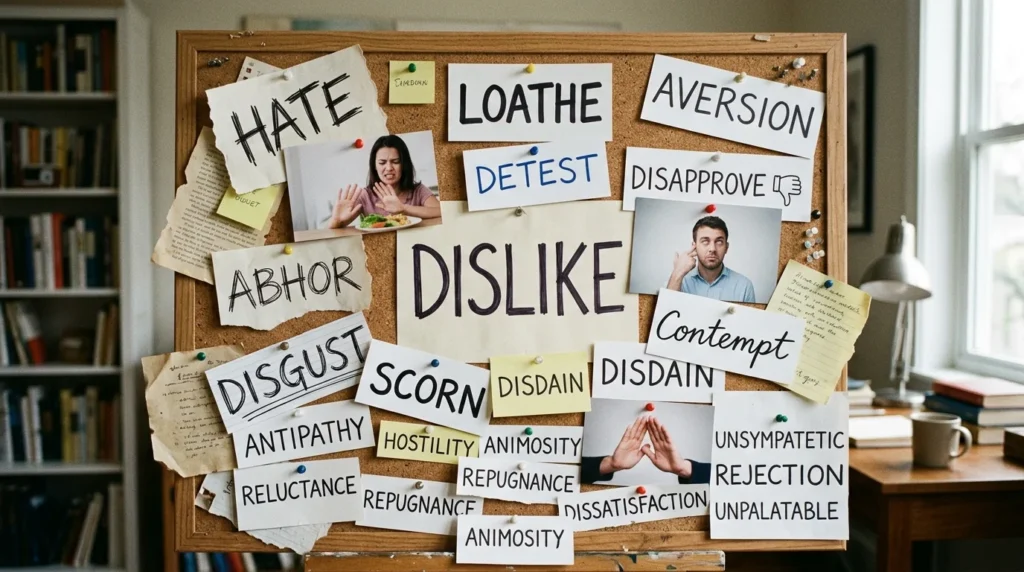
The closest general synonyms for dislike are not like, distaste, aversion, antipathy, disapproval, and objection. For stronger feelings, use hate, detest, loathe, despise, abhor, or can’t stand.
The best choice depends on the strength and type of feeling. Distaste suggests mild dislike, aversion suggests a strong tendency to avoid something, disapproval focuses on judging something negatively, and hate expresses very strong dislike.
Quick Synonym List
- Not like
- Distaste
- Aversion
- Antipathy
- Disapproval
- Objection
- Disaffection
- Displeasure
- Reluctance
- Disfavor
- Resentment
- Hostility
- Animosity
- Disdain
- Contempt
- Repugnance
- Repulsion
- Revulsion
- Hatred
- Hate
- Detest
- Loathe
- Despise
- Abhor
- Abominate
- Can’t stand
- Can’t bear
- Have no taste for
- Object to
- Look down on
Closest Synonyms for Dislike
Not Like
Meaning: To have a negative feeling toward someone or something.
How it differs: Not like is the simplest everyday expression of dislike. In ordinary conversation, it is often more natural than the verb dislike, which can sound somewhat formal. Oxford notes that dislike is relatively formal and that don’t like is more common in spoken English.
Tone: Neutral, conversational
Best for: Everyday speech and writing
Example:
I don’t like the way he speaks to people.
Watch out: Not like is not a single-word replacement, but it is often the most natural phrase.
Relationship: Usually interchangeable
Distaste
Meaning: A feeling of not liking something.
How it differs: Distaste usually suggests mild or moderate dislike rather than intense hatred.
Tone: Formal, restrained
Best for: Formal writing, personal preferences, reactions
Example:
She expressed her distaste for overly sweet foods.
Watch out: It often sounds more restrained than hatred or loathing. Cambridge lists distaste as a noun associated with feelings of dislike.
Aversion
Meaning: A strong feeling of dislike that makes you want to avoid something.
Tone: Neutral to formal
Best for: Strong preferences, things people avoid
Example:
He has a strong aversion to crowded places.
Watch out: Aversion often emphasizes avoidance, not simply a negative opinion.
Antipathy
Meaning: A strong feeling of dislike toward someone or something.
Tone: Formal
Best for: People, groups, relationships, formal writing
Example:
She felt a deep antipathy toward dishonesty.
Watch out: This word is more formal than everyday dislike.
Disapproval
Meaning: A negative judgment or feeling that something is wrong or unacceptable.
Tone: Neutral, formal
Best for: Behavior, decisions, actions, policies
Example:
His parents expressed their disapproval of the decision.
Watch out: Disapproval is about judging something negatively; it does not simply mean that you do not enjoy it.
Displeasure
Meaning: A feeling of annoyance or dissatisfaction.
Tone: Formal
Best for: Formal descriptions of negative reactions
Example:
The customer expressed her displeasure with the service.
Watch out: Displeasure can suggest dissatisfaction or annoyance rather than simple dislike.
Strong Synonyms for Dislike
Hate
Meaning: To dislike someone or something very much.
Tone: Strong, common
Best for: Very strong negative feelings
Example:
I hate being late.
Watch out: Hate is much stronger than ordinary dislike, although it is also common in casual speech for relatively minor things.
Relationship: Similar meaning but stronger
Detest
Meaning: To dislike someone or something very much.
Tone: Strong, formal
Best for: Strong negative opinions and formal writing
Example:
She detests dishonesty.
Watch out: Detest is considerably stronger than ordinary dislike. Oxford describes it as a very strong form of dislike.
Loathe
Meaning: To hate someone or something very strongly.
Tone: Strong, formal to literary
Best for: Intense personal dislike
Example:
He loathes unnecessary meetings.
Watch out: Loathe is stronger than dislike and can sound dramatic in casual contexts.
Despise
Meaning: To dislike someone or something intensely, often with a lack of respect.
Tone: Strong, critical
Best for: People, behavior, values, actions
Example:
She despises dishonesty.
Watch out: Unlike ordinary dislike, despise can carry an additional sense of contempt or lack of respect.
Abhor
Meaning: To hate or strongly dislike something, especially something considered morally wrong or offensive.
Tone: Very strong, formal
Best for: Serious moral or ethical objections
Example:
He abhors cruelty.
Watch out: This is usually far too strong for ordinary preferences.
Abominate
Meaning: To strongly hate or dislike something.
Tone: Very strong, formal
Best for: Formal, literary, or emphatic writing
Example:
The organization abominates corruption.
Watch out: It is much less common in everyday American English than dislike or hate.
Formal and Professional Alternatives
Object To
Meaning: To express disagreement or opposition to something.
Tone: Neutral to formal
Best for: Rules, decisions, proposals, actions
Example:
Several employees objected to the proposed changes.
Watch out: Object to usually means that you actively oppose something, not simply that you do not like it.
Regard With Disfavor
Meaning: To view something negatively or unfavorably.
Tone: Formal
Best for: Formal reports, criticism, institutional writing
Example:
The committee regarded the proposal with disfavor.
Have No Taste For
Meaning: To have little or no liking for something.
Tone: Neutral, somewhat formal
Best for: Preferences and personal tastes
Example:
I have no taste for overly complicated explanations.
Regard as Disagreeable
Meaning: To consider someone or something unpleasant or objectionable.
Tone: Formal
Best for: Formal descriptions and analytical writing
Example:
Many readers regard the character’s behavior as disagreeable.
Regard With Displeasure
Meaning: To view something with dissatisfaction or negative feeling.
Tone: Formal
Best for: Formal criticism
Example:
The board regarded the proposal with displeasure.
Neutral and Everyday Alternatives
Object To
Although object to can be formal, it is also common in everyday English when someone actively disagrees with something.
I don’t object to the idea.
Notice that this does not mean exactly the same thing as I dislike the idea. Object to focuses on opposition.
Not Be Fond Of
Meaning: To not particularly like something.
Tone: Polite, mild
Best for: Softening negative opinions
Example:
I’m not particularly fond of spicy food.
Watch out: This is much softer than hate or detest.
Not Care For
Meaning: To not like or prefer something.
Tone: Polite, neutral
Best for: Preferences and polite disagreement
Example:
I don’t really care for horror movies.
Watch out: In American English, care for can also mean look after, so context matters.
Be Put Off By
Meaning: To develop a dislike or loss of interest because of something.
Tone: Conversational
Best for: Reactions to behavior, appearances, experiences, or situations
Example:
I was put off by his rude attitude.
Watch out: This focuses on something causing the negative reaction.
Not Be Someone’s Cup of Tea
Meaning: To be something that someone does not particularly like or enjoy.
Tone: Informal, idiomatic
Example:
Action movies aren’t really my cup of tea.
Watch out: This is usually mild and polite, not a strong expression of hatred.
Casual Alternatives
Can’t Stand
Meaning: To strongly dislike someone or something.
Tone: Informal, strong
Best for: Everyday conversation
Example:
I can’t stand waiting in long lines.
Oxford describes can’t stand as an informal way to emphasize strong dislike.
Can’t Bear
Meaning: To dislike or find something so unpleasant that you cannot tolerate it.
Tone: Conversational
Best for: Strong emotional reactions
Example:
I can’t bear listening to that noise.
Watch out: Can’t bear can be slightly stronger and more formal than can’t stand.
Go Off
Meaning: To stop liking something that you previously liked.
Tone: Informal, conversational
Best for: Food, hobbies, interests, habits
Example:
I’ve gone off coffee recently.
Watch out: This does not simply mean dislike; it often suggests a change from liking to disliking.
Not Be Into
Meaning: To not be interested in or enthusiastic about something.
Tone: Casual
Best for: Hobbies, entertainment, activities, trends
Example:
I’m not really into reality TV.
Watch out: This often means lack of interest rather than strong dislike.
Look Down On
Meaning: To consider someone or something inferior or unworthy of respect.
Tone: Critical
Best for: People, behavior, social attitudes
Example:
She looks down on people who make different choices.
Watch out: This expresses contempt or superiority, not ordinary dislike.
Dislike vs. Near Synonyms
Dislike is broad and usually means simply not liking someone or something. It can be a verb or noun.
- Dislike vs. hate: Hate is generally much stronger.
- Dislike vs. detest: Detest expresses very strong dislike and often sounds more formal.
- Dislike vs. loathe: Loathe is very strong and can sound emphatic or literary.
- Dislike vs. despise: Despise often adds contempt or lack of respect.
- Dislike vs. distaste: Distaste is usually milder and more restrained.
- Dislike vs. aversion: Aversion often involves wanting to avoid something.
- Dislike vs. antipathy: Antipathy suggests a strong negative feeling, especially toward a person or group.
- Dislike vs. disapproval: Disapproval focuses on judging something as wrong or unacceptable.
- Dislike vs. objection: An objection is active opposition, not simply a negative preference.
- Dislike vs. can’t stand: Can’t stand is informal and usually stronger than ordinary dislike.
- Dislike vs. not be fond of: Not be fond of is softer and more polite.
Comparison Table
| Alternative | Relationship | Can Replace “Dislike”? | Tone | Best Context |
|---|---|---|---|---|
| Not like | Direct phrase | Usually | Neutral | Everyday English |
| Distaste | Close noun synonym | Often | Formal | Mild negative preference |
| Aversion | Near synonym | Sometimes | Formal | Strong avoidance |
| Antipathy | Near synonym | Sometimes | Formal | Strong personal dislike |
| Disapproval | Contextual alternative | Sometimes | Formal | Actions and decisions |
| Displeasure | Near synonym | Sometimes | Formal | Dissatisfaction |
| Hate | Stronger synonym | Sometimes | Strong | Very strong dislike |
| Detest | Stronger synonym | Sometimes | Formal/strong | Intense dislike |
| Loathe | Stronger synonym | Sometimes | Strong | Intense personal dislike |
| Despise | Stronger/nuanced synonym | Sometimes | Critical | Dislike plus contempt |
| Abhor | Very strong synonym | Sometimes | Very formal | Moral objections |
| Object to | Contextual alternative | Sometimes | Neutral/formal | Opposition |
| Can’t stand | Strong informal synonym | Sometimes | Casual | Everyday strong dislike |
| Can’t bear | Strong informal synonym | Sometimes | Conversational | Intolerance |
| Not be fond of | Softer alternative | Often | Polite | Mild preferences |
| Not care for | Softer alternative | Often | Polite | Preferences |
| Not be into | Contextual alternative | Sometimes | Casual | Interests and activities |
How to Choose the Right Alternative
Use dislike for ordinary negative preferences
I dislike crowded restaurants.
This is clear and neutral, although I don’t like crowded restaurants may sound more natural in casual American English. Oxford notes that dislike is relatively formal compared with don’t like.
Use distaste for mild, restrained dislike
He expressed his distaste for aggressive advertising.
Use aversion when avoidance matters
She has an aversion to flying.
Use disapproval when you think something is wrong
His parents showed their disapproval of the decision.
Use hate for strong dislike
I hate waiting in traffic.
Use detest for strong, more formal dislike
They detest dishonesty.
Use despise when contempt is involved
He despises people who abuse their authority.
Use can’t stand in casual conversation
I can’t stand that noise.
Use not be fond of when you want to soften your opinion
I’m not particularly fond of the design.
Use not be into for interests and activities
I’m not really into competitive sports.
Sentence Transformations
- Original: I dislike crowded places.
Everyday: I don’t like crowded places. - Original: She dislikes spicy food.
Milder: She isn’t fond of spicy food. - Original: He dislikes dishonesty.
Stronger: He detests dishonesty. - Original: She dislikes the way he behaves.
Stronger: She can’t stand the way he behaves. - Original: They dislike the new policy.
Formal: They object to the new policy. - Original: He dislikes long meetings.
Casual: He isn’t into long meetings. - Original: She dislikes the proposal.
Formal: She regards the proposal with disfavor. - Original: I dislike horror movies.
Milder: Horror movies aren’t really my cup of tea. - Original: He dislikes dishonest behavior.
Stronger: He abhors dishonest behavior. - Original: She dislikes being interrupted.
Strong: She can’t bear being interrupted. - Original: I dislike the smell of smoke.
Strong: I have an aversion to the smell of smoke. - Original: He dislikes the decision.
Judgment-focused: He expressed his disapproval of the decision.
Grammar and Usage
“Dislike” can be a verb
As a verb, dislike means to not like someone or something. It is normally transitive, so it can take a direct object.
I dislike loud music.
She dislikes crowded places.
They dislike the new policy.
“Dislike” can also be a noun
As a noun, dislike can mean a feeling of not liking something or a thing that someone does not like.
He has a strong dislike of spicy food.
She has several dislikes.
Common patterns with “dislike”
Natural structures include:
- dislike something
- dislike someone
- dislike doing something
- dislike the idea of something
- have a dislike of something
- have a dislike for something
- take a dislike to someone
- express a dislike of something
Examples:
I dislike waiting.
She dislikes the idea of moving.
He took an instant dislike to his new colleague.
Cambridge and Oxford both document these noun and verb patterns.
“Dislike” vs. “don’t like”
Both are correct, but they differ in tone.
I don’t like this movie.
I dislike this movie.
The first is more conversational. The second can sound more formal or deliberate. Oxford specifically notes that dislike is relatively formal compared with don’t like.
“Dislike” + -ing
When talking about an activity, dislike can be followed by a gerund.
I dislike waiting.
She dislikes driving at night.
This pattern is also used with stronger alternatives such as hate, can’t stand, can’t bear, loathe, and detest.
Common Mistakes
1. Treating “dislike” and “hate” as identical
Dislike is usually weaker than hate.
I dislike the movie.
I hate the movie.
The second expresses a stronger reaction.
2. Using “despise” for a mild preference
Despise is much stronger than dislike and can imply contempt.
Better: Use dislike, not like, or not be fond of for mild preferences.
3. Using “detest” in every situation
Detest is a strong word.
I detest waiting in line.
This is grammatically correct, but it sounds much stronger than:
I don’t like waiting in line.
4. Confusing “disapproval” with “dislike”
You can dislike something without believing that it is wrong.
I dislike horror movies.
But:
I disapprove of violent behavior.
The second expresses a judgment about acceptability.
5. Confusing “aversion” with simple dislike
An aversion often suggests that you actively want to avoid something.
She has an aversion to heights.
6. Using “object to” when you simply have no preference
Object to usually means actively oppose.
I object to the new rule.
This is stronger and more specific than:
I dislike the new rule.
7. Using “not be into” in formal writing
Not be into is conversational.
Better: Use not be interested in, dislike, or have little interest in in formal contexts.
8. Assuming “can’t stand” is neutral
Can’t stand is informal and strongly negative. Oxford identifies it as an informal expression of strong dislike.
Commonly Confused Words
Dislike vs. Hate
Dislike means not to like something. Hate means to dislike it very much.
Dislike vs. Detest
Detest is a much stronger and somewhat more formal word for dislike.
Dislike vs. Despise
Despise can mean intense dislike combined with a lack of respect or contempt.
Dislike vs. Aversion
A dislike is a negative feeling. An aversion often includes a strong tendency to avoid the thing.
Dislike vs. Disapproval
Dislike concerns personal negative feeling. Disapproval involves judging something negatively or considering it unacceptable.
Dislike vs. Resentment
Resentment is a lasting feeling of anger or bitterness, often because of perceived unfair treatment. It is not simply another word for dislike.
When Not to Use an Alternative
Sometimes dislike is the clearest word.
Use the original word when:
- You mean ordinary negative preference.
- The feeling is not especially strong.
- You want neutral wording.
- You are writing for a broad audience.
- A stronger synonym would exaggerate the feeling.
- You are not trying to express opposition, contempt, or avoidance.
For example:
I dislike the new design.
This is neutral and measured.
Replacing it with:
I despise the new design.
changes the emotional force substantially.
Likewise, I object to the new design changes the meaning toward active opposition, while I have an aversion to the new design suggests a stronger tendency to avoid it.
Writing Tips
- Use dislike for a neutral expression of negative preference.
- Use don’t like for more natural everyday conversation.
- Use distaste for mild, restrained dislike.
- Use aversion when avoidance is part of the meaning.
- Use disapproval when you are judging an action or idea negatively.
- Use hate for strong everyday dislike.
- Use detest for strong, somewhat formal dislike.
- Use loathe for very strong dislike.
- Use despise when dislike includes contempt or lack of respect.
- Use abhor for very strong moral or ethical dislike.
- Use can’t stand for strong, informal dislike.
- Use not be fond of to soften a negative opinion.
- Use not be into for casual comments about interests.
- Don’t choose a stronger synonym simply to make your writing sound more sophisticated.
FAQs
What is the best synonym for dislike?
For general meaning, not like is the simplest everyday alternative. Distaste, aversion, and antipathy can work as noun alternatives, while hate, detest, and loathe express much stronger feelings.
What is a stronger word for dislike?
Hate, detest, loathe, despise, and abhor are stronger alternatives. The exact choice depends on the level and type of negative feeling.
What is a formal synonym for dislike?
Depending on the context, distaste, aversion, antipathy, disapproval, and disfavor can work in formal writing.
What is a polite way to say dislike?
Not be fond of, not care for, and not particularly like can soften a negative opinion.
I’m not particularly fond of the design.
This sounds less direct than:
I dislike the design.
What is a casual synonym for dislike?
Don’t like, can’t stand, not be into, and not be a fan of are common conversational alternatives.
What is the difference between dislike and hate?
Dislike means not liking someone or something, while hate means disliking someone or something very much.
What is the noun form of dislike?
Dislike itself is also a noun. It can describe a feeling of not liking something or a thing that someone does not like.
She has a strong dislike of cold weather.
We discussed our likes and dislikes.
Editor’s Choice
Choose the alternative based on the exact feeling you want to express:
- For neutral dislike: dislike / don’t like
- For mild dislike: distaste / not be fond of
- For strong avoidance: aversion
- For strong everyday dislike: hate / can’t stand
- For intense dislike: detest / loathe
- For dislike with contempt: despise
- For moral or ethical rejection: abhor
- For active opposition: object to
Key Takeaways
- Dislike is a broad, neutral word meaning to not like someone or something.
- Distaste, aversion, and antipathy describe different forms or degrees of negative feeling.
- Hate, detest, loathe, and abhor are much stronger than ordinary dislike.
- Despise can add an idea of contempt, while object to focuses on opposition.
- In everyday American English, don’t like is often more natural than dislike, while can’t stand provides a stronger informal alternative.
Internal Link Opportunities
| Anchor Text | Suggested Topic | Why It Fits |
|---|---|---|
| synonyms for hate | Synonyms for Hate | Covers stronger forms of dislike |
| synonyms for dislike | Synonyms for Dislike | Core vocabulary topic |
| synonyms for detest | Synonyms for Detest | Explores intense negative reactions |
| synonyms for dislike and hatred | Dislike and Hatred Vocabulary | Helps readers understand degrees of negative feeling |
| synonyms for disapproval | Synonyms for Disapproval | Distinguishes negative judgment from personal dislike |
| synonyms for aversion | Synonyms for Aversion | Covers avoidance-based negative feelings |
| synonyms for angry | Synonyms for Angry | Connects dislike with related negative emotions |
| synonyms for contempt | Synonyms for Contempt | Explains the stronger idea often associated with despise |