

Quick Synonym List
- Fairness
- Justice
- Equal treatment
- Equal opportunity
- Fair treatment
- Impartiality
- Fair play
- Parity
- Equity
- Egalitarianism
- Evenness
- Balance
- Equivalence
- Correspondence
- Sameness
- Similarity
- Uniformity
- Identity
- Likeness
- Equatability
- Equilibrium
- Equal rights
- Equal access
- Equal status
- Equal standing
- Non-discrimination
- Fair distribution
- Level playing field
- Coequality
- Justness
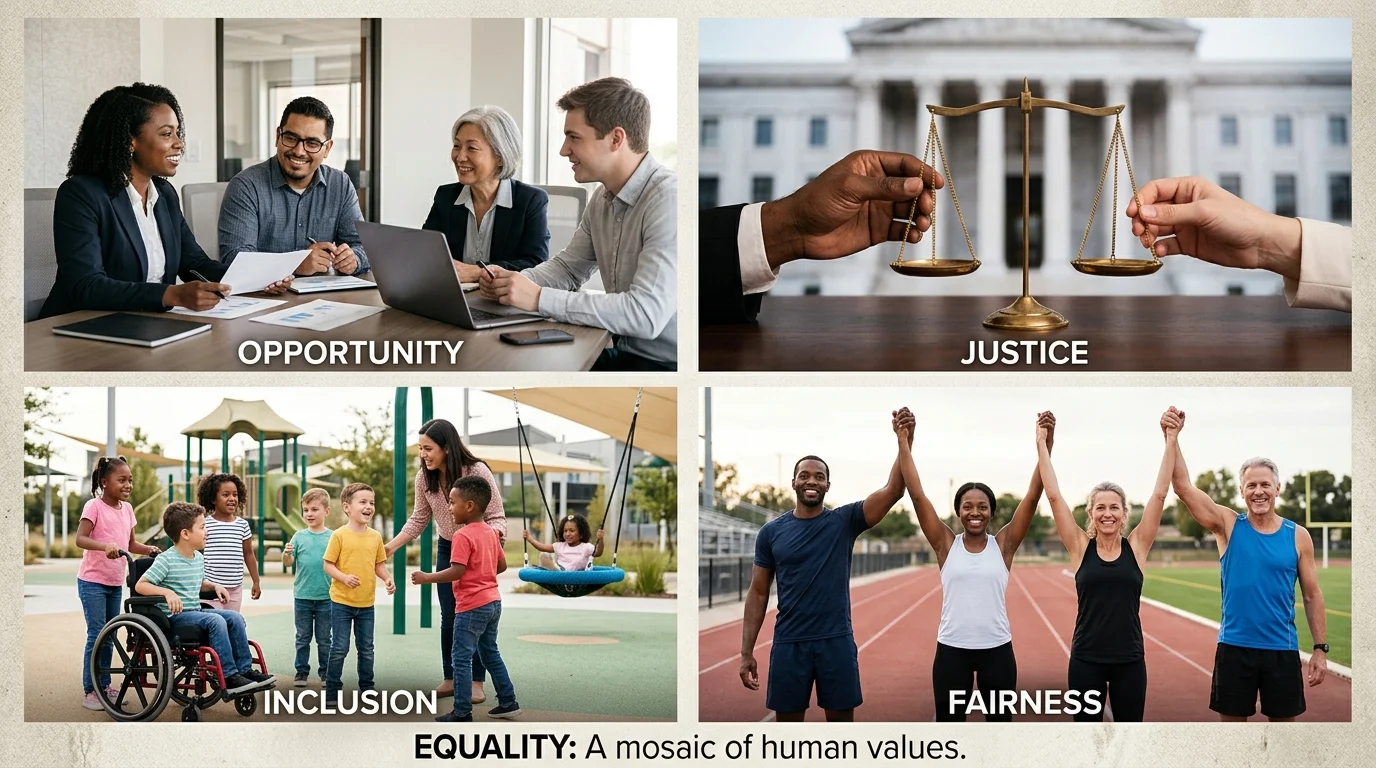
Not all of these are interchangeable. Equality has two important broad senses: fairness or equal rights between people and groups, and sameness or equivalence in amount, value, or status. Major thesauruses separate these senses.
Closest Synonyms
Fairness
Meaning: The quality of treating people reasonably, justly, and without favoritism.
How it differs: Fairness emphasizes just treatment, while equality specifically emphasizes equal status, rights, treatment, or opportunities.
Tone: Neutral.
Best for: Social situations, workplaces, schools, decisions, and policies.
Example:
The new policy was designed to promote fairness in the workplace.
Relationship: Usually interchangeable in some social contexts, but not all.
Equal Treatment
Meaning: Treating people in the same or equivalent way.
Tone: Neutral/formal.
Best for: Rights, laws, workplaces, education, and institutions.
Example:
Every employee deserves equal treatment.
Relationship: Close phrase-level alternative.
Equal Opportunity
Meaning: The principle that people should have the same opportunities to succeed or participate.
Tone: Neutral/formal.
Best for: Education, employment, public policy, and social issues.
Example:
The organization is committed to equal opportunity.
Cambridge lists equal opportunity as a synonym related to equality and specifically discusses equality in terms of people having the same opportunities and treatment.
Watch out: Equal opportunity focuses on access to opportunities, not necessarily identical outcomes.
Parity
Meaning: Equality in status, amount, value, or level.
Tone: Formal, professional.
Best for: Pay, statistics, economics, business, and comparisons.
Example:
The company is working toward pay parity.
Relationship: Usually interchangeable when equality means equivalent level or status.
Cambridge lists parity among alternatives for equality involving equal amounts or levels.
Impartiality
Meaning: The quality of treating people or situations without favoritism or bias.
Tone: Formal.
Best for: Decisions, judges, organizations, hiring, and professional settings.
Example:
The committee must act with impartiality.
Watch out: Impartiality means freedom from bias, not necessarily giving everyone exactly the same treatment.
Justice
Meaning: Fair and morally appropriate treatment.
Tone: Neutral/formal.
Best for: Law, ethics, social issues, and rights.
Example:
The movement called for justice and equality.
Watch out: Justice is broader than equality. A situation can be considered just without requiring identical treatment.
Fair Treatment
Meaning: Treatment that is reasonable and free from unfair discrimination.
Tone: Neutral.
Best for: Workplaces, schools, relationships, and institutions.
Example:
All employees expect fair treatment.
Relationship: Close contextual alternative.
Formal and Professional Alternatives
Egalitarianism
Meaning: The belief that people should have equal rights, status, or opportunities.
Tone: Formal, academic.
Best for: Political theory, sociology, philosophy, history, and social analysis.
Example:
The philosophy is based on egalitarianism.
Watch out: Egalitarianism describes a principle or ideology, not simply a condition of equality.
Equivalence
Meaning: A state in which two things have equal value, meaning, function, or effect.
Tone: Formal, technical, academic.
Best for: Mathematics, science, language, education, and technical writing.
Example:
The researchers established an equivalence between the two methods.
Relationship: Usually interchangeable only when equality means equivalent value or function.
Correspondence
Meaning: A close match, relationship, or similarity between two things.
Tone: Formal.
Example:
There is a strong correspondence between the two sets of results.
Watch out: Correspondence does not necessarily mean exact equality.
Equatability
Meaning: The quality of being capable of being made equal or fairly comparable.
Tone: Formal, uncommon.
Example:
The policy was designed to improve the equatability of access.
Watch out: This is much less common than equality or fairness.
Justness
Meaning: The quality of being fair or morally right.
Tone: Formal.
Example:
The debate focused on the justness of the decision.
Relationship: Close to fairness, but not a direct replacement in every sentence.
Non-discrimination
Meaning: The principle of not treating people unfairly because they belong to a particular group.
Tone: Formal, legal, professional.
Example:
The policy includes strong protections against discrimination and supports non-discrimination in employment.
Watch out: Non-discrimination is one aspect of equality, not a complete synonym.
Neutral and Everyday Alternatives
Balance
Meaning: A state in which different elements are equal or appropriately distributed.
Tone: Neutral.
Best for: Resources, responsibilities, power, representation, and competing interests.
Example:
The agreement seeks a balance between the two groups.
Relationship: Context-dependent.
Evenness
Meaning: A state in which amounts, levels, or distributions are equal or consistent.
Tone: Neutral.
Best for: Distribution, surfaces, measurements, and patterns.
Example:
The evenness of the distribution was carefully measured.
Watch out: This usually describes measurable distribution rather than social rights.
Sameness
Meaning: The state of being the same or nearly identical.
Tone: Neutral.
Best for: Objects, characteristics, appearance, or repeated experiences.
Example:
The sameness of the two designs made them difficult to distinguish.
Watch out: Sameness can imply a lack of difference, while equality often concerns fair treatment.
Similarity
Meaning: The quality of being alike.
Tone: Neutral.
Example:
There is a surprising similarity between the two systems.
Watch out: Similar things are not necessarily equal. This is an important distinction.
Uniformity
Meaning: Consistency or sameness across people, things, or situations.
Tone: Neutral/formal.
Example:
The company introduced uniformity in its procedures.
Watch out: Uniformity emphasizes sameness, not fairness.
Equal Rights
Meaning: The same legal or fundamental rights for different people or groups.
Tone: Neutral/formal.
Example:
The organization advocates equal rights for all citizens.
Relationship: Strong contextual alternative in discussions of civil and human rights.
Equal Standing
Meaning: Having the same level of status, recognition, or importance.
Tone: Neutral/formal.
Example:
All members should have equal standing in the organization.
Equal Access
Meaning: Having the same opportunity to use or reach something.
Tone: Neutral/formal.
Example:
The program aims to provide equal access to education.
Watch out: This refers specifically to access, not every aspect of equality.
Casual Alternatives
Equality is a formal concept, so there are fewer genuinely casual one-word synonyms. In everyday speech, people often use short phrases instead.
A Level Playing Field
Meaning: A situation in which everyone has a fair chance.
Tone: Conversational.
Example:
Everyone deserves a level playing field when applying for jobs.
Relationship: Phrase-level alternative.
A Fair Shake
Meaning: A fair chance or fair treatment.
Tone: Informal.
Example:
Everyone deserves a fair shake.
Watch out: This is an idiomatic alternative to fair treatment, not a direct replacement for equality.
The Same Chance
Meaning: An equal opportunity to succeed or participate.
Tone: Conversational.
Example:
Everyone should have the same chance to apply.
A Fair Share
Meaning: A reasonable or equal portion of something.
Tone: Conversational.
Example:
Everyone should receive a fair share of the resources.
Watch out: Fair share can mean an appropriate portion without requiring mathematically equal portions.
Equality vs. Near Synonyms
The most important distinction is between equal treatment, fair treatment, equity, and sameness.
- Equality → people have equal rights, status, treatment, or opportunities.
- Fairness → treatment is just and reasonable.
- Equity → treatment or resources are adjusted according to people’s circumstances or needs.
- Parity → two sides have equal status, amount, or level.
- Equivalence → two things have equal value, meaning, or function.
- Sameness → things are identical or alike.
- Impartiality → decisions are made without favoritism or bias.
- Equal opportunity → people have the same opportunity to participate or succeed.
- Justice → people receive treatment considered morally or legally right.
- Uniformity → things are made consistent or the same.
Equality vs. Equity
These words are often confused.
Equality focuses on giving people the same rights, opportunities, or treatment.
Equity focuses on fairness while recognizing that people may have different circumstances or needs. Cambridge explicitly distinguishes equity from equality in this way.
For example:
Equality: Every student receives the same basic resources.
Equity: Students receive the resources and support they need to participate successfully.
Neither word is simply a replacement for the other.
Comparison Table
| Alternative | Relationship | Can Replace Equality? | Tone | Best Context |
|---|---|---|---|---|
| Fairness | Near synonym | Sometimes | Neutral | Fair treatment |
| Equal treatment | Close phrase | Usually | Neutral/formal | Rights and institutions |
| Equal opportunity | Contextual | Usually | Formal | Education and employment |
| Parity | Close synonym | Usually | Formal | Pay, status, amounts |
| Impartiality | Related | Sometimes | Formal | Decisions and judgment |
| Justice | Near synonym | Sometimes | Formal | Law and ethics |
| Fair treatment | Close phrase | Usually | Neutral | Work and society |
| Egalitarianism | Related concept | Rarely | Academic | Social philosophy |
| Equity | Related concept | No, not always | Formal | Needs-based fairness |
| Equivalence | Near synonym | Sometimes | Technical | Value or function |
| Balance | Contextual | Sometimes | Neutral | Distribution and power |
| Evenness | Near synonym | Sometimes | Neutral | Amounts and distribution |
| Sameness | Near synonym | Sometimes | Neutral | Identical qualities |
| Similarity | Related | Rarely | Neutral | Things that resemble each other |
| Uniformity | Related | Rarely | Formal | Consistency |
| Equal rights | Close phrase | Usually | Formal | Civil and human rights |
| Equal access | Contextual | Sometimes | Formal | Services and opportunities |
| Level playing field | Phrase | Sometimes | Conversational | Fair chances |
| Fair share | Phrase | Sometimes | Conversational | Resources |
| Fair shake | Idiom | Rarely | Informal | Fair treatment |
How to Choose the Right Alternative
Use “fairness” for general fair treatment
The policy was designed to promote fairness.
This works when you want to emphasize reasonable treatment rather than exact sameness.
Use “equal treatment” for people and groups
Employees deserve equal treatment.
This is especially useful in workplace, legal, and institutional writing.
Use “equal opportunity” for access to opportunities
The program promotes equal opportunity in education.
This is more specific than equality.
Use “parity” for measurable equality
The company is working toward pay parity.
This sounds natural when comparing levels, amounts, status, or representation.
Use “equivalence” for equal value or function
The two qualifications have equivalence in the new system.
This is particularly useful in technical or academic contexts.
Use “impartiality” for unbiased decisions
The judge must demonstrate impartiality.
This does not mean everyone receives identical treatment.
Use “equity” when needs or circumstances matter
The organization focuses on equity in access to education.
Do not automatically substitute equity for equality. The distinction can change the meaning.
Sentence Transformations
- The organization promotes equality in the workplace.
→ The organization promotes fairness in the workplace. - The policy aims to provide equality of opportunity.
→ The policy aims to provide equal opportunity. - The two groups demanded equality in treatment.
→ The two groups demanded equal treatment. - The company is working toward equality in pay.
→ The company is working toward pay parity. - The decision must be based on equality and fairness.
→ The decision must be based on justice and fairness. - The system should provide equality of access.
→ The system should provide equal access. - The two measurements show equality.
→ The two measurements show equivalence. - The organization supports equality among its members.
→ The organization supports equal standing among its members. - The policy was created to promote equality.
→ The policy was created to promote a level playing field. - The distribution should reflect equality.
→ The distribution should reflect evenness.
Grammar and Usage
Equality is primarily a noun. It is commonly followed by of, between, or for, depending on the relationship being described.
Equality + of
Use equality of when discussing equal amounts, rights, treatment, access, or opportunities.
equality of opportunity
equality of rights
equality of access
equality of treatment
equality of pay
Cambridge gives examples such as equality of rights/treatment/access and equality between different parties.
Equality + between
Use equality between when comparing two or more people, groups, or entities.
equality between men and women
equality between the two groups
Equality + for
Use equality for when emphasizing who should receive equal treatment or rights.
equality for everyone
equality for all citizens
Common collocations
Some natural combinations include:
- gender equality
- racial equality
- social equality
- economic equality
- political equality
- legal equality
- workplace equality
- equality of opportunity
- equality of rights
- equality of access
- equality of treatment
- equality of pay
- promote equality
- achieve equality
- support equality
- fight for equality
- advance equality
- protect equality
Common Mistakes
1. Treating equality and equity as exact synonyms
They overlap, but equity focuses on fairness in light of different needs or circumstances, while equality emphasizes equal treatment, rights, status, or opportunities.
2. Using “similarity” to mean equality
Two things can be similar without being equal.
The two designs have similarities.
does not mean:
The two designs are equal.
3. Confusing fairness with sameness
Fairness does not always require giving everyone exactly the same thing.
The distribution was fair.
does not necessarily mean:
Everyone received exactly the same amount.
4. Using “uniformity” when you mean social equality
Uniformity means sameness or consistency. It does not necessarily imply equal rights or fair treatment.
5. Using “parity” in every social context
Parity works especially well for comparable levels, amounts, status, or representation.
pay parity
sounds natural.
parity of kindness
would usually be unnatural.
6. Using “impartiality” to mean identical treatment
An impartial person avoids favoritism or bias. Impartiality does not require treating every person in exactly the same way.
7. Confusing equal opportunity with equal outcomes
Equal opportunity concerns access to opportunities. It does not necessarily mean that everyone will achieve the same result.
8. Using “sameness” in positive social contexts
Although sameness can technically relate to equality, it may suggest that differences are being ignored or eliminated. Equal rights, equal treatment, or fairness are usually clearer when discussing people.
Commonly Confused Words
Equality vs. Equity
Equality focuses on equal treatment or opportunities. Equity focuses on fair treatment according to circumstances and needs.
Equality vs. Fairness
Equality is specifically about equal status, rights, treatment, or opportunities. Fairness is broader and focuses on what is reasonable or just.
Equality vs. Parity
Parity usually means equality between comparable things, especially amounts, levels, status, or representation.
Equality vs. Equivalence
Equivalence means two things have equal value, meaning, effect, or function. It is common in technical and academic contexts.
Equality vs. Sameness
Sameness means being the same or nearly identical. Equality can exist without complete sameness.
Equality vs. Uniformity
Uniformity emphasizes consistency and lack of variation. Equality can exist while people or things remain different in other ways.
When Not to Use an Alternative
Sometimes equality is more precise than any synonym.
Use the original word when:
- You are discussing equal rights.
- You are discussing social or legal status.
- You mean equal treatment between groups.
- You are discussing a broad principle rather than one specific aspect.
- You want to avoid suggesting sameness.
- The context already makes the meaning clear.
For example:
The law protects equality before the law.
Replacing equality with similarity or uniformity would change the meaning.
Likewise:
The organization supports gender equality.
is more precise than simply saying:
The organization supports fairness.
Writing Tips
- Use fairness when emphasizing reasonable treatment.
- Use equal treatment when discussing how people are treated.
- Use equal opportunity when discussing access to opportunities.
- Use parity for equal levels, amounts, pay, or status.
- Use equivalence for equal value, function, or meaning.
- Use impartiality when the focus is freedom from bias.
- Use sameness when things are identical or nearly identical.
- Use uniformity when emphasizing consistency.
- Use equity carefully because it has a distinct meaning from equality.
- Keep equality when you mean the broad principle of equal rights, status, treatment, or opportunity.
FAQs
What is the closest synonym for equality?
There is no single synonym that works in every context. Fairness, equal treatment, equal opportunity, parity, and equivalence are among the closest alternatives, depending on the meaning. Cambridge separates these alternatives according to different senses of equality.
What is a formal synonym for equality?
Parity, impartiality, equivalence, egalitarianism, and justness can work in formal writing, but each has a narrower meaning than equality in some contexts.
Is equity a synonym for equality?
Not always. Equity and equality are closely related but can express different ideas. Equality focuses on equal treatment, rights, or opportunities, while equity emphasizes fair treatment according to people’s circumstances or needs.
What is a synonym for equality in the workplace?
Depending on the context, use equal treatment, equal opportunity, fairness, pay parity, equal access, or workplace equity. The best choice depends on whether you mean treatment, opportunity, compensation, or needs-based fairness.
What is a synonym for equality in terms of numbers?
Parity, equivalence, evenness, balance, or sameness may work, depending on exactly what is being compared.
For example:
The two teams reached numerical parity.
What is a synonym for social equality?
Equal rights, equal treatment, equal opportunity, fairness, egalitarianism, and social justice can be appropriate depending on the specific idea being expressed.
What is the opposite of equality?
The direct opposite is inequality. Related opposites include unfairness, injustice, discrimination, bias, prejudice, and imbalance, although each describes a different type of inequality.
Editor’s Choice
Choose according to the meaning you need:
- For general fair treatment: fairness
- For equal treatment: equal treatment
- For equal opportunities: equal opportunity
- For equal pay or status: parity
- For unbiased decisions: impartiality
- For equal value or function: equivalence
- For needs-based fairness: equity
Key Takeaways
- Equality can refer to equal rights, treatment, opportunities, status, amounts, or value.
- Fairness, equal treatment, and equal opportunity are useful alternatives for social and institutional contexts.
- Parity and equivalence are better choices when comparing levels, amounts, value, or function.
- Equity is related to equality but is not always interchangeable because it emphasizes fairness based on circumstances and needs.
- Choose equality when you need a broad and precise term for equal rights, status, treatment, or opportunity.
Internal Link Opportunities
| Anchor Text | Suggested Topic | Why It Fits |
|---|---|---|
| synonyms for fairness | Synonyms for Fairness | Directly overlaps with one major sense of equality |
| synonyms for equity | Synonyms for Equity | Helps readers understand a closely related but distinct concept |
| synonyms for justice | Synonyms for Justice | Useful for legal and social contexts |
| synonyms for equal | Synonyms for Equal | Covers the adjective related to equality |
| synonyms for balance | Synonyms for Balance | Connects with equality in distribution and proportion |
| synonyms for similar | Synonyms for Similar | Helps distinguish similarity from equality |
| synonyms for opportunity | Synonyms for Opportunity | Supports the phrase “equal opportunity” |