
Quick Answer
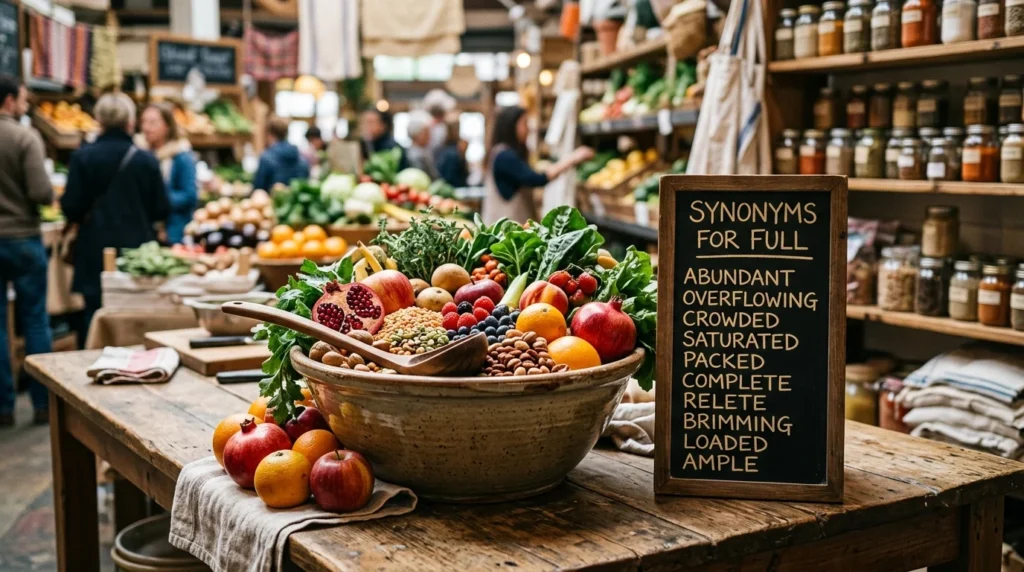
Common synonyms for full include filled, packed, crowded, brimming, overflowing, complete, whole, entire, total, thorough, maximum, abundant, replete, loaded, stuffed, crammed, satisfied, sated, busy, rich, strong, deep, ample, comprehensive, and intact. The right alternative depends on whether full means containing a lot, complete, crowded, satisfied after eating, or at the highest possible level.

Quick Synonym List
When “full” means containing as much as possible
- Filled
- Packed
- Brimming
- Overflowing
- Bursting
- Crammed
- Stuffed
- Loaded
- Heaped
- Chock-full
- Teeming
- Swarming
- Replete
- Laden
When “full” means complete
- Complete
- Whole
- Entire
- Total
- Thorough
- Comprehensive
- Unabridged
- Intact
- Inclusive
- All-inclusive
When “full” means the greatest possible amount
- Maximum
- Greatest
- Highest
- Utmost
- Total
- Absolute
- Complete
- Ultimate
When “full” means having eaten enough
- Satisfied
- Sated
- Replete
- Stuffed
- Gorged
When “full” means active or busy
- Busy
- Hectic
- Bustling
- Lively
- Active
- Humming
- Frenetic
When “full” means strong or rich
- Rich
- Deep
- Strong
- Intense
- Robust
- Resonant
- Powerful
Cambridge’s thesaurus groups alternatives such as filled, brimming, packed, crammed, bursting, loaded, replete, complete, entire, whole, maximum, thorough, and intact under different meanings of full. (dictionary.cambridge.org)
Closest Synonyms
Filled
Meaning: Containing something, often to a particular level or capacity.
How it differs: Filled is one of the closest alternatives when full describes a container or space containing something.
Tone: Neutral
Best for: Containers, rooms, spaces, forms, and objects.
Example:
The box is full of books.
→ The box is filled with books.
Watch out: Full and filled do not always have identical grammar. We normally say the room is full of people but the room is filled with people.
Interchangeability: Usually interchangeable in physical-containment contexts.
Complete
Meaning: Including all parts or details; lacking nothing essential.
How it differs: Complete focuses on wholeness rather than physical capacity.
Tone: Neutral, professional
Best for: Information, documents, processes, sets, and tasks.
Example:
Please provide your full name.
→ Please provide your complete name.
The second sentence is possible but often less natural. Full name is the standard expression.
Watch out: Do not replace full with complete automatically. Some common collocations are fixed.
Interchangeability: Context-dependent.
Whole
Meaning: Including every part; not divided or incomplete.
Tone: Neutral
Best for: Objects, periods of time, groups, and complete quantities.
Example:
I spent the full day there.
→ I spent the whole day there.
Watch out: Whole often works naturally before a noun, while full has many additional meanings.
Interchangeability: Often interchangeable in contexts involving entirety.
Entire
Meaning: Whole or complete, with no part left out.
Tone: Neutral to formal
Best for: Formal writing, quantities, periods, groups, and objects.
Example:
She read the full report.
→ She read the entire report.
Watch out: Entire strongly emphasizes every part.
Interchangeability: Usually interchangeable when full means whole.
Packed
Meaning: Filled with people or things, often with little or no space remaining.
Tone: Neutral
Best for: Rooms, venues, vehicles, schedules, bags, and containers.
Example:
The stadium was full.
→ The stadium was packed.
Watch out: Packed often emphasizes density or lack of space.
Interchangeability: Usually interchangeable for crowded places.
Brimming
Meaning: Filled almost to the top.
Tone: Descriptive, expressive
Best for: Containers, emotions, confidence, energy, and figurative writing.
Example:
The glass was full.
→ The glass was brimming.
Watch out: Brimming usually suggests something is nearly overflowing, not merely partly or completely filled.
Interchangeability: Context-dependent.
Overflowing
Meaning: So full that the contents spill or seem likely to spill.
Tone: Strong, expressive
Best for: Containers, crowds, emotions, ideas, and figurative language.
Example:
The basket was full of flowers.
→ The basket was overflowing with flowers.
Watch out: Overflowing is stronger than full.
Interchangeability: Sometimes interchangeable.
Replete
Meaning: Filled or abundantly supplied with something.
Tone: Formal
Best for: Formal writing, descriptions, literature, and abstract qualities.
Example:
The book is full of useful examples.
→ The book is replete with useful examples.
Watch out: Replete often sounds formal and is commonly followed by with.
Interchangeability: Usually interchangeable in formal contexts involving abundance.
Satisfied
Meaning: Having eaten enough and no longer wanting more food.
Tone: Neutral
Best for: Food and appetite.
Example:
I am full after dinner.
→ I am satisfied after dinner.
Watch out: Satisfied can mean emotionally or generally content, so it does not always specifically mean “not hungry.”
Interchangeability: Context-dependent.
Sated
Meaning: Completely satisfied, especially after eating or experiencing something.
Tone: Formal, literary
Best for: Formal or literary writing.
Example:
After the meal, he was full.
→ After the meal, he was sated.
Watch out: This is much less common in everyday conversation.
Interchangeability: Context-dependent.
Formal and Professional Alternatives
When full means complete, comprehensive, or containing all relevant information, these alternatives can be more precise.
| Alternative | Meaning | Tone | Best Context | Interchangeable? |
|---|---|---|---|---|
| Complete | Including all necessary parts | Neutral/formal | Documents, information | Often |
| Entire | Whole, with nothing omitted | Neutral/formal | Reports, periods | Often |
| Comprehensive | Covering many or all relevant aspects | Formal | Reports, research | Sometimes |
| Thorough | Detailed and careful | Formal | Analysis, reviews | Sometimes |
| Total | Entire amount | Neutral/formal | Numbers, quantities | Sometimes |
| Unabridged | Not shortened or condensed | Formal | Books, texts | Rarely |
| All-inclusive | Including everything | Professional | Services, plans | Sometimes |
| Plenary | Complete or involving all members | Very formal | Meetings, institutions | Rarely |
| Intact | Complete and undamaged | Formal | Objects, systems | Sometimes |
| Maximum | Greatest possible amount | Neutral/formal | Capacity, effort | Context-specific |
Comprehensive
Use comprehensive when full means covering a subject broadly and thoroughly.
The report provides a full analysis of the issue.
→ The report provides a comprehensive analysis of the issue.
This is often a better choice in academic and professional writing when you mean detailed coverage.
Thorough
Use thorough when the emphasis is on careful attention to detail.
We conducted a full review of the process.
→ We conducted a thorough review of the process.
Thorough does not simply mean “complete”; it suggests careful examination.
Total
Use total when you mean the entire amount or sum.
The full cost was $500.
→ The total cost was $500.
This is especially natural with amounts, numbers, and quantities.
Unabridged
Use unabridged when something has not been shortened, edited, or condensed.
The full version of the book is available.
→ The unabridged version of the book is available.
This is more precise than full when text length or completeness is the issue.
Neutral and Everyday Alternatives
For everyday English, the most useful alternatives include:
- Filled
- Complete
- Whole
- Entire
- Packed
- Busy
- Satisfied
- Loaded
- Brimming
- Stuffed
Examples
Full bottle → filled bottle
Full day → whole day
Full report → complete report
Full room → packed room
Full schedule → busy schedule
Full after dinner → satisfied after dinner
Full bag → packed bag or loaded bag
The natural choice depends on what exactly is being described.
Casual Alternatives
In informal speech, these expressions can sometimes replace full:
- Packed
- Stuffed
- Loaded
- Jam-packed
- Chock-full
- Packed to the brim
- Bursting
- Swamped — for being extremely busy
- Stuffed — after eating
Examples
The restaurant was full.
→ The restaurant was packed.
I’m full.
→ I’m stuffed.
My schedule is full.
→ My schedule is packed.
Be careful with stuffed: it is informal and can sound exaggerated.
Full vs. Near Synonyms
Full vs. Filled
These are close, but their grammar differs.
The room is full of people.
The room is filled with people.
Both are natural.
But:
My schedule is full.
does not always become:
My schedule is filled.
The second sounds incomplete without additional wording such as filled with meetings.
Full vs. Complete
Full can mean complete, but complete is broader when referring to information, processes, or sets.
I need the full story.
I need the complete story.
Both work.
But:
The glass is full.
does not normally become:
The glass is complete.
Full vs. Whole
Both can mean “entire.”
the full day
the whole day
the full amount
the whole amount
However, whole often emphasizes every part of something, while full has many other meanings.
Full vs. Entire
Entire strongly emphasizes every part of something.
the full report
the entire report
The two are often interchangeable.
But entire cannot replace full in expressions such as:
a full stomach
a full glass
full speed
Full vs. Packed
Packed suggests that something is filled densely, often leaving little space.
The theater was full.
The theater was packed.
The second sounds more crowded.
Full vs. Brimming
Brimming means filled almost to the top, often with a sense of abundance.
a full glass
a glass brimming with water
The second is more vivid and suggests the liquid is near the rim.
Full vs. Complete
Use full for physical capacity or quantity and complete for completeness of information, tasks, or parts.
a full bottle
a complete report
Trying to switch these words mechanically can make the sentence unnatural.
Comparison Table
| Word | Relationship | Can Replace “Full”? | Tone | Best Context |
|---|---|---|---|---|
| Filled | Close synonym | Often | Neutral | Containers, spaces |
| Packed | Close contextual synonym | Often | Neutral | Crowds, schedules |
| Brimming | Stronger near synonym | Sometimes | Expressive | Containers, emotions |
| Overflowing | Stronger synonym | Sometimes | Expressive | Abundance, emotions |
| Crammed | Stronger contextual synonym | Sometimes | Informal | Tight spaces |
| Stuffed | Contextual synonym | Sometimes | Informal | Food, containers |
| Complete | Close synonym | Often | Neutral/formal | Information, tasks |
| Whole | Close synonym | Often | Neutral | Periods, objects |
| Entire | Close synonym | Often | Formal/neutral | Reports, periods |
| Comprehensive | Related synonym | Sometimes | Formal | Information |
| Thorough | Related synonym | Sometimes | Formal | Analysis |
| Maximum | Contextual synonym | Sometimes | Neutral/formal | Capacity, amount |
| Replete | Formal near synonym | Sometimes | Formal | Abundance |
| Satisfied | Contextual synonym | Sometimes | Neutral | Food |
| Sated | Contextual synonym | Sometimes | Formal/literary | Appetite |
| Busy | Contextual synonym | Sometimes | Neutral | Schedules, activity |
| Rich | Contextual synonym | Sometimes | Neutral | Flavor, content |
| Strong | Contextual synonym | Sometimes | Neutral | Sound, flavor, smell |
How to Choose the Right Alternative
If “full” means containing as much as possible
Choose:
- filled
- brimming
- packed
- overflowing
- loaded
The bottle is full.
→ The bottle is filled.
If “full” means crowded
Choose:
- packed
- crowded
- crammed
- jam-packed
- teeming
The stadium was full.
→ The stadium was packed.
If “full” means complete
Choose:
- complete
- whole
- entire
- comprehensive
- thorough
We need the full report.
→ We need the complete report.
If “full” means the greatest possible level
Choose:
- maximum
- greatest
- highest
- utmost
- absolute
The machine is operating at full capacity.
→ The machine is operating at maximum capacity.
If “full” means satisfied after eating
Choose:
- satisfied
- sated
- stuffed
I’m too full to eat dessert.
→ I’m too stuffed to eat dessert.
If “full” means very busy
Choose:
- busy
- hectic
- packed
- bustling
- active
I have a full schedule tomorrow.
→ I have a packed schedule tomorrow.
Sentence Transformations
- The glass is full of water.
→ The glass is filled with water. - The room was full of people.
→ The room was packed with people. - Please provide your full name.
→ Please provide your complete name. - She spent the full day at the museum.
→ She spent the entire day at the museum. - The report contains the full details.
→ The report contains all the details. - The restaurant was full.
→ The restaurant was crowded. - The basket was full of flowers.
→ The basket was overflowing with flowers. - The company operates at full capacity.
→ The company operates at maximum capacity. - I’m too full to eat anything else.
→ I’m too satisfied to eat anything else. - My schedule is full this week.
→ My schedule is packed this week. - We need a full explanation.
→ We need a complete explanation. - The wine has a full flavor.
→ The wine has a rich flavor.
Grammar and Usage
Full is primarily an adjective
Common structures include:
- full of + noun
- full + noun
- be full
- full enough
- too full to + verb
- full of + abstract noun
Examples:
The room is full of people.
She gave me a full explanation.
I’m too full to eat.
Cambridge identifies several major adjective meanings for full, including containing a lot, complete, greatest possible, having eaten enough, large or rounded, and strong or deep in flavor, sound, or smell. (dictionary.cambridge.org)
Full of
Full of is one of the most useful structures.
Examples:
- full of energy
- full of ideas
- full of people
- full of information
- full of problems
- full of hope
- full of life
The phrase does not always describe physical quantity.
She is full of ideas.
Here, full of means having a lot of ideas.
Full + noun
Use full before a noun when you mean complete or maximum.
Examples:
- full name
- full report
- full amount
- full price
- full details
- full version
- full access
- full responsibility
- full support
Full as an adverb
In some expressions, full works as an adverb meaning completely or directly.
I know full well what happened.
The light hit him full in the face.
Cambridge also lists full as an adverb with these meanings. (dictionary.cambridge.org)
Full as a noun
The noun appears in expressions such as:
Pay the bill in full.
She lived life to the full.
She lived life to the fullest.
In these expressions, full means the complete amount or the greatest possible degree. (dictionary.cambridge.org)
Common Mistakes
1. Using “filled” everywhere
Full and filled overlap, but their grammar is different.
Correct:
The room is full of people.
The room is filled with people.
2. Using “complete” for physical fullness
A glass can be full, but it is not normally complete.
3. Using “packed” when there is no crowd
A packed schedule is natural, but packed usually emphasizes density or a large amount squeezed into limited space or time.
4. Confusing “full” with “whole”
They overlap when referring to entirety, but whole cannot replace every meaning of full.
5. Using “maximum” as a universal synonym
Maximum refers to the greatest possible amount or level. It cannot replace full in sentences about food, completeness, or physical appearance.
6. Overusing “stuffed”
Stuffed is informal and can sound exaggerated.
I’m stuffed.
is natural in casual speech, but:
I am stuffed after the formal dinner.
may sound less appropriate in professional writing.
7. Confusing “full” with “fulfilled”
Full means containing a lot, complete, or satisfied, depending on context.
Fulfilled means a requirement, promise, wish, or expectation has been satisfied.
The room is full.
The contract has been fulfilled.
8. Assuming “full” always means “complete”
It can mean complete, but it can also mean crowded, filled, satisfied after eating, maximum, strong, or abundant. (dictionary.cambridge.org)
Commonly Confused Words
Full vs. Filled
Full describes a state.
The cup is full.
Filled often describes the process or result of putting something into a container or space.
She filled the cup with water.
You can also say:
The cup is filled with water.
Full vs. Fulfilled
Fulfilled is related to completing a requirement, promise, goal, wish, or expectation.
The room is full.
She fulfilled her promise.
They are not interchangeable.
Full vs. Whole
Whole emphasizes every part of something.
I ate the whole pizza.
Full can mean the entire amount, but it has many additional meanings.
I ate a full meal.
Full vs. Complete
Complete means nothing is missing.
Full can mean complete, but can also mean containing as much as possible.
a full bottle
a complete report
Full vs. Packed
Packed suggests that something is filled densely or has many people or things in it.
The theater is full.
The theater is packed.
The second emphasizes crowding.
When Not to Use an Alternative
Sometimes full is the most natural and precise word.
For example:
I’m full.
This is the ordinary way to say that you have eaten enough. Complete or entire would not work.
Likewise:
The glass is full.
Here, full clearly describes the container’s condition. Complete is wrong, while filled changes the grammatical structure.
Another example:
The report gives the full details.
Although complete can work, full details is a natural collocation. Replacing familiar phrases simply to avoid repetition can make your writing less natural.
The best synonym is not always a more sophisticated word. Sometimes full is shorter, clearer, and more idiomatic.
Writing Tips
- Use filled for containers or spaces containing something.
- Use packed for crowded places or tightly scheduled plans.
- Use brimming when something is nearly overflowing.
- Use overflowing when there is more than can comfortably fit.
- Use complete when nothing is missing.
- Use whole or entire when emphasizing every part.
- Use comprehensive when something covers many or all relevant details.
- Use maximum for the greatest possible amount or level.
- Use satisfied when someone has eaten enough.
- Use sated for a more formal or literary tone.
- Use busy or packed for a schedule filled with activities.
- Use rich or deep for strong flavors, sounds, or smells.
- Keep full when it is the most natural collocation, especially in phrases such as full name, full details, full price, full access, and full support.
FAQs
1. What is the best synonym for full?
There is no single best synonym because full has several meanings. Filled works for containers, complete or entire works for completeness, packed works for crowds, maximum works for the highest possible level, and satisfied works when talking about hunger.
2. What is a synonym for full in formal writing?
Depending on the context, formal alternatives include complete, entire, comprehensive, thorough, total, maximum, and replete. The most precise choice depends on the meaning of full in the sentence.
3. What is another word for full of?
Useful alternatives include filled with, packed with, brimming with, overflowing with, abundant in, rich in, replete with, and laden with.
4. What is a synonym for full meaning complete?
The closest alternatives are complete, whole, entire, total, comprehensive, and thorough. Entire is especially useful when emphasizing every part of something.
5. What is a synonym for full when talking about food?
Common alternatives include satisfied, sated, and stuffed. Satisfied is neutral, sated is formal or literary, and stuffed is informal.
6. Is “filled” the same as “full”?
They are closely related but not identical. Full usually describes a state, while filled can describe the result of putting something into a space or container. For example, The glass is full and The glass is filled with water are both natural.
7. What is the opposite of full?
The most common opposite is empty. Depending on the meaning, other contrasts include partial, incomplete, vacant, limited, and devoid. Cambridge lists empty, void, vacant, and devoid among opposites for one major sense of full. (dictionary.cambridge.org)
Editor’s Choice
For different uses of full, these alternatives provide the clearest fit:
- Containing a lot: filled
- Crowded: packed
- Nearly overflowing: brimming
- Complete: entire
- Detailed and complete: comprehensive
- Greatest possible: maximum
- After eating: satisfied
- Very busy: packed
- Strong or rich: robust or deep
- Abundant: replete
These choices are more useful than treating full as if it had one universal synonym.
Key Takeaways
- Full has several meanings, including containing a lot, complete, maximum, satisfied after eating, crowded, and strong or rich.
- Filled, packed, brimming, and overflowing are useful for different degrees of physical or figurative abundance.
- Complete, whole, and entire work when full means including every part.
- Maximum describes the greatest possible level, while satisfied or sated can describe someone who has eaten enough.
- Keep full when it forms a natural expression or when another synonym would change the intended meaning.
Internal Link Opportunities
| Anchor Text | Suggested Topic | Why It Fits |
|---|---|---|
| synonyms for filled | Synonyms for Filled | Covers the closest physical-containment alternative. |
| synonyms for complete | Synonyms for Complete | Expands the completeness meaning of full. |
| synonyms for whole | Synonyms for Whole | Helps distinguish whole from full. |
| synonyms for packed | Synonyms for Packed | Covers crowds, schedules, and dense contents. |
| synonyms for abundant | Synonyms for Abundant | Supports the “containing a lot” sense. |
| synonyms for maximum | Synonyms for Maximum | Covers the greatest-possible meaning. |
| synonyms for busy | Synonyms for Busy | Useful for the “full schedule” meaning. |
| synonyms for satisfied | Synonyms for Satisfied | Covers the food-related sense of full. |