
Quick Answer
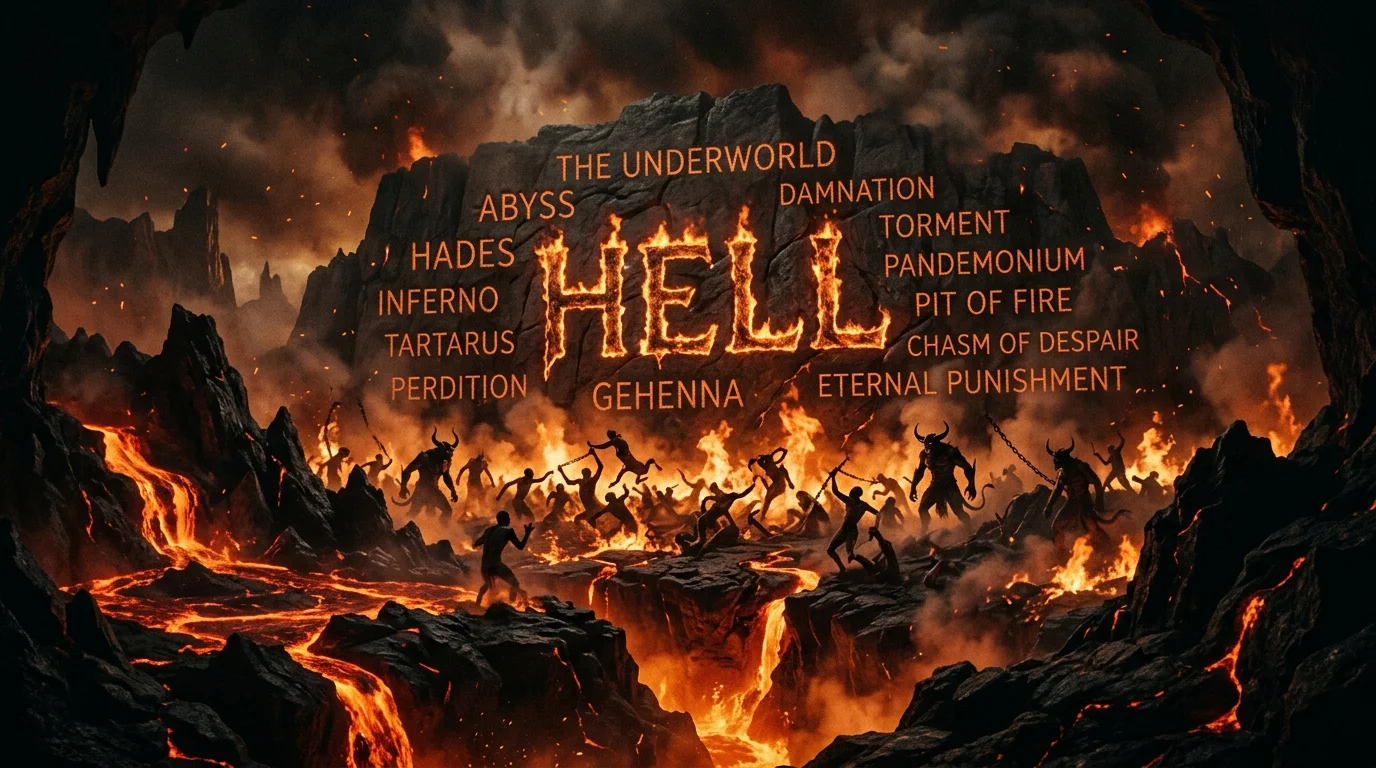
The closest synonyms for hell include inferno, underworld, Hades, abyss, hellfire, perdition, torment, agony, anguish, misery, suffering, nightmare, ordeal, purgatory, and Gehenna. Some describe a religious or mythological realm, while others describe extreme suffering or a terrible situation. These words are related to hell but are not interchangeable in every context.
Quick Synonym List
Religious or mythological meanings
- Inferno
- Underworld
- Hades
- Abyss
- Hellfire
- Perdition
- Damnation
- Gehenna
- Tartarus
- Purgatory
- Netherworld
- Infernal regions
- Bottomless pit
- Abode of the damned
- Lake of fire
Suffering or difficult experience
- Torment
- Agony
- Anguish
- Misery
- Suffering
- Ordeal
- Nightmare
- Wretchedness
- Despair
- Affliction
- Torture
- Hardship
- Calamity
- Distress
Cambridge and Collins distinguish these two major groups: words such as underworld, Hades, and inferno relate to the religious or mythological sense, while torment, agony, anguish, and misery describe the figurative sense of extreme suffering.
Closest Synonyms
1. Inferno
Meaning: A place or situation associated with intense fire, destruction, or suffering.
How it differs: Inferno is especially vivid and often suggests a huge or destructive fire. It can also describe a figurative situation of extreme difficulty.
Tone: Dramatic
Best for: Fire, destruction, intense situations, literary writing
Example:
The burning building looked like an inferno.
Watch out: It is not a universal replacement for hell. It emphasizes fire or extreme conditions.
Interchangeability: Context-dependent.
2. Underworld
Meaning: A realm associated with the dead or the afterlife in various religions and mythologies.
How it differs: Underworld is broader than the specifically punitive concept of Hell.
Tone: Neutral to literary
Best for: Mythology, religion, literature, fantasy
Example:
In Greek mythology, Hades ruled the underworld.
Interchangeability: Similar meaning but not interchangeable.
3. Hades
Meaning: In Greek mythology, the realm of the dead and also the name of its ruler.
How it differs: Hades belongs specifically to Greek mythology.
Tone: Literary, mythological
Best for: Greek mythology and classical references
Example:
The hero was said to have traveled into Hades.
Watch out: Hades should not automatically be treated as exactly equivalent to the Christian concept of Hell.
Interchangeability: Context-dependent.
4. Abyss
Meaning: An extremely deep or seemingly bottomless place; figuratively, a profound state of darkness or despair.
How it differs: Abyss emphasizes depth or emptiness rather than punishment.
Tone: Literary, dramatic
Best for: Religious writing, literature, metaphorical descriptions
Example:
The character seemed to be staring into an abyss.
Interchangeability: Similar meaning but not interchangeable.
5. Hellfire
Meaning: Fire associated with punishment in Hell.
How it differs: Hellfire specifically emphasizes the fire or punishment associated with Hell.
Tone: Religious, dramatic
Best for: Religious or theological contexts
Example:
The sermon warned listeners about hellfire.
Interchangeability: Context-dependent.
6. Perdition
Meaning: A state of complete spiritual loss or eternal punishment.
How it differs: Perdition has a strongly religious and formal tone.
Tone: Very formal, religious
Best for: Religious, literary, and historical writing
Example:
The text describes the consequences of spiritual perdition.
Interchangeability: Context-dependent.
7. Torment
Meaning: Extreme physical or emotional suffering.
How it differs: Torment focuses on suffering rather than a place.
Tone: Strong
Best for: Emotional pain, prolonged suffering, literary writing
Example:
The uncertainty caused months of torment.
Interchangeability: Not interchangeable when hell means a place.
8. Agony
Meaning: Extreme physical or emotional pain.
How it differs: Agony emphasizes intense pain rather than an environment or situation.
Tone: Strong
Best for: Severe emotional or physical suffering
Example:
Waiting for an answer was agony.
Interchangeability: Context-dependent.
9. Anguish
Meaning: Severe emotional or mental suffering.
How it differs: Anguish is especially associated with emotional distress.
Tone: Strong, serious
Best for: Emotional pain and literary writing
Example:
She experienced deep anguish after the loss.
Interchangeability: Context-dependent.
10. Misery
Meaning: Great unhappiness or suffering.
How it differs: Misery is broader and often less intense than agony or torment.
Tone: Neutral
Best for: Unhappy circumstances, emotional suffering
Example:
The long winter became a period of misery.
Interchangeability: Context-dependent.
11. Ordeal
Meaning: A very difficult or painful experience.
How it differs: Ordeal emphasizes the experience or process of going through something difficult.
Tone: Neutral to formal
Best for: Difficult experiences and prolonged challenges
Example:
The journey became a difficult ordeal.
Interchangeability: Similar meaning but not interchangeable.
12. Nightmare
Meaning: An extremely unpleasant or frightening experience or situation.
How it differs: Nightmare is often more conversational and can describe everyday situations that become extremely difficult.
Tone: Neutral, expressive
Best for: Problems, experiences, events, situations
Example:
The delayed flight turned into a complete nightmare.
Interchangeability: Context-dependent.
13. Purgatory
Meaning: A place or state of suffering or purification in certain religious traditions; figuratively, a prolonged unpleasant situation.
Tone: Religious, literary
Best for: Religious discussions and metaphors
Example:
Waiting for the decision felt like purgatory.
Watch out: Purgatory is not simply another name for Hell. Its theological meaning is distinct.
Interchangeability: Similar meaning but not interchangeable.
14. Gehenna
Meaning: A biblical term associated with a place of punishment or destruction and later with Hell.
Tone: Religious, historical
Best for: Biblical, theological, and historical contexts
Example:
The passage refers to Gehenna as a place of judgment.
Interchangeability: Context-dependent.
15. Infernal Regions
Meaning: A formal or literary expression for the regions associated with Hell or the underworld.
Tone: Very formal, literary
Best for: Literature, historical writing, religious contexts
Example:
The poem describes a descent into the infernal regions.
Interchangeability: Usually interchangeable only in specific religious or literary contexts.
Formal and Professional Alternatives
If you mean a very difficult or unpleasant situation, professional writing usually benefits from replacing hell with a more precise term:
| Alternative | Meaning | Tone | Best Context | Can Replace “Hell”? |
|---|---|---|---|---|
| Ordeal | Very difficult experience | Formal/neutral | Difficult experiences | Often |
| Hardship | Difficult condition | Formal/neutral | Personal or social difficulties | Sometimes |
| Suffering | Physical or emotional pain | Formal | Serious difficulties | Often |
| Distress | Severe discomfort or anxiety | Formal | Emotional situations | Sometimes |
| Adversity | Difficult circumstances | Formal | Professional/academic writing | Sometimes |
| Affliction | Serious suffering or hardship | Formal | Serious difficulties | Sometimes |
| Torment | Severe prolonged suffering | Strong/formal | Emotional suffering | Sometimes |
| Calamity | Major disaster or misfortune | Formal | Disasters | Rarely |
For example:
Informal: The entire process was hell.
Professional: The entire process was an ordeal.
That change makes the sentence more suitable for formal writing without losing its basic meaning.
Neutral and Everyday Alternatives
When hell means an extremely unpleasant experience, these alternatives are often more natural:
- Nightmare
- Ordeal
- Misery
- Suffering
- Torment
- Hardship
- Terrible experience
- Awful experience
- Difficult situation
- Miserable experience
Nightmare
The move was hell.
→ The move was a nightmare.
Ordeal
The application process was hell.
→ The application process was an ordeal.
Miserable experience
The trip was hell.
→ The trip was a miserable experience.
The best choice depends on whether you want to emphasize fear, difficulty, suffering, or general unpleasantness.
Casual Alternatives
In informal American English, people may use expressions such as:
- Nightmare
- Disaster
- Misery
- Total chaos
- A mess
- A nightmare situation
- A terrible experience
- A living nightmare
Nightmare is especially useful when you want a strong but less profane alternative.
Getting through airport security was a nightmare.
Hell vs. Near Synonyms
Hell vs. Inferno
Hell can refer to a religious place, extreme suffering, or a terrible situation.
Inferno strongly suggests fire or a fiery, destructive environment.
The war was hell.
The building was an inferno.
The first describes an experience. The second strongly evokes fire.
Hell vs. Underworld
Hell generally carries ideas of punishment, damnation, or extreme suffering.
Underworld is a broader term for a realm of the dead in mythology or religion.
The story describes Hell as a place of punishment.
The hero descends into the underworld.
Hell vs. Hades
Hades is specifically associated with Greek mythology. It should not be used as a universal synonym for every religious concept of Hell.
Hell vs. Purgatory
These are not exact synonyms.
Hell traditionally represents punishment or damnation in many religious traditions.
Purgatory has a different theological meaning in traditions that teach it.
Figuratively, however, both can describe a prolonged unpleasant situation:
Waiting for the results was purgatory.
Hell vs. Torment
Hell can describe a place or experience.
Torment describes severe suffering.
Life became hell.
The uncertainty caused intense torment.
Hell vs. Misery
Misery means great unhappiness or suffering. It is less associated with a specific place or religious idea.
The conditions were hell.
The conditions caused widespread misery.
Comparison Table
| Word | Relationship | Can Replace “Hell”? | Tone | Best Context |
|---|---|---|---|---|
| Inferno | Related synonym | Sometimes | Dramatic | Fire, destruction |
| Underworld | Related term | Sometimes | Literary | Mythology, afterlife |
| Hades | Mythological equivalent | Context-dependent | Literary | Greek mythology |
| Abyss | Near synonym | Rarely | Dramatic | Darkness, depth, despair |
| Hellfire | Related term | Sometimes | Religious | Religious punishment |
| Perdition | Near synonym | Sometimes | Formal/religious | Spiritual punishment |
| Torment | Figurative synonym | Often | Strong | Suffering |
| Agony | Near synonym | Sometimes | Strong | Extreme pain |
| Anguish | Near synonym | Sometimes | Serious | Emotional suffering |
| Misery | Near synonym | Often | Neutral | Unhappiness |
| Ordeal | Contextual alternative | Often | Neutral/formal | Difficult experiences |
| Nightmare | Contextual alternative | Often | Conversational | Terrible situations |
| Purgatory | Related religious term | Sometimes | Religious/literary | Prolonged suffering |
| Gehenna | Religious term | Context-dependent | Religious | Biblical contexts |
| Hardship | Contextual alternative | Sometimes | Neutral/formal | Difficult conditions |
How to Choose the Right Alternative
Ask what hell means in your sentence.
If you mean a religious place of punishment
Choose:
- Hellfire
- Inferno
- Perdition
- Gehenna
- Underworld
- Infernal regions
If you mean a mythological realm
Choose:
- Hades
- Underworld
- Tartarus
- Netherworld
If you mean extreme suffering
Choose:
- Torment
- Agony
- Anguish
- Misery
- Suffering
If you mean a terrible experience
Choose:
- Ordeal
- Nightmare
- Hardship
- Terrible experience
- Miserable situation
If you want formal writing
Choose:
- Ordeal
- Suffering
- Distress
- Adversity
- Hardship
- Torment
If you want strong literary language
Choose:
- Inferno
- Abyss
- Perdition
- Purgatory
- Infernal regions
Sentence Transformations
1. Hell → Nightmare
Original:
The entire trip was hell.
Alternative:
The entire trip was a nightmare.
2. Hell → Ordeal
Original:
The recovery process was hell.
Alternative:
The recovery process was an ordeal.
3. Hell → Misery
Original:
The long winter was hell for the family.
Alternative:
The long winter brought misery to the family.
4. Hell → Torment
Original:
The uncertainty was hell.
Alternative:
The uncertainty was torment.
5. Hell → Suffering
Original:
The prisoners endured hell.
Alternative:
The prisoners endured severe suffering.
6. Hell → Inferno
Original:
The burning building looked like hell.
Alternative:
The burning building looked like an inferno.
7. Hell → Underworld
Original:
The hero entered Hell in the story.
Alternative:
The hero entered the underworld in the story.
8. Hell → Adversity
Original:
They went through hell after the disaster.
Alternative:
They went through severe adversity after the disaster.
Grammar and Usage
“Hell” is usually a noun
Common patterns include:
- go to hell
- in hell
- from hell
- through hell
- make someone’s life hell
- a living hell
- hell on earth
Examples:
They went through hell during the crisis.
The workplace became a living hell.
Cambridge identifies make someone’s life hell as an informal expression meaning to cause someone many problems and make them very unhappy.
“Hell” can also be an exclamation
In informal English, hell can express anger or add emphasis:
Oh hell, I forgot my keys.
What the hell is happening?
This usage is informal and can be considered offensive by some people.
For formal writing, replace it with a more neutral expression or remove it entirely.
“Hellish” is an adjective
Hellish means very bad or unpleasant.
It was a hellish journey.
Possible alternatives include:
- dreadful
- terrible
- unbearable
- miserable
- awful
- nightmarish
- infernal
Common Mistakes
1. Treating Hades as a universal synonym for Hell
Hades belongs specifically to Greek mythology. Religious concepts of Hell vary across traditions.
2. Confusing Hell with the underworld
The underworld is a broader concept. It does not necessarily mean a place of eternal punishment.
3. Using purgatory as an exact synonym
Purgatory has a distinct theological meaning. It can be a figurative synonym for a prolonged unpleasant situation, but not a universal replacement for Hell.
4. Using “inferno” for every unpleasant experience
Inferno strongly suggests fire, heat, or destructive intensity.
5. Using “agony” to mean a place
Agony describes extreme suffering or pain. It does not mean a physical or spiritual location.
6. Using “hell” in formal writing without considering tone
Hell is common in everyday speech but can be inappropriate in formal or professional contexts, especially when used as profanity.
7. Confusing “hell” and “hellish”
Hell is primarily a noun or exclamation.
Hellish is an adjective.
The situation was hell.
It was a hellish situation.
8. Using religious terms casually without considering meaning
Words such as Gehenna, perdition, and hellfire carry specific religious associations. Use them when those associations fit the context.
Commonly Confused Words
Hell vs. Hades
Hell is used across different religious and figurative contexts.
Hades specifically comes from Greek mythology and can refer to both the realm of the dead and its ruler.
Hell vs. Inferno
Hell is broader.
Inferno emphasizes fire or intense destruction.
Hell vs. Purgatory
These represent different religious concepts. Purgatory should not be treated as a simple synonym for Hell.
Hell vs. Hellish
- Hell: noun — The situation was hell.
- Hellish: adjective — It was a hellish situation.
When Not to Use an Alternative
Sometimes hell is the most natural word.
For example:
We went through hell together.
Replacing it with:
We went through an inferno together.
changes the meaning and sounds unnatural unless fire or destruction is involved.
Similarly:
What the hell?
has a specific conversational function. Replacing it with What the torment? or What the inferno? does not preserve the normal meaning.
If the word is being used as an exclamation or intensifier, look for a natural phrase-level alternative rather than forcing a single-word synonym.
Writing Tips
- Use “inferno” when fire or destruction is central.
- Use “underworld” for broad mythological or afterlife references.
- Use “Hades” specifically for Greek mythology.
- Use “torment” for severe suffering.
- Use “agony” for extreme pain.
- Use “ordeal” for a difficult experience.
- Use “nightmare” for a terrible situation in everyday writing.
- Use “adversity” or “hardship” in more formal writing.
- Use “hellish” when you need an adjective.
- Do not assume every religious term has the same theological meaning as Hell.
FAQs
1. What is the closest synonym for hell?
It depends on the meaning. Inferno is a close alternative for a fiery concept, while torment, misery, and suffering work for the figurative meaning of an extremely unpleasant experience.
2. What is another word for hell in a bad situation?
Good alternatives include nightmare, ordeal, misery, suffering, torment, hardship, and adversity.
3. What is a formal word for hell?
For the religious concept, perdition, Gehenna, infernal regions, and hellfire may fit particular contexts. For a difficult situation, ordeal, adversity, hardship, or suffering can provide a more formal alternative.
4. Is “inferno” another word for hell?
Sometimes. Inferno can refer to Hell or a place associated with intense fire, but it can also simply mean a large or destructive fire.
5. Is “Hades” the same as hell?
Not exactly. Hades comes from Greek mythology and refers to the realm of the dead and its ruler. It should not automatically be treated as identical to every religious concept of Hell.
6. What is a synonym for “hellish”?
Words such as dreadful, terrible, awful, miserable, nightmarish, and infernal can work depending on the sentence. Cambridge specifically lists demonic, god-awful, and infernal as related synonyms for hellish.
7. What is the opposite of hell?
For the religious or figurative sense, common opposites include heaven, paradise, bliss, and happiness, depending on the intended meaning.
Editor’s Choice
Choose the alternative based on what you want to communicate:
- General unpleasant experience: nightmare
- Difficult experience: ordeal
- Extreme suffering: torment
- Emotional pain: anguish
- Religious context: inferno, perdition, or hellfire
- Mythological context: underworld or Hades
- Formal writing: suffering, adversity, or hardship
- Fire or destruction: inferno
Key Takeaways
- Hell has both religious and figurative meanings, so its synonyms depend strongly on context.
- Inferno, hellfire, perdition, and Gehenna relate to religious or fiery concepts.
- Underworld and Hades are related to afterlife traditions but are not universal equivalents of Hell.
- Torment, agony, anguish, misery, and suffering work when hell means extreme distress.
- For a terrible everyday experience, nightmare or ordeal is often more natural than forcing a literal synonym.
Internal Link Opportunities
| Anchor Text | Suggested Topic | Why It Fits |
|---|---|---|
| synonyms for nightmare | Synonyms for Nightmare | Covers a common figurative replacement for hell. |
| synonyms for misery | Synonyms for Misery | Explores the suffering-related sense. |
| synonyms for torment | Synonyms for Torment | Closely connected to extreme suffering. |
| synonyms for suffering | Synonyms for Suffering | Useful for formal alternatives to figurative hell. |
| synonyms for agony | Synonyms for Agony | Covers intense emotional or physical pain. |
| synonyms for difficult | Synonyms for Difficult | Helps replace phrases such as “a hellish situation.” |
| synonyms for terrible | Synonyms for Terrible | Provides everyday alternatives for unpleasant experiences. |
| synonyms for awful | Synonyms for Awful | Supports casual and conversational vocabulary choices. |