

Quick Answer
The closest synonyms for ignore include disregard, overlook, neglect, dismiss, avoid, shun, snub, slight, bypass, brush off, tune out, pay no attention to, take no notice of, turn a blind eye to, and pass over. Some are direct replacements, while others add ideas such as disrespect, avoidance, carelessness, or deliberate refusal to acknowledge something.
Quick Synonym List
- Disregard
- Overlook
- Neglect
- Dismiss
- Avoid
- Shun
- Snub
- Slight
- Bypass
- Brush off
- Tune out
- Pass over
- Skip
- Omit
- Sideline
- Reject
- Refuse to acknowledge
- Pay no attention to
- Take no notice of
- Pay no heed to
- Turn a blind eye to
- Close one’s eyes to
- Turn a deaf ear to
- Shut out
- Block out
- Give the cold shoulder to
- Cold-shoulder
- Scorn
- Eschew
- Let go
- Let pass
Cambridge’s thesaurus groups words such as disregard, neglect, overlook, shun, snub, slight, brush off, tune out, and turn a blind eye to with ignore, while noting that they differ in meaning and usage.
Closest Synonyms
1. Disregard
Meaning: To intentionally pay no attention to something or to treat it as unimportant.
How it differs: Disregard is one of the closest formal synonyms for ignore. It often suggests consciously deciding not to consider something.
Tone: Neutral to formal
Best for: Warnings, advice, rules, evidence, instructions
Example:
He disregarded the warning and continued.
Watch out: Disregard can sound more deliberate than ignore.
Interchangeability: Usually interchangeable.
2. Overlook
Meaning: To fail to notice, consider, or remember something.
How it differs: Overlook often suggests that something was missed rather than deliberately rejected.
Tone: Neutral
Best for: Details, mistakes, facts, problems
Example:
We overlooked an important detail in the report.
Watch out: It can imply an accidental omission, while ignore often implies intention.
Interchangeability: Context-dependent.
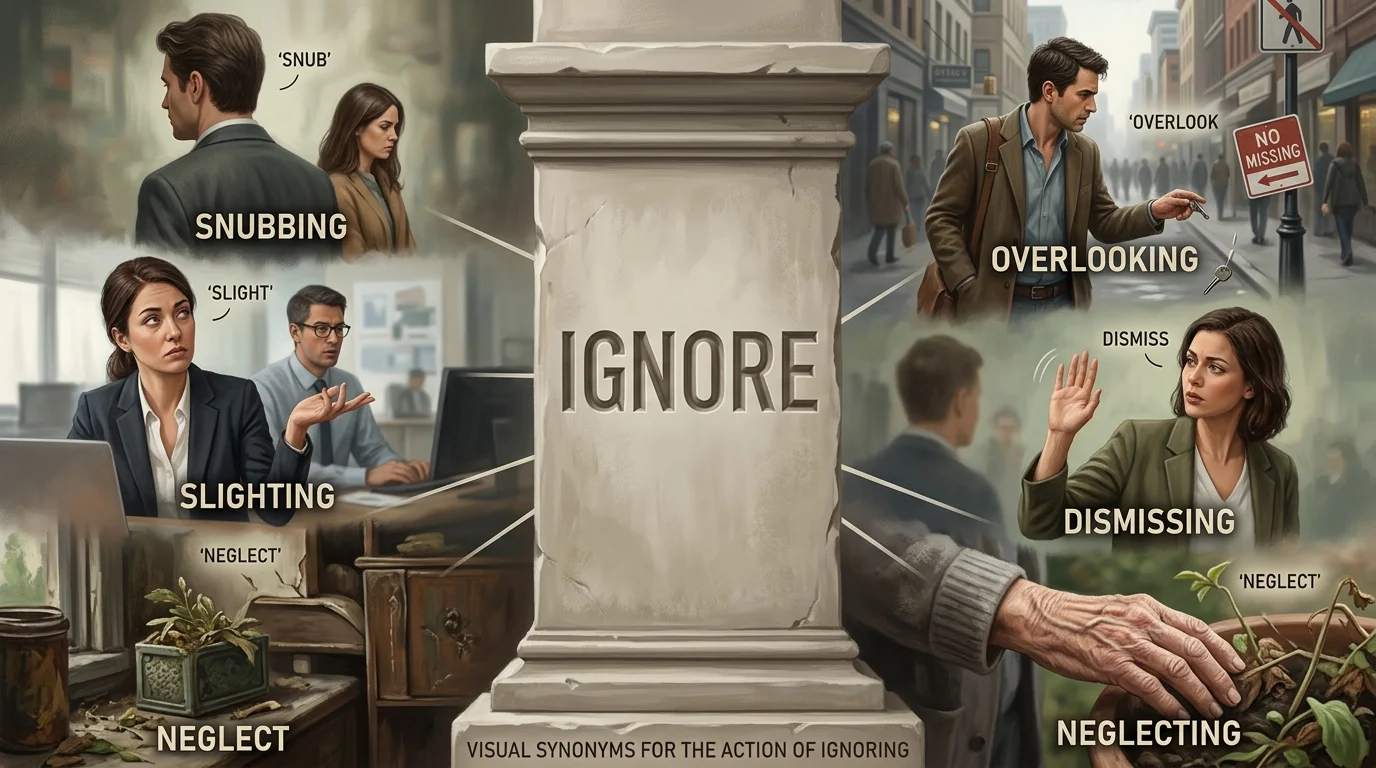
3. Neglect
Meaning: To fail to give proper attention or care to someone or something.
How it differs: Neglect often implies a failure to provide necessary care or attention over time.
Tone: Neutral to formal
Best for: Duties, responsibilities, maintenance, people, needs
Example:
The company neglected several safety concerns.
Interchangeability: Context-dependent.
4. Dismiss
Meaning: To decide that something is not worth considering or to reject it as unimportant.
How it differs: Dismiss emphasizes rejection rather than simply failing to notice something.
Tone: Neutral to formal
Best for: Ideas, concerns, suggestions, arguments, explanations
Example:
She dismissed his concerns as unimportant.
Interchangeability: Context-dependent.
5. Avoid
Meaning: To deliberately stay away from someone or something.
How it differs: Avoid means actively staying away, while ignore means giving no attention.
Tone: Neutral
Best for: People, situations, topics, responsibilities
Example:
He avoided the subject during the meeting.
Interchangeability: Similar meaning but not always interchangeable.
6. Shun
Meaning: To deliberately avoid someone or something.
How it differs: Shun is stronger than avoid and often suggests deliberate social rejection.
Tone: Strong, formal/literary
Best for: People, groups, attention, social contact
Example:
She shunned the spotlight.
Interchangeability: Context-dependent.
7. Snub
Meaning: To deliberately ignore or treat someone as unimportant or unwelcome.
How it differs: Snub usually involves a person and carries a clear social or disrespectful meaning.
Tone: Neutral to strong
Best for: Social situations, invitations, people
Example:
He snubbed his former colleague at the event.
Interchangeability: Context-dependent.
8. Slight
Meaning: To treat someone as though they are not important or worthy of consideration.
How it differs: Slight focuses on disrespect or an insult caused by ignoring or excluding someone.
Tone: Formal
Best for: People, social treatment, recognition
Example:
She felt slighted when her contribution was ignored.
Interchangeability: Similar meaning but not interchangeable.
9. Brush Off
Meaning: To dismiss someone or something casually or without giving it proper attention.
How it differs: This phrasal verb is more informal and can suggest that someone treats a concern as unimportant.
Tone: Informal
Best for: Questions, concerns, requests, people
Example:
He brushed off my concerns.
Interchangeability: Usually interchangeable in informal contexts.
10. Tune Out
Meaning: To stop listening to or paying attention to something.
How it differs: Tune out usually describes deliberately stopping attention, especially when listening.
Tone: Informal
Best for: Conversations, speeches, noise, distractions
Example:
I tuned out after the conversation became repetitive.
Interchangeability: Context-dependent.
11. Pass Over
Meaning: To fail to consider, notice, or select someone or something.
How it differs: Pass over often suggests leaving something or someone out in favor of another choice.
Tone: Neutral
Best for: Candidates, opportunities, details, options
Example:
She was passed over for the promotion.
Interchangeability: Context-dependent.
12. Omit
Meaning: To leave something out.
How it differs: Omit focuses on exclusion rather than lack of attention.
Tone: Formal
Best for: Information, details, names, steps, sections
Example:
The author omitted several important details.
Interchangeability: Similar meaning but not interchangeable.
13. Skip
Meaning: To leave something out or move past it without dealing with it.
How it differs: Skip is usually neutral and often suggests a conscious choice to move on.
Tone: Neutral
Best for: Steps, sections, activities, questions
Example:
You can skip this section if you already know the basics.
Interchangeability: Context-dependent.
14. Pay No Attention To
Meaning: To give someone or something no attention.
How it differs: This is a phrase-level alternative that often preserves the meaning of ignore very closely.
Tone: Neutral
Best for: Everyday speech and writing
Example:
Pay no attention to the noise outside.
Interchangeability: Usually interchangeable.
15. Take No Notice Of
Meaning: To deliberately or consciously not respond to something.
Tone: Neutral
Best for: Everyday writing, behavior, distractions
Example:
She took no notice of the criticism.
Interchangeability: Usually interchangeable.
Formal and Professional Alternatives
For professional or academic writing, these alternatives can make the intended meaning more precise:
| Alternative | Meaning | Tone | Best Context | Can Replace “Ignore”? |
|---|---|---|---|---|
| Disregard | Deliberately not consider | Formal | Rules, warnings, advice | Often |
| Neglect | Fail to give proper attention | Formal | Duties, needs, problems | Sometimes |
| Dismiss | Reject as unimportant | Formal | Concerns, ideas, claims | Sometimes |
| Overlook | Fail to notice or consider | Neutral/formal | Details, errors | Sometimes |
| Omit | Leave out | Formal | Information, details | Sometimes |
| Eschew | Deliberately avoid | Very formal | Practices, behaviors | Rarely |
| Pass over | Fail to select or consider | Neutral/formal | People, options | Sometimes |
| Pay no heed to | Give no attention | Formal/literary | Advice, warnings | Often |
Disregard
Disregard is often the strongest direct replacement in formal writing:
The committee ignored the warning.
→ The committee disregarded the warning.
It clearly communicates that the warning was not given consideration. Cambridge defines disregard as ignoring something and also uses it for a lack of care or respect.
Neglect
Use neglect when the problem involves failing to give something the attention or care it requires:
The organization neglected its responsibilities.
This is more specific than simply saying:
The organization ignored its responsibilities.
Dismiss
Use dismiss when someone actively rejects an idea or concern:
The manager dismissed the complaint.
This suggests more than simply failing to notice it.
Neutral and Everyday Alternatives
For everyday English, the most natural alternatives are:
- Disregard
- Overlook
- Avoid
- Dismiss
- Pay no attention to
- Take no notice of
- Skip
- Brush off
- Tune out
Pay No Attention To
This is one of the closest phrase-level alternatives.
Ignore the noise.
→ Pay no attention to the noise.
Take No Notice Of
This is also close:
She ignored the comments.
→ She took no notice of the comments.
Brush Off
Use this when someone dismisses a person or concern casually:
He brushed off my question.
This sounds more conversational than disregarded my question.
Casual Alternatives
Common informal alternatives include:
- Brush off
- Tune out
- Blow off
- Blow past
- Skip
- Let it go
- Let it pass
- Give someone the cold shoulder
- Shut someone out
Blow Off
Blow off can mean deliberately not give someone or something attention, especially in casual American English.
He blew off my invitation.
It is informal and can sound dismissive.
Give Someone the Cold Shoulder
This means deliberately treating someone in an unfriendly way by not speaking to or acknowledging them.
She gave him the cold shoulder after the argument.
It applies mainly to people, not general information or objects.
Shut Someone Out
This means deliberately prevent someone from communicating or participating.
He shut his friends out when he was upset.
It is stronger and more specific than ignore.
Ignore vs. Near Synonyms
Ignore vs. Disregard
These are very close.
Ignore is the general everyday choice.
Disregard often sounds more deliberate or formal.
Ignore the instructions.
Disregard the instructions.
Both are possible, but the second can sound more official.
Ignore vs. Overlook
Overlook can imply that something was missed unintentionally.
I overlooked a spelling mistake.
This does not necessarily mean I deliberately chose not to correct it.
Ignore usually emphasizes intentional lack of attention.
I ignored the spelling mistake.
Ignore vs. Neglect
Neglect suggests failing to provide attention or care, often over a period of time.
He neglected his responsibilities.
It is not simply a synonym for every instance of ignore.
Ignore vs. Dismiss
Dismiss means rejecting something as unimportant, invalid, or unworthy of consideration.
She dismissed the suggestion.
This is stronger and more specific than simply not noticing the suggestion.
Ignore vs. Avoid
Avoid means staying away from something.
He avoided the topic.
Ignore means giving the topic no attention.
He ignored the question.
The difference is subtle but useful.
Ignore vs. Snub
Snub usually involves a person and implies intentional social disrespect.
She ignored me.
She snubbed me.
The second sentence carries a stronger social meaning.
Ignore vs. Neglect
Neglect often involves responsibility or care:
They neglected the garden.
Ignore simply means they did not give it attention:
They ignored the garden.
The first suggests a failure to maintain or care for it.
Comparison Table
| Word | Relationship | Can Replace “Ignore”? | Tone | Best Context |
|---|---|---|---|---|
| Disregard | Close synonym | Yes | Formal/neutral | Warnings, advice, rules |
| Overlook | Near synonym | Sometimes | Neutral | Details, mistakes |
| Neglect | Near synonym | Sometimes | Formal | Duties, needs, care |
| Dismiss | Contextual synonym | Sometimes | Neutral/formal | Ideas, concerns |
| Avoid | Near synonym | Sometimes | Neutral | Topics, people, situations |
| Shun | Stronger synonym | Sometimes | Formal/literary | People, social contact |
| Snub | Contextual synonym | Sometimes | Strong | Social situations |
| Slight | Contextual synonym | Rarely | Formal | People, respect |
| Brush off | Informal synonym | Often | Informal | Concerns, people |
| Tune out | Contextual synonym | Sometimes | Informal | Speech, noise |
| Omit | Related term | Rarely | Formal | Information |
| Skip | Contextual alternative | Sometimes | Neutral | Steps, sections |
| Pass over | Contextual alternative | Sometimes | Neutral | People, choices |
| Pay no attention to | Direct phrase | Yes | Neutral | General use |
| Turn a blind eye to | Idiomatic alternative | Sometimes | Expressive | Problems, wrongdoing |
| Give the cold shoulder | Idiomatic alternative | Rarely | Informal | People |
How to Choose the Right Alternative
If you mean “give no attention”
Use:
- Ignore
- Disregard
- Pay no attention to
- Take no notice of
If you mean “fail to notice”
Use:
- Overlook
- Miss
- Fail to notice
If you mean “fail to care for”
Use:
- Neglect
- Abandon
- Fail to attend to
If you mean “reject as unimportant”
Use:
- Dismiss
- Brush off
- Reject
- Disregard
If you mean “avoid someone”
Use:
- Shun
- Avoid
- Keep away from
- Shut out
If you mean “treat someone disrespectfully”
Use:
- Snub
- Slight
- Give the cold shoulder to
If you mean “deliberately refuse to acknowledge a problem”
Use:
- Turn a blind eye to
- Close one’s eyes to
- Disregard
- Refuse to acknowledge
Cambridge specifically lists turn a blind eye to, close your eyes to, and turn a deaf ear to as related expressions for deliberately refusing to give something attention.
Sentence Transformations
1. Ignore → Disregard
Original:
They ignored the safety warning.
Alternative:
They disregarded the safety warning.
2. Ignore → Overlook
Original:
I ignored one small error in the report.
Alternative:
I overlooked one small error in the report.
Note: Overlook can make the omission sound accidental.
3. Ignore → Neglect
Original:
The company ignored its maintenance responsibilities.
Alternative:
The company neglected its maintenance responsibilities.
4. Ignore → Dismiss
Original:
She ignored his concerns.
Alternative:
She dismissed his concerns.
The second version suggests that she regarded the concerns as unimportant or invalid.
5. Ignore → Avoid
Original:
He ignored the subject during the interview.
Alternative:
He avoided the subject during the interview.
6. Ignore → Brush Off
Original:
She ignored my question.
Alternative:
She brushed off my question.
The alternative sounds more informal and suggests dismissive behavior.
7. Ignore → Tune Out
Original:
I ignored the speaker after a while.
Alternative:
I tuned out after a while.
8. Ignore → Snub
Original:
He ignored her at the party.
Alternative:
He snubbed her at the party.
The second version suggests intentional social disrespect.
9. Ignore → Turn a Blind Eye To
Original:
The manager ignored the problem.
Alternative:
The manager turned a blind eye to the problem.
This implies a deliberate refusal to acknowledge something that is known or visible.
10. Ignore → Pay No Attention To
Original:
Ignore the noise.
Alternative:
Pay no attention to the noise.
This is one of the closest natural phrase-level replacements.
Grammar and Usage
“Ignore” is a transitive verb
It normally takes a direct object:
- ignore the warning
- ignore the message
- ignore him
- ignore the problem
- ignore the instructions
She ignored my email.
They ignored the evidence.
Cambridge classifies ignore as a transitive verb and defines it as intentionally not listening or giving attention.
“Ignore” does not normally need “to”
Incorrect:
She ignored to the warning.
Correct:
She ignored the warning.
For the phrase pay attention, however, use to:
She paid no attention to the warning.
“Ignore” vs. “overlook”
Use ignore when the lack of attention is intentional:
He ignored the warning.
Use overlook when something may have been missed:
He overlooked the warning.
Common collocations
Natural combinations include:
- ignore a warning
- ignore advice
- ignore instructions
- ignore a message
- ignore a request
- ignore a problem
- ignore a question
- ignore someone’s concerns
- ignore criticism
- ignore the evidence
- ignore the rules
- ignore the facts
- ignore someone’s needs
- completely ignore
- deliberately ignore
- intentionally ignore
Common Mistakes
1. Using “overlook” when you mean deliberate refusal
Overlook can suggest an accidental failure to notice something.
2. Using “neglect” for a one-time lack of attention
Neglect often suggests an ongoing failure to provide necessary care or attention.
3. Using “snub” for objects or information
Snub is primarily about people and social treatment.
She snubbed her colleague.
Not usually:
She snubbed the report.
Use ignored or dismissed instead.
4. Using “avoid” as a perfect synonym
Avoiding something means staying away from it. Ignoring something means not giving it attention.
5. Confusing “ignore” with “omit”
Omit means leave something out.
The writer omitted the final paragraph.
It does not necessarily mean the writer deliberately refused to pay attention to it.
6. Using “dismiss” when something was simply unnoticed
Dismiss implies an active decision to reject or minimize something.
7. Forgetting that “ignore” can be intentional
The core meaning usually involves intentionally withholding attention, although context can sometimes leave the speaker’s intention unclear.
8. Overusing dramatic idioms
Expressions such as turn a blind eye can add a stronger implication than the simple word ignore. Use them only when that implication fits.
Commonly Confused Words
Ignore vs. Overlook
- Ignore: intentionally give no attention
- Overlook: fail to notice or consider, sometimes accidentally
Ignore vs. Neglect
- Ignore: give no attention
- Neglect: fail to give necessary care or attention
Ignore vs. Avoid
- Ignore: do not give attention
- Avoid: stay away from
Ignore vs. Dismiss
- Ignore: give no attention
- Dismiss: reject as unimportant or invalid
Ignore vs. Omit
- Ignore: fail or refuse to give attention
- Omit: leave something out
Ignore vs. Snub
- Ignore: give no attention
- Snub: deliberately ignore someone in a way that communicates disrespect
When Not to Use an Alternative
Sometimes ignore is the clearest word.
For example:
Ignore the noise.
Replacing it with disregard the noise sounds more formal but does not necessarily improve the sentence.
Likewise:
I ignored his message.
does not always mean:
I dismissed his message.
Dismissed can suggest that you considered the message and decided it was unimportant. Ignored simply emphasizes the lack of attention.
Be especially careful with overlook, neglect, avoid, and snub. Each adds a meaning that ignore does not necessarily contain.
Writing Tips
- Use “disregard” for a formal, deliberate lack of attention.
- Use “overlook” when something may have been missed.
- Use “neglect” when necessary care or responsibility was not provided.
- Use “dismiss” when an idea or concern was actively rejected.
- Use “avoid” when someone stays away from something.
- Use “snub” when deliberate social disrespect is involved.
- Use “brush off” for casual, dismissive behavior.
- Use “tune out” when someone stops listening.
- Use “turn a blind eye to” when someone knowingly refuses to acknowledge a problem.
- Keep “ignore” when you simply mean “give no attention”; it is often the clearest choice.
FAQs
1. What is the closest synonym for ignore?
Disregard is one of the closest synonyms, especially in formal writing. Pay no attention to is also a very close phrase-level alternative.
2. What is a stronger word for ignore?
Depending on the context, shun, snub, slight, dismiss, or turn a blind eye to can express a stronger or more specific form of ignoring.
3. What is a formal synonym for ignore?
Good formal alternatives include disregard, neglect, dismiss, overlook, omit, and pay no heed to. The right choice depends on the intended meaning.
4. What is another word for ignoring someone?
Depending on the situation, you can use avoiding, shunning, snubbing, slighting, brushing off, or giving someone the cold shoulder.
5. Is “disregard” the same as “ignore”?
They are very close. Disregard often sounds more formal and can emphasize a deliberate decision not to consider something.
6. What is the difference between ignore and neglect?
Ignore means to give no attention. Neglect suggests failing to give someone or something the attention or care that is needed.
7. What is the opposite of ignore?
Common opposites include notice, acknowledge, recognize, heed, regard, attend to, and pay attention to. Cambridge lists heed, acknowledge, notice, and recognize among the antonyms of ignore.
Editor’s Choice
Choose the alternative that matches the specific meaning:
- General use: ignore
- Formal: disregard
- Missed accidentally: overlook
- Failed to provide care: neglect
- Rejected as unimportant: dismiss
- Stayed away from: avoid
- Social rejection: snub
- Strong social avoidance: shun
- Informal dismissal: brush off
- Stopped listening: tune out
- Knowingly refused to acknowledge: turn a blind eye to
Key Takeaways
- Ignore generally means intentionally giving no attention to someone or something.
- Disregard is one of the closest formal alternatives.
- Overlook can suggest an accidental failure to notice, while neglect suggests a failure to provide needed care or attention.
- Dismiss, snub, shun, and avoid add specific meanings that are not always present in ignore.
- Choose the alternative based on intention, context, tone, and the kind of attention being withheld.
Internal Link Opportunities
| Anchor Text | Suggested Topic | Why It Fits |
|---|---|---|
| synonyms for disregard | Synonyms for Disregard | Directly covers one of the closest alternatives to ignore. |
| synonyms for neglect | Synonyms for Neglect | Explores the care and responsibility sense. |
| synonyms for avoid | Synonyms for Avoid | Helps distinguish avoidance from ignoring. |
| synonyms for dismiss | Synonyms for Dismiss | Covers the rejection and minimization sense. |
| synonyms for overlook | Synonyms for Overlook | Explains the difference between missing and intentionally ignoring. |
| synonyms for snub | Synonyms for Snub | Covers social forms of deliberate ignoring. |
| synonyms for avoid | Synonyms for Avoid | Useful for readers looking for alternatives related to staying away. |
| synonyms for reject | Synonyms for Reject | Connects to dismissing or refusing to accept something. |