
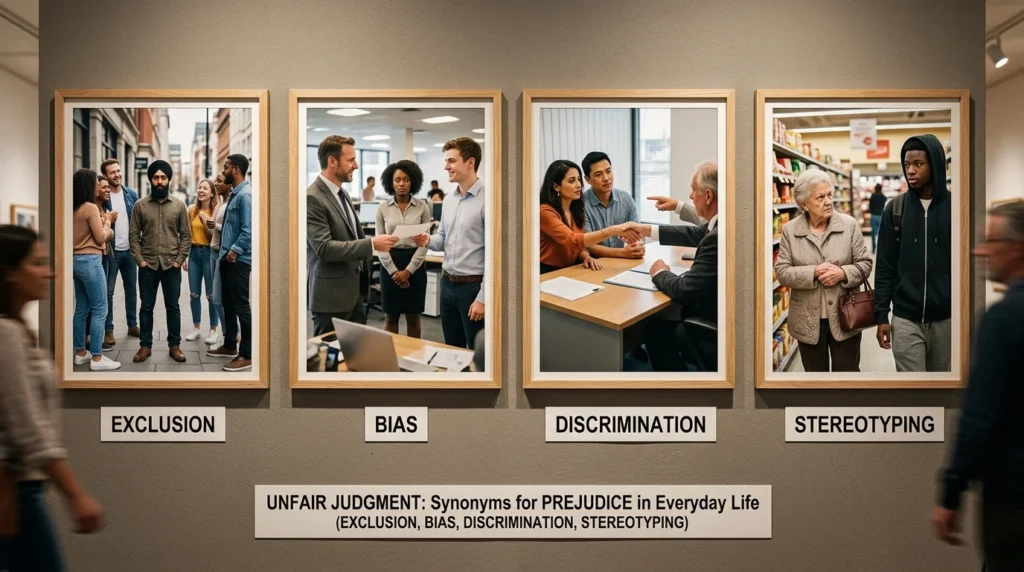
Quick Answer: What Are the Best Synonyms for Prejudice?
The closest synonyms for prejudice include bias, preconception, preconceived idea, preconceived notion, partiality, unfair judgment, intolerance, bigotry, narrow-mindedness, stereotyping, and discrimination. The best choice depends on the meaning. Use bias for a general preference or unfair tendency, bigotry for deep intolerance, and discrimination for unfair treatment.
Quick List of Synonyms for Prejudice
Here are useful alternatives grouped by meaning:
- Bias
- Preconception
- Preconceived idea
- Preconceived notion
- Prejudgment
- Partiality
- Favoritism
- Unfair judgment
- One-sidedness
- Subjectivity
- Stereotyping
- Generalization
- Assumption
- Presumption
- Misconception
- Ignorance
- Intolerance
- Bigotry
- Narrow-mindedness
- Closed-mindedness
- Hostility
- Antipathy
- Dislike
- Aversion
- Discrimination
- Racism
- Sexism
- Ageism
- Xenophobia
- Sectarianism
- Injustice
- Unfairness
- Predisposition
- Preconceived belief
- Negative attitude
- Unreasonable opinion
Some of these are direct synonyms, while others describe particular types, causes, or results of prejudice.
Closest Synonyms for Prejudice
1. Bias
Bias is one of the most common and flexible synonyms for prejudice. It means a tendency to favor or oppose someone or something without fully considering the facts.
- Relationship: Very close synonym
- Tone: Neutral to critical
- Best for: General, academic, professional, and everyday contexts
- Interchangeability: Often interchangeable, but bias can be less personal or less hostile
Example:
The hiring process was criticized for showing bias against older applicants.
Unlike prejudice, bias does not always involve hostility. A person can have a bias toward a particular brand, method, or viewpoint without actively disliking alternatives.
2. Preconception
A preconception is an idea or belief formed before someone has enough information or experience.
- Relationship: Close synonym
- Tone: Neutral or formal
- Best for: Academic writing, discussions, and careful analysis
- Interchangeability: Context-dependent
Example:
The study challenged common preconceptions about learning disabilities.
A preconception is not always unfair or harmful. It becomes similar to prejudice when it is unreasonable, rigid, or directed unfairly toward a person or group.
3. Preconceived Idea
A preconceived idea is an opinion formed in advance rather than based on new evidence.
- Relationship: Phrase-level synonym
- Tone: Neutral
- Best for: Explanations, essays, and general writing
- Interchangeability: Usually interchangeable when discussing prior judgments
Example:
The documentary encouraged viewers to question their preconceived ideas about poverty.
This phrase is often clearer than prejudice when the writer wants to emphasize that an opinion was formed too early.
4. Preconceived Notion
A preconceived notion has nearly the same meaning as preconceived idea, but it often suggests a belief that may be mistaken or difficult to change.
- Relationship: Close phrase-level synonym
- Tone: Neutral to formal
- Best for: Essays, reports, and thoughtful discussions
- Interchangeability: Usually interchangeable in suitable contexts
Example:
She began the course with a preconceived notion that science was too difficult.
5. Prejudgment
Prejudgment means forming an opinion before examining the facts or hearing all sides.
- Relationship: Very close synonym
- Tone: Formal
- Best for: Legal, academic, and analytical writing
- Interchangeability: Often interchangeable
Example:
The committee promised to evaluate the complaint without prejudgment.
Prejudgment focuses strongly on the timing of the judgment. It does not always suggest hatred or discrimination.
6. Partiality
Partiality means an unfair preference for one person, group, or side.
- Relationship: Contextual synonym
- Tone: Formal
- Best for: Formal writing, judgment, and decision-making
- Interchangeability: Context-dependent
Example:
The referee was accused of partiality toward the home team.
Partiality is especially useful when someone favors one side instead of remaining neutral.
7. Unfair Judgment
Unfair judgment describes an opinion or evaluation that lacks fairness or objectivity.
- Relationship: Explanatory synonym
- Tone: Neutral
- Best for: Clear, accessible writing
- Interchangeability: Often useful, but less concise
Example:
Assuming that someone is unreliable because of their accent is an unfair judgment.
This phrase is helpful when writing for general readers who may not know the precise meaning of prejudice.
Synonyms Related to Intolerance and Hostility
Some alternatives are stronger than prejudice. They should be used carefully.
8. Intolerance
Intolerance means an unwillingness to accept people, beliefs, practices, or opinions that differ from one’s own.
- Relationship: Related synonym
- Tone: Strongly critical
- Best for: Religion, culture, politics, social behavior, and human rights
- Interchangeability: Sometimes interchangeable
Example:
The organization works to reduce religious intolerance.
Prejudice may exist without open hostility. Intolerance usually suggests difficulty accepting differences.
9. Bigotry
Bigotry means stubborn, unreasonable prejudice against people with different identities, beliefs, or backgrounds.
- Relationship: Stronger synonym
- Tone: Strongly negative
- Best for: Serious criticism of discriminatory attitudes
- Interchangeability: Not always interchangeable
Example:
The speaker condemned bigotry in all its forms.
Bigotry suggests more than an uninformed assumption. It often involves deeply rooted hostility and refusal to reconsider one’s views.
10. Narrow-Mindedness
Narrow-mindedness means an unwillingness to consider different ideas, experiences, or ways of life.
- Relationship: Related synonym
- Tone: Critical
- Best for: General discussions of attitudes and beliefs
- Interchangeability: Context-dependent
Example:
Travel can help people overcome narrow-mindedness.
Narrow-mindedness is broader than prejudice. A person may be narrow-minded about art, education, or lifestyle without targeting a particular group.
11. Closed-Mindedness
Closed-mindedness refers to refusing to consider new information or viewpoints.
- Relationship: Related synonym
- Tone: Critical
- Best for: Discussions, education, relationships, and public debate
- Interchangeability: Not a perfect synonym
Example:
Closed-mindedness can prevent productive conversations.
Use this term when the main problem is resistance to new ideas rather than unfair treatment of a group.
12. Hostility
Hostility means unfriendly, aggressive, or openly negative behavior or feelings.
- Relationship: Related term
- Tone: Strong
- Best for: Describing behavior or emotional reactions
- Interchangeability: Not usually interchangeable
Example:
The minority community faced hostility from some local residents.
Prejudice is an attitude or judgment. Hostility describes a stronger emotional or behavioral response that may result from prejudice.
13. Antipathy
Antipathy means a strong feeling of dislike or opposition toward someone or something.
- Relationship: Related synonym
- Tone: Formal
- Best for: Formal descriptions of strong dislike
- Interchangeability: Context-dependent
Example:
His antipathy toward immigrants was clear from his remarks.
Antipathy describes dislike but does not necessarily prove that the dislike is based on an unfair belief.
14. Aversion
Aversion means a strong feeling of dislike or unwillingness to approach or accept something.
- Relationship: Related term
- Tone: Neutral to formal
- Best for: People, activities, ideas, or situations
- Interchangeability: Usually not interchangeable
Example:
Her aversion to unfamiliar cultures was based on limited experience.
An aversion may be personal or practical. It becomes similar to prejudice only when it involves an unfair or unsupported judgment.
Synonyms Related to Stereotypes and Assumptions
15. Stereotyping
Stereotyping means applying a simplified or fixed idea to all members of a group.
- Relationship: Related synonym
- Tone: Critical
- Best for: Social science, education, media, and cultural discussions
- Interchangeability: Context-dependent
Example:
Stereotyping can lead people to overlook individual differences.
A stereotype is a generalized belief. Prejudice is the unfair attitude or judgment that may develop from that belief.
16. Generalization
A generalization is a broad statement about a group or category based on limited information.
- Relationship: Broader related term
- Tone: Neutral to critical
- Best for: Academic and analytical writing
- Interchangeability: Not always interchangeable
Example:
The claim that all teenagers are irresponsible is an unfair generalization.
Not every generalization is prejudiced. Some generalizations are reasonable when supported by evidence.
17. Assumption
An assumption is something accepted as true without complete proof.
- Relationship: Broader related term
- Tone: Neutral
- Best for: Everyday, academic, and professional contexts
- Interchangeability: Usually not interchangeable
Example:
The assumption that quiet people lack confidence can be misleading.
An assumption becomes prejudice when it produces an unfair judgment about a person or group.
18. Presumption
A presumption is a belief accepted as likely true before all the facts are known.
- Relationship: Contextual synonym
- Tone: Formal
- Best for: Legal, academic, and formal contexts
- Interchangeability: Context-dependent
Example:
The decision was based on the presumption that the applicant lacked experience.
A presumption can be reasonable or unreasonable. Prejudice usually carries a stronger sense of unfairness.
19. Misconception
A misconception is an incorrect or mistaken belief.
- Relationship: Related term
- Tone: Neutral
- Best for: Education, science, and public information
- Interchangeability: Not always interchangeable
Example:
The lesson corrected several misconceptions about mental illness.
A misconception is false, but it is not necessarily directed against a particular person or group.
Synonyms Related to Unfair Treatment
20. Discrimination
Discrimination means treating a person or group unfairly because of a characteristic such as race, religion, sex, disability, age, or nationality.
- Relationship: Closely related term
- Tone: Formal and strongly critical
- Best for: Law, public policy, workplaces, education, and social issues
- Interchangeability: Not always interchangeable
Example:
The company introduced new policies to prevent workplace discrimination.
The key difference is that prejudice is usually an attitude or belief, while discrimination is unfair treatment or conduct. Prejudice can lead to discrimination, but the two words are not identical.
21. Injustice
Injustice means a lack of fairness or an unfair situation, action, or system.
- Relationship: Broader related term
- Tone: Strongly critical
- Best for: Law, politics, social issues, and ethics
- Interchangeability: Not usually interchangeable
Example:
The campaign sought to challenge racial injustice.
Injustice may result from prejudice or discrimination, but it can also involve unequal laws, corruption, or abuse of power.
22. Unfairness
Unfairness means a lack of fairness, equality, or impartiality.
- Relationship: Explanatory related term
- Tone: Neutral to critical
- Best for: General readers and everyday writing
- Interchangeability: Context-dependent
Example:
The unfairness of the decision became obvious after the evidence was reviewed.
23. Favoritism
Favoritism means giving unfair advantages to a particular person or group.
- Relationship: Contextual synonym
- Tone: Critical
- Best for: Schools, workplaces, organizations, and families
- Interchangeability: Not always interchangeable
Example:
Employees complained about favoritism in promotions.
Favoritism usually means unfair preference, not necessarily hostility toward another group.
Specific Forms of Prejudice
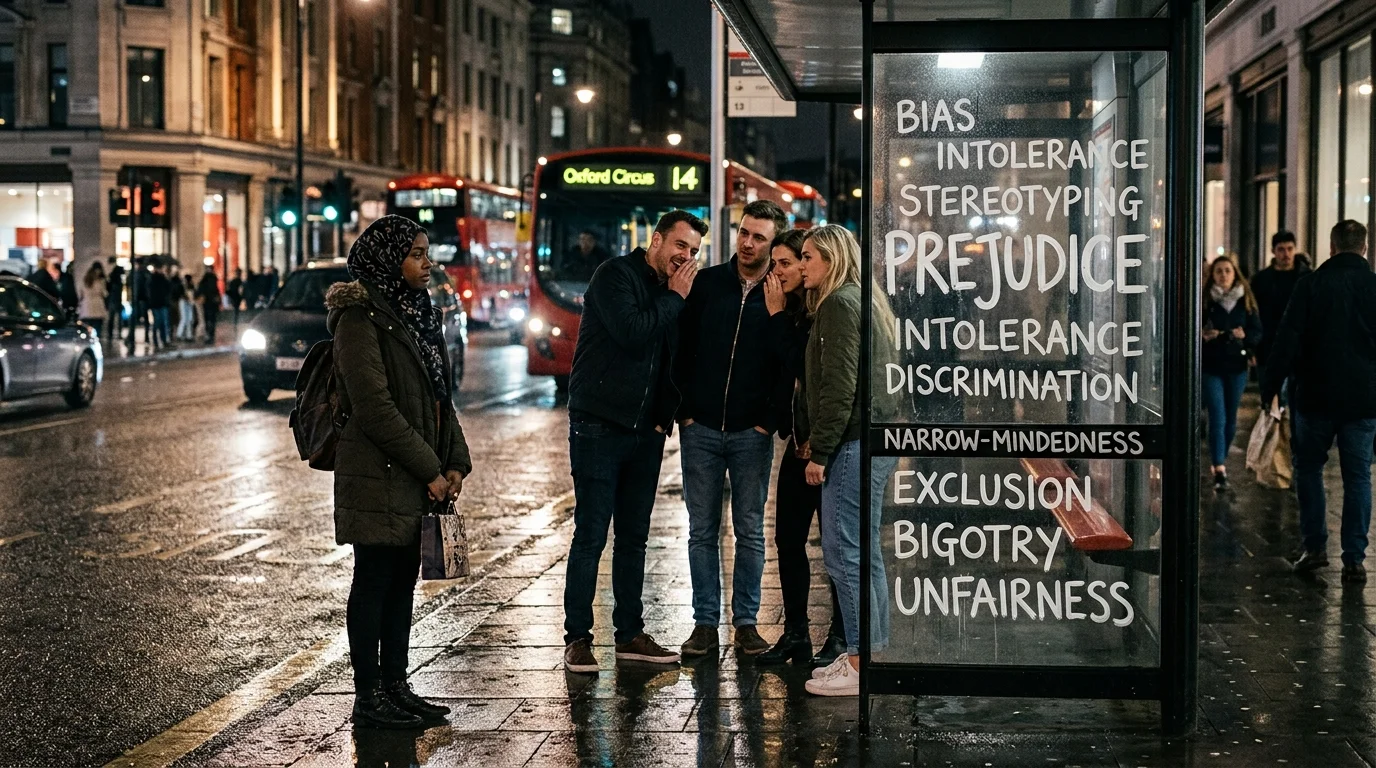
Some words describe particular types of prejudice. They are not general replacements in every sentence.
24. Racism
Racism is prejudice, discrimination, or unequal treatment based on race or racial identity.
Example:
The school introduced lessons designed to challenge racism.
Use racism only when race or racial identity is the relevant subject.
25. Sexism
Sexism is prejudice, discrimination, or unfair treatment based on sex or gender.
Example:
The organization adopted policies to address sexism in the workplace.
26. Ageism
Ageism is prejudice or discrimination based on a person’s age, especially against older or younger people.
Example:
Ageism can affect hiring decisions and promotion opportunities.
27. Xenophobia
Xenophobia is fear, dislike, or hostility toward foreigners, immigrants, or people perceived as outsiders.
Example:
The leaders spoke against xenophobia and anti-immigrant hatred.
Xenophobia is more specific than prejudice and often involves hostility toward people from other countries or cultures.
28. Sectarianism
Sectarianism is excessive loyalty to a particular religious, political, or social group, often accompanied by hostility toward other groups.
Example:
Sectarianism can deepen divisions within a community.
29. Classism
Classism is prejudice or discrimination based on social or economic class.
Example:
The novel explores classism and unequal access to education.
Comparison Table: Prejudice and Its Alternatives
| Alternative | Relationship | Can Replace “Prejudice”? | Tone | Best Context |
|---|---|---|---|---|
| Bias | Very close synonym | Often | Neutral to critical | General and professional |
| Preconception | Close synonym | Often | Neutral | Academic and analytical |
| Prejudgment | Close synonym | Often | Formal | Legal and formal writing |
| Partiality | Contextual synonym | Sometimes | Formal | Decisions and evaluations |
| Bigotry | Stronger synonym | Sometimes | Strongly negative | Deep intolerance |
| Intolerance | Related synonym | Sometimes | Critical | Beliefs and identities |
| Narrow-mindedness | Related term | Sometimes | Critical | Attitudes and viewpoints |
| Stereotyping | Related term | Sometimes | Critical | Groups and social beliefs |
| Assumption | Broader term | Rarely | Neutral | Everyday and academic |
| Misconception | Related term | Rarely | Neutral | Incorrect beliefs |
| Discrimination | Closely related term | Sometimes | Strongly critical | Unfair treatment |
| Favoritism | Contextual synonym | Sometimes | Critical | Unequal preference |
| Racism | Specific form | Only in racial contexts | Strongly critical | Race |
| Sexism | Specific form | Only in gender contexts | Strongly critical | Sex and gender |
| Xenophobia | Specific form | Only in outsider-related contexts | Strongly critical | Foreigners and immigrants |
A More Detailed Comparison
| Word or Phrase | Meaning | Tone | Strength | Best Use | Interchangeable? |
|---|---|---|---|---|---|
| Bias | A tendency to favor or oppose | Neutral to critical | Mild to moderate | General analysis | Often |
| Preconception | An opinion formed in advance | Neutral | Mild to moderate | Academic writing | Often |
| Prejudgment | Judgment before facts are known | Formal | Moderate | Legal or formal contexts | Often |
| Partiality | Unfair preference for one side | Formal | Moderate | Decisions and judgments | Sometimes |
| Stereotyping | Applying a fixed idea to a group | Critical | Moderate | Social discussions | Not always |
| Intolerance | Refusal to accept differences | Critical | Strong | Beliefs and identities | Sometimes |
| Bigotry | Deep, unreasonable intolerance | Strongly negative | Very strong | Serious criticism | Sometimes |
| Discrimination | Unfair treatment or conduct | Formal and critical | Strong | Law and policy | No |
| Racism | Race-based prejudice or discrimination | Strongly critical | Strong | Racial issues | Only specifically |
| Assumption | Belief accepted without proof | Neutral | Mild | General reasoning | Rarely |
Which Synonym for Prejudice Should You Choose?
Use “bias” for general situations
Choose bias when you mean an unfair tendency in judgment, hiring, reporting, research, or decision-making.
The survey may contain bias.
Use “preconception” for an opinion formed too early
Choose preconception when you want to emphasize that someone already had an idea before learning the facts.
The experiment challenged her preconceptions.
Use “prejudgment” for formal or legal writing
Choose prejudgment when someone reaches a conclusion before hearing all the evidence.
The panel must avoid prejudgment.
Use “bigotry” for deep intolerance
Choose bigotry when the attitude is stubborn, extreme, and hostile toward a group.
The speech was condemned as bigotry.
Use “discrimination” for unfair treatment
Choose discrimination when the issue involves actions, policies, decisions, or behavior rather than beliefs alone.
The policy may result in discrimination.
Use “stereotyping” for fixed group-based ideas
Choose stereotyping when someone treats all members of a group as if they share the same characteristics.
The advertisement relied on harmful stereotyping.
Use a specific term for a specific type
Use:
- Racism for race-based prejudice
- Sexism for gender-based prejudice
- Ageism for age-based prejudice
- Xenophobia for hostility toward foreigners or outsiders
- Classism for class-based prejudice
- Sectarianism for hostility between religious or political groups
Sentence Transformations: Replacing Prejudice Naturally
1. Original
The manager showed prejudice against younger workers.
Better alternative:
The manager showed bias against younger workers.
Why: Bias works well for unfair tendencies in workplace decisions.
2. Original
The course challenged students’ prejudice about immigrants.
Better alternative:
The course challenged students’ preconceived ideas about immigrants.
Why: Preconceived ideas emphasizes opinions formed before gaining accurate information.
3. Original
The judge tried to avoid prejudice.
Better alternative:
The judge tried to avoid prejudgment.
Why: Prejudgment is more precise in a legal or formal context.
4. Original
The organization fights prejudice based on race.
Better alternative:
The organization fights racism.
Why: Racism identifies the specific type of prejudice.
5. Original
The policy may encourage prejudice against disabled people.
Better alternative:
The policy may encourage discrimination against disabled people.
Why: Discrimination is suitable when the concern involves unfair treatment or policy effects.
6. Original
His prejudice prevented him from listening to other viewpoints.
Better alternative:
His narrow-mindedness prevented him from listening to other viewpoints.
Why: Narrow-mindedness highlights an unwillingness to consider different ideas.
7. Original
The article criticized religious prejudice.
Better alternative:
The article criticized religious intolerance.
Why: Intolerance emphasizes an unwillingness to accept different religious beliefs.
8. Original
The advertisement was criticized for prejudice.
Better alternative:
The advertisement was criticized for stereotyping.
Why: Stereotyping is more precise if the advertisement presents a group through a fixed or oversimplified image.
9. Original
The company promised to remove prejudice from its hiring process.
Better alternative:
The company promised to reduce bias in its hiring process.
Why: Bias is a natural term for unfair influence in evaluation and selection.
10. Original
The community faced prejudice from outsiders.
Better alternative:
The community faced hostility from outsiders.
Why: Hostility works when the prejudice appeared as openly unfriendly or aggressive behavior.
Grammar and Usage of “Prejudice”
Prejudice as a noun
Prejudice is usually an uncountable noun when it means an unfair attitude or belief.
- Prejudice can damage social trust.
- The campaign aims to challenge prejudice.
- She spoke against racial prejudice.
It can sometimes be plural in specialized contexts, especially when discussing different forms or instances of prejudice.
The book examines the prejudices of the period.
Common prepositions
Use prejudice against when identifying the target:
- prejudice against immigrants
- prejudice against women
- prejudice against people with disabilities
Use prejudice based on when explaining the cause:
- prejudice based on race
- prejudice based on religion
- prejudice based on social class
Use prejudice toward or prejudice towards when describing an attitude:
- prejudice toward outsiders
- prejudice towards unfamiliar traditions
Use without prejudice in formal or legal contexts:
The complaint was considered without prejudice.
Prejudice as a verb
As a verb, prejudice means to influence someone unfairly or harm someone’s position.
Examples:
- The early report may prejudice the jury.
- The decision could prejudice future negotiations.
- The publicity prejudiced public opinion against the defendant.
In this sense, prejudice does not always mean discrimination. It can mean causing harm, disadvantage, or an unfair influence.
Common Mistakes When Using Synonyms for Prejudice
1. Treating “bias” and “prejudice” as identical
They overlap, but bias is broader. It can refer to a preference in research, media, or personal judgment without involving hostility.
2. Using “discrimination” for every unfair opinion
Discrimination usually involves behavior, treatment, or policies. An unfair belief is more accurately called prejudice or bias.
3. Calling every assumption prejudice
An assumption is not automatically unfair. It becomes prejudiced when it is unreasonable, rigid, or directed unfairly toward a person or group.
4. Using “bigotry” for a mild preference
Bigotry is a strong word. It suggests deep and unreasonable intolerance, so it should not be used for ordinary disagreement.
5. Confusing stereotyping with prejudice
A stereotype is a generalized belief about a group. Prejudice is an unfair attitude or judgment. Stereotyping can contribute to prejudice, but the words describe different things.
6. Using specific terms without the correct subject
Do not use racism, sexism, or ageism unless race, gender, or age is actually involved.
7. Assuming “antipathy” always means prejudice
Antipathy means strong dislike. The dislike may be personal or reasonable, so it does not automatically indicate prejudice.
8. Replacing every use of “prejudice” with a stronger word
Words such as bigotry, hostility, and intolerance can make a statement more severe than the original. Choose them only when the context supports that strength.
When Not to Use a Synonym for Prejudice
Sometimes prejudice is the clearest and most accurate word. Keep it when:
- You are discussing unfair attitudes toward a person or group.
- The exact target of the unfair judgment matters.
- You want a broad term that includes different forms of unfair bias.
- The context involves social, cultural, racial, religious, or gender-based attitudes.
- A stronger term would exaggerate the situation.
- The issue involves an attitude rather than an action or policy.
For example, these sentences are not identical:
- Prejudice: The belief is unfair.
- Bias: The judgment is influenced in one direction.
- Stereotyping: A fixed idea is applied to a whole group.
- Discrimination: Someone is treated unfairly.
- Bigotry: The attitude is deeply intolerant.
- Hostility: The attitude is expressed through strong unfriendly behavior.
Writing Tips: How to Discuss Prejudice Clearly
- Identify the target. Explain who or what is being judged unfairly.
- Name the basis. State whether the prejudice concerns race, gender, religion, age, class, nationality, or another characteristic.
- Separate beliefs from actions. Use prejudice for attitudes and discrimination for unfair treatment.
- Avoid exaggeration. Reserve bigotry and hostility for stronger cases.
- Use precise language. Choose stereotyping for fixed group assumptions and bias for unfair influence in decisions.
- Give evidence when making a serious claim. A strong accusation should be supported by specific words, actions, policies, or patterns.
- Do not use synonyms only for variety. Repeat prejudice when it is more accurate than a weaker or stronger alternative.
Commonly Confused Words
Prejudice vs. bias
Both involve a tendency toward unfair judgment. Bias is broader and can occur in research, media, hiring, or personal preference. Prejudice more often refers to an unfair opinion about a person or group.
Prejudice vs. discrimination
Prejudice is generally an attitude or belief. Discrimination is unfair treatment, behavior, or policy.
Prejudice vs. stereotype
A stereotype is a simplified belief about a group. Prejudice is an unfair judgment that may grow from that belief.
Prejudice vs. intolerance
Intolerance means refusing to accept differences. It often involves prejudice but can also concern opinions, practices, or beliefs.
Prejudice vs. bigotry
Bigotry is a stronger term that suggests stubborn, unreasonable, and often hostile intolerance.
FAQs
What is the closest synonym for prejudice?
Bias is usually the closest general synonym. Depending on the sentence, preconception, prejudgment, or unfair judgment may be more precise.
Is “bias” the same as “prejudice”?
Not always. Bias is a broader term that can describe any tendency to favor or oppose something. Prejudice usually involves an unfair or unreasonable judgment, often about a person or group.
What is a strong synonym for prejudice?
Bigotry is a strong synonym when the prejudice involves deep, stubborn, and unreasonable intolerance. Hostility may fit when the attitude is openly unfriendly or aggressive.
What is the formal synonym for prejudice?
Depending on the context, formal alternatives include prejudgment, partiality, preconception, and subjectivity. Prejudgment is especially useful when someone reaches a conclusion before considering the facts.
What is the difference between prejudice and discrimination?
Prejudice is usually an unfair attitude or belief. Discrimination involves unfair treatment, decisions, behavior, or policies. Prejudice can lead to discrimination, but they are not identical.
What is the opposite of prejudice?
Possible opposites include fairness, impartiality, objectivity, open-mindedness, tolerance, acceptance, understanding, equality, and respect.
Can prejudice be positive?
The word prejudice normally carries a negative meaning because it involves an unfair or unreasonable judgment. A positive preference is usually better described as favor, preference, or inclination.
Related Questions
- What are the synonyms for bias?
- What are the differences between prejudice and discrimination?
- What are the synonyms for intolerance?
- What are examples of unconscious bias?
- What is the opposite of prejudice?
- What are the types of prejudice?
- How can people avoid making prejudiced judgments?
Editor’s Choice: The 5 Most Useful Alternatives
If you need only a few strong alternatives, choose these:
- Bias — the best general alternative
- Preconception — useful for opinions formed in advance
- Prejudgment — precise and formal
- Stereotyping — useful for fixed ideas about groups
- Discrimination — appropriate for unfair treatment or behavior
Key Takeaways
- Bias is the most flexible general synonym for prejudice.
- Preconception and prejudgment emphasize opinions formed too early.
- Bigotry and intolerance describe stronger forms of unfair or hostile attitudes.
- Stereotyping concerns fixed ideas about groups, while discrimination concerns unfair treatment.
- Use specific terms such as racism, sexism, ageism, or xenophobia only when the context clearly supports them.