
Quick Answer
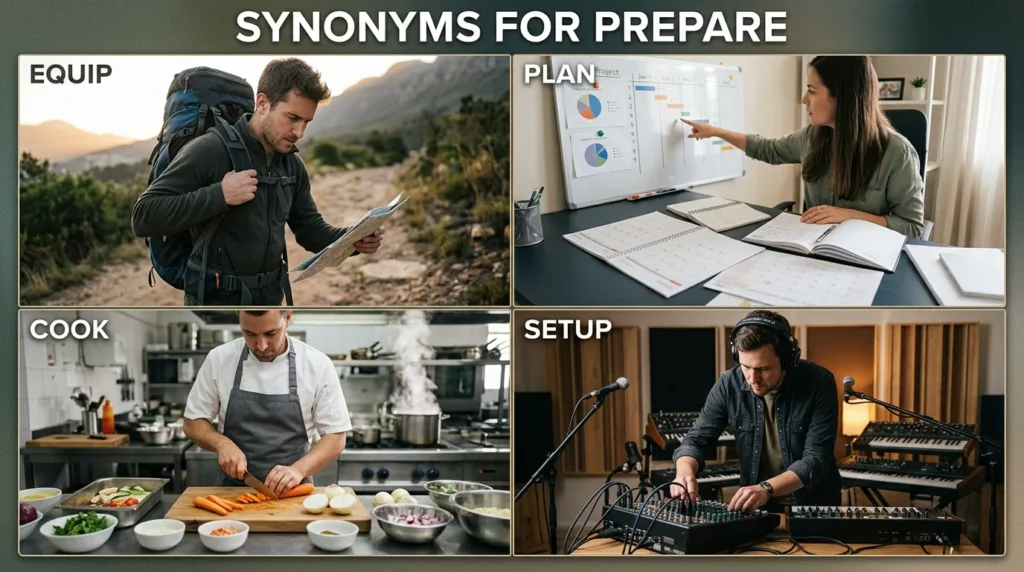
Some of the closest synonyms for prepare are get ready, arrange, organize, plan, equip, ready, set up, assemble, develop, practice, train, rehearse, formulate, compile, create, make, cook, condition, brief, and schedule.
Not all of these can replace prepare in every sentence. The word is broad, so choosing a more specific alternative can make your writing clearer.
Quick Synonym List
- Get Ready
- Ready
- Arrange
- Organize
- Plan
- Set Up
- Equip
- Assemble
- Gather
- Collect
- Compile
- Develop
- Formulate
- Create
- Make
- Produce
- Practice
- Train
- Rehearse
- Study
- Review
- Condition
- Brief
- Schedule
- Coordinate
- Establish
- Lay the Groundwork
- Put Together
- Get Set
- Make Ready
- Prepare for
- Gear Up
- Get in Shape
- Work Toward
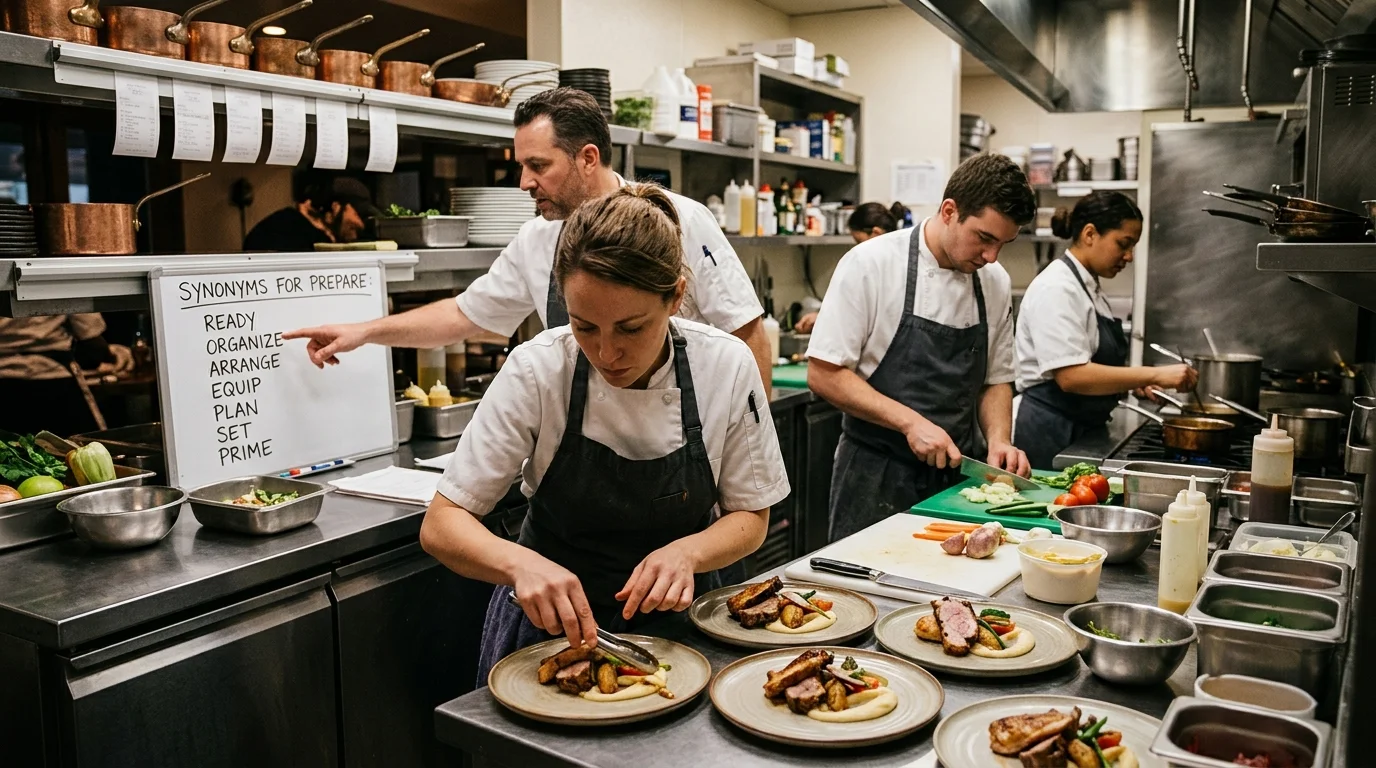
Synonyms for Prepare
Get Ready
Get ready is the closest everyday phrase for prepare. It means becoming ready for an event, activity, task, or situation.
I need to get ready for school.
It is natural and conversational, while prepare is often more suitable for formal or professional writing.
Ready
As a verb, ready means to make something or someone ready for use or action.
The staff readied the room for the meeting.
It is concise and slightly more formal or literary than get ready.
Arrange
Arrange means to organize things or make the necessary preparations for something to happen.
She arranged transportation for the guests.
It works especially well for logistics, appointments, events, objects, and practical details. It does not always mean preparing yourself.
Organize
Organize means to put things, information, people, or activities into an orderly and effective system.
We need to organize the materials before the presentation.
It overlaps with prepare when preparation involves arranging resources or information.
Plan
Plan means deciding in advance what you will do and how you will do it.
They planned the project several weeks in advance.
Planning is often part of preparation, but the words are not identical. You can prepare something without creating a detailed plan.
Set Up
Set up means to arrange something so it is ready to be used or begin.
The technician set up the equipment before the presentation.
It is common in everyday and workplace English, especially for rooms, equipment, systems, meetings, and activities.
Equip
Equip means to provide someone or something with the tools, resources, or abilities needed for a particular purpose.
The course equipped students with practical skills.
It is more specific than prepare because it focuses on providing what is needed.
Assemble
Assemble means to bring separate parts or people together.
The team assembled the materials needed for the experiment.
It can mean preparation when preparation involves gathering or putting components together.
Gather
Gather means to collect things, information, people, or resources in one place.
We gathered all the documents before the meeting.
It is useful when the main part of preparation is collecting what you need.
Collect
Collect emphasizes obtaining or bringing together items or information.
The researcher collected the data before analyzing it.
It is narrower than prepare because collecting is only one possible part of preparation.
Compile
Compile means to collect information or materials and organize them into a single document, list, report, or collection.
She compiled the research notes into a report.
This is particularly useful in academic, technical, and professional writing.
Develop
Develop means to create, improve, or gradually prepare something for a particular purpose.
The team developed a strategy for the upcoming campaign.
It works well for plans, strategies, skills, systems, programs, and ideas.
Formulate
Formulate means to develop something carefully and systematically, especially a plan, strategy, policy, theory, or response.
The committee formulated a new safety policy.
It is more formal and precise than prepare.
Create
Create means to make something new.
The teacher created a lesson plan for the class.
Creation can be part of preparation, but create does not necessarily imply that the thing is being made in advance for a specific event.
Make
Make is a broad everyday alternative that can replace prepare in certain contexts, especially food and simple objects.
She made dinner for the family.
However, make is much broader than prepare, so it does not fit every use.
Produce
Produce means to create, make, or provide something, often as a result of a process.
The team produced a detailed presentation.
It works particularly well for reports, documents, products, media, and other finished outputs.
Practice
Practice means repeatedly performing an activity to improve skill or become ready for a future performance.
The students practiced their speeches before the competition.
Practice is one way to prepare, but it does not replace prepare in every context.
Train
Train means to develop someone’s skills, abilities, or physical condition for a particular activity or role.
The athletes trained for months before the competition.
It is more specific than prepare because it involves systematic development of ability.
Rehearse
Rehearse means to practice a performance or presentation before doing it publicly.
The actors rehearsed the scene several times.
Use it for speeches, plays, concerts, presentations, ceremonies, and similar performances.
Study
Study can mean preparing for an examination, lesson, or academic task by learning information.
I need to study for tomorrow’s exam.
It is a specific type of preparation rather than a general synonym.
Review
Review means to look over information again in order to understand, check, or remember it.
She reviewed her notes before the test.
It is useful when preparation involves revisiting material rather than learning or creating something new.
Condition
Condition means to train or prepare someone or something to perform under particular conditions.
The runners conditioned their bodies for the long race.
It is commonly used in sports, physical training, and technical contexts.
Brief
Brief means to give someone the information they need before an event, task, or situation.
The manager briefed the team before the meeting.
It can overlap with prepare when preparing someone means giving them essential information.
Schedule
Schedule means to arrange an event or activity for a particular time.
We scheduled the meeting for Friday.
Scheduling can be part of preparation, but it does not mean getting everything ready.
Coordinate
Coordinate means to organize people, activities, or resources so they work together effectively.
She coordinated the arrangements for the conference.
This is especially useful in professional and organizational contexts.
Establish
Establish means to create or set something up on a firm or lasting basis.
The organization established a procedure for handling complaints.
It can overlap with prepare when preparation involves creating a system, process, or foundation.
Lay the Groundwork
Lay the groundwork means to take the initial steps needed to make a future action or result possible.
The early research laid the groundwork for the new project.
This phrase is useful when preparation happens over time and creates a foundation for later work.
Put Together
Put together is an informal phrase meaning to assemble, organize, or create something.
She put together a presentation for the meeting.
It is natural in conversation but less formal than prepare.
Get Set
Get set means become ready to begin something.
Everyone got set for the race.
It is informal and often used before an immediate activity.
Make Ready
Make ready means prepare something for use or action.
The crew made the equipment ready for the test.
It is grammatically correct but less common in everyday American English than prepare or get ready.
Gear Up
Gear up means prepare for an upcoming event, activity, or challenge, often with energy or determination.
The team is gearing up for the final round.
It is informal and often suggests active preparation.
Get in Shape
Get in shape means physically prepare yourself through exercise or training.
He spent several months getting in shape for the marathon.
It is much narrower than prepare.
Work Toward
Work toward means make gradual efforts to achieve a future goal.
The students worked toward completing the project before the deadline.
It emphasizes ongoing effort rather than simply becoming ready.
Prepare Has Several Different Meanings
The word prepare covers several related ideas, so context matters.
Getting someone or something ready
We prepared the room for the guests.
Good alternatives include ready, arrange, set up, organize, and get ready.
Planning for a future event
She prepared for the interview.
Depending on what she did, alternatives could include plan, practice, study, train, rehearse, or get ready.
Making food
He prepared dinner for the family.
Here, make or cook may sound more natural:
He cooked dinner for the family.
Creating a document or material
She prepared a report for the meeting.
Possible alternatives include compiled, created, produced, drafted, or put together, depending on how the report was made.
Training for a challenge
The athletes prepared for the competition.
More specific choices include trained, practiced, rehearsed, or conditioned.
Preparing someone with information
The manager prepared the staff for the changes.
Depending on the meaning, briefed, informed, trained, or equipped may be more precise.
Synonyms vs. Near Synonyms
| Word | Relationship to “prepare” | Can Replace Original? | Best Context |
|---|---|---|---|
| Get ready | Closest everyday alternative | Usually | General situations |
| Ready | Close synonym | Usually | Making something ready |
| Arrange | Contextual alternative | Sometimes | Logistics and details |
| Organize | Near synonym | Sometimes | Materials and activities |
| Plan | Related alternative | Sometimes | Future actions |
| Set up | Contextual alternative | Often | Equipment and events |
| Equip | Specific alternative | Sometimes | Providing resources |
| Assemble | Specific alternative | Sometimes | Parts and materials |
| Develop | Contextual alternative | Sometimes | Plans and strategies |
| Practice | Specific alternative | No | Skill preparation |
| Train | Specific alternative | No | Skill or physical preparation |
| Rehearse | Specific alternative | No | Performances |
| Compile | Specific alternative | Sometimes | Reports and information |
| Formulate | Formal alternative | Sometimes | Plans, policies, strategies |
| Brief | Specific alternative | Sometimes | Giving information |
| Schedule | Related alternative | No | Timing events |
| Coordinate | Contextual alternative | Sometimes | People and activities |
| Lay the groundwork | Phrase-level alternative | Sometimes | Long-term preparation |
How to Choose the Right Alternative
Use the word that describes the specific kind of preparation involved.
- General preparation: get ready, ready
- Planning: plan, develop, formulate
- Organization: organize, arrange, coordinate
- Equipment or resources: equip, assemble, gather
- Documents or information: compile, produce, create
- Skill development: train, practice, study
- Performance preparation: rehearse
- Giving information: brief
- Physical preparation: condition, get in shape
- Long-term preparation: lay the groundwork
- Informal conversation: get ready, put together, gear up
If the context does not require a more specific word, prepare is often the clearest choice.
Sentence Transformations
- She prepared for the exam.
→ She studied for the exam. - We prepared the room for the meeting.
→ We set up the room for the meeting. - They prepared a detailed report.
→ They compiled a detailed report. - The athletes prepared for the competition.
→ The athletes trained for the competition. - He prepared his speech several times.
→ He rehearsed his speech several times. - The manager prepared the employees for the changes.
→ The manager briefed the employees about the changes. - She prepared dinner for her family.
→ She cooked dinner for her family. - The team prepared a new strategy.
→ The team developed a new strategy. - We prepared all the materials before class.
→ We gathered all the materials before class. - The company prepared for future growth.
→ The company laid the groundwork for future growth.
Grammar and Usage
Prepare for + noun
Use prepare for when getting ready for an upcoming event, situation, or challenge.
We are preparing for the meeting.
She is preparing for the exam.
Prepare to + verb
Use prepare to when someone is getting ready to perform an action.
The team prepared to leave.
He prepared to answer the question.
Prepare something
Use prepare + object when making something ready.
She prepared the documents.
They prepared the room.
Prepare something for someone
This construction is common when creating or arranging something for another person.
He prepared dinner for his guests.
Prepare someone for something
Use this when helping another person become ready.
The training prepared employees for the new system.
Prepare someone to do something
The course prepared students to enter the workforce.
Prepare vs. preparation
Prepare is the verb:
We need to prepare for the event.
Preparation is the noun:
The preparation took several days.
Prepare vs. prepared
Prepared can mean ready:
Are you prepared for the test?
It can also describe something that has already been made:
The food was prepared in advance.
Common Mistakes
1. Confusing prepare with plan
Planning is often part of preparation, but prepare covers more than planning.
We planned the presentation.
We prepared the presentation.
The first emphasizes decisions about what will happen; the second can include creating materials, practicing, organizing, and other steps.
2. Using “prepare” when “practice” is more precise
I prepared my speech.
This is correct, but if you specifically mean repeated performance, practiced or rehearsed may communicate the action more clearly.
3. Confusing prepare with arrange
Arrange usually focuses on organizing details or objects.
She arranged transportation.
Prepare can include arranging transportation but has a much broader meaning.
4. Using “train” for every type of preparation
Train specifically involves developing skills, abilities, or physical condition.
You can train for a competition, but you do not normally train a report.
5. Confusing “prepare for” and “prepare to”
Use prepare for + noun:
We prepared for the interview.
Use prepare to + verb:
We prepared to leave.
6. Assuming “get ready” always works in formal writing
Get ready is perfectly natural, but prepare may be more appropriate for academic, business, and formal writing.
7. Using “make” as a universal replacement
Make works in some contexts:
She made dinner.
But it cannot replace prepare naturally in every sentence:
The training prepared employees for the new system.
“Made employees for the new system” does not have the same meaning.
8. Confusing prepare with prevent
Preparing for a problem means getting ready in case it happens. Preventing a problem means taking action to stop it from happening.
We prepared for the storm.
We prevented the damage.
Writing Tips
Use prepare when you want a broad, neutral word that covers several kinds of readiness.
Choose a more specific alternative when the exact action matters. Plan tells readers that you decided what to do. Organize shows that you put things in order. Practice shows repeated skill-building. Train suggests systematic development. Compile emphasizes gathering information into one place. Brief tells readers that you gave someone important information.
For formal writing, formulate, develop, compile, coordinate, and establish can sometimes provide more precision.
For casual writing, get ready, put together, get set, and gear up are more conversational.
The original word prepare is often preferable when several preparation steps are involved and you do not need to specify exactly which one occurred.
FAQs
What is the closest synonym for prepare?
Get ready is the closest everyday alternative to prepare. Ready is also a close verb synonym, especially when something is being made ready for use.
What is a professional synonym for prepare?
Depending on the context, organize, arrange, develop, formulate, compile, coordinate, equip, or brief can be more precise professional alternatives.
What is another word for prepare for an exam?
Useful alternatives include study, review, practice, train, and get ready, depending on how you are preparing.
She studied for the exam.
What is another word for prepare a report?
Depending on the process, you can say compile, create, produce, develop, draft, or put together a report.
What is another word for prepare for a meeting?
You can say get ready for, plan for, organize, arrange for, or brief yourself for a meeting, depending on the specific preparation.
Is “prepare” formal or informal?
Prepare is neutral and works in casual, professional, academic, and formal writing. Get ready is more conversational, while words such as formulate and compile are more specialized.
What is the difference between prepare and get ready?
They have almost the same basic meaning, but get ready is more conversational. Prepare is broader and works naturally in both everyday and formal contexts.
Key Takeaways
- Prepare means to make someone or something ready for a future action, event, task, or situation.
- Get ready is the closest everyday alternative, while ready is a concise verb with a similar meaning.
- Plan, organize, arrange, and coordinate describe specific parts of the preparation process.
- Practice, train, rehearse, study, and brief are more precise when preparation involves skills, performances, learning, or information.
- Use prepare when you want a broad, natural word and choose a narrower synonym when the exact type of preparation matters.