
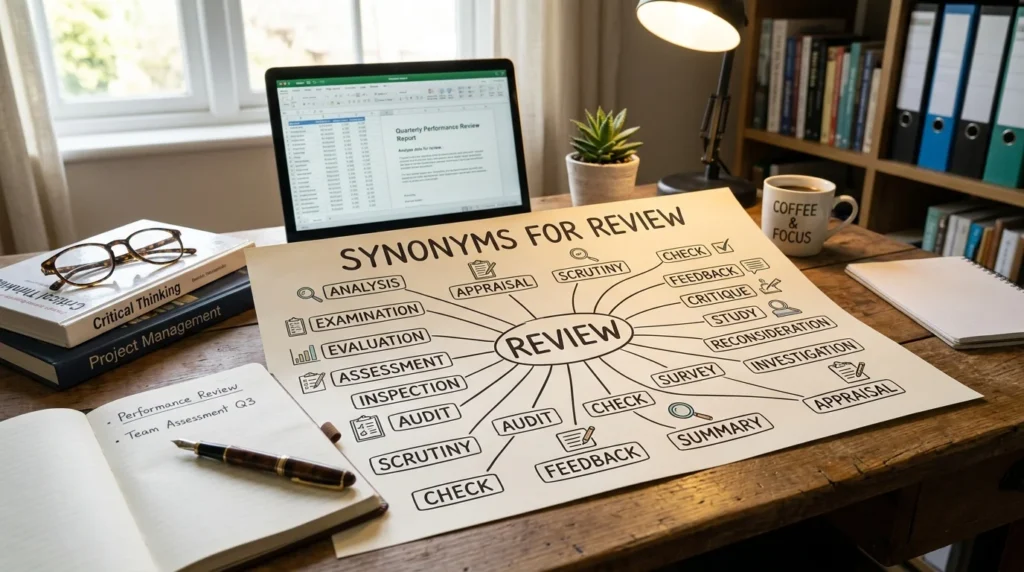
Quick Answer: What Are the Best Synonyms for Review?
The best synonyms for review include examine, inspect, assess, evaluate, analyze, study, consider, check, audit, survey, appraise, critique, revisit, reconsider, revise, summarize, recap, overview, commentary, assessment, evaluation, inspection, analysis, report, and appraisal. The best choice depends on whether review means examining, judging, studying, summarizing, or reconsidering something.
Quick List of Synonyms for Review
Review Meaning “Examine or Check”
- examine
- inspect
- check
- look over
- go through
- study
- assess
- verify
- scrutinize
- investigate
- audit
- survey
Review Meaning “Evaluate or Judge”
- evaluate
- assess
- appraise
- rate
- judge
- measure
- analyze
- critique
- test
- grade
- compare
Review Meaning “Study Again”
- revise
- reread
- revisit
- go over
- practice
- refresh
- recap
- review again
- study again
- brush up on
Review Meaning “Look Back At”
- revisit
- reconsider
- reflect on
- rethink
- look back on
- reassess
- reexamine
- reconsider
- recall
Review Meaning “Summarize”
- summarize
- recap
- outline
- overview
- discuss
- explain
- cover
- report on
- revisit
Review Meaning “Written Opinion”
- critique
- evaluation
- assessment
- appraisal
- commentary
- analysis
- report
- rating
- recommendation
- judgment
Closest Synonyms for Review
1. Examine
Meaning: To look at something carefully in order to understand or evaluate it.
Tone: Neutral to formal
Best for: Documents, evidence, reports, problems, objects, and information
Example:
“The manager will examine the report.”
Difference: Examine emphasizes careful inspection or study. It does not always include a final judgment.
2. Inspect
Meaning: To look at something closely, especially to check its condition, quality, or safety.
Tone: Neutral to formal
Best for: Equipment, buildings, products, systems, and documents
Example:
“The technician inspected the machine.”
Difference: Inspect often suggests a practical or official check.
3. Assess
Meaning: To judge the quality, importance, value, or condition of something.
Tone: Neutral to formal
Best for: Performance, risk, needs, progress, damage, and situations
Example:
“The teacher assessed the students’ progress.”
Difference: Assess emphasizes making a judgment based on information.
4. Evaluate
Meaning: To judge something carefully by considering its quality, effectiveness, or value.
Tone: Formal and professional
Best for: Programs, plans, research, performance, products, and decisions
Example:
“The committee will evaluate the proposal.”
Difference: Evaluate often involves comparing results with standards, goals, or criteria.
5. Analyze
Meaning: To study something by examining its parts, structure, or details.
Tone: Neutral to formal
Best for: Data, arguments, texts, research, problems, and systems
Example:
“The researchers analyzed the results.”
Difference: Analyze focuses on understanding how something works or what it means, rather than simply deciding whether it is good.
6. Check
Meaning: To look at something to make sure it is correct, safe, complete, or suitable.
Tone: Neutral and conversational
Best for: Everyday situations, documents, answers, schedules, and details
Example:
“Please check the report before sending it.”
Difference: Check is broader and more informal than review.
7. Study
Meaning: To examine or learn about something carefully.
Tone: Neutral
Best for: Subjects, documents, evidence, research, and learning material
Example:
“The team studied the available evidence.”
Difference: Study emphasizes learning or gaining understanding.
8. Consider
Meaning: To think carefully about something before making a decision.
Tone: Neutral
Best for: Options, proposals, ideas, requests, and decisions
Example:
“The board will consider the proposal.”
Difference: Consider focuses on thought and judgment rather than a detailed inspection.
9. Reassess
Meaning: To assess something again, often after new information becomes available.
Tone: Formal
Best for: Plans, risks, decisions, strategies, and performance
Example:
“The company reassessed its priorities.”
Difference: Reassess specifically means to evaluate again.
10. Revisit
Meaning: To return to a subject, idea, decision, or document for further thought or examination.
Tone: Neutral to formal
Best for: Plans, topics, policies, arguments, and earlier decisions
Example:
“We should revisit the proposal next week.”
Difference: Revisit suggests returning to something rather than examining it for the first time.
Formal and Professional Synonyms for Review
Evaluate
Use evaluate when you need to judge effectiveness, quality, value, or results.
“The department will evaluate the new training program.”
Assess
Use assess for risks, progress, performance, needs, or conditions.
“The doctor assessed the patient’s condition.”
Analyze
Use analyze when you need to understand details, causes, patterns, or relationships.
“The team analyzed the financial data.”
Inspect
Use inspect for physical condition, safety, compliance, or quality control.
“The officer inspected the facility.”
Audit
Use audit when checking financial records, procedures, or compliance systematically.
“An independent firm audited the company’s accounts.”
Audit is more specialized than review and usually suggests a structured, formal process.
Scrutinize
Use scrutinize when examining something very carefully, often because errors or problems may exist.
“The committee scrutinized the proposed contract.”
Scrutinize can imply suspicion or intense attention.
Appraise
Use appraise when judging value, quality, or worth.
“The expert appraised the antique.”
It is also used in workplace performance discussions:
“The manager appraised the employee’s performance.”
Verify
Use verify when checking whether something is true, accurate, or authentic.
“Please verify the information before publication.”
Verify is narrower than review because it focuses on confirmation.
Synonyms for Review Meaning “Study Again”
In education, review often means studying information again to remember or understand it better.
Useful alternatives include:
- revise
- reread
- go over
- revisit
- recap
- refresh
- practice
- study again
- brush up on
- rehearse
- review again
Revise
“I need to revise for tomorrow’s exam.”
Revise is especially common in British English for exam preparation. In American English, study or review is often more natural.
Go Over
“Let’s go over the main points again.”
This is conversational and common in classrooms and meetings.
Reread
“I reread the chapter before the test.”
Use reread when you specifically mean reading something again.
Brush Up On
“I need to brush up on my grammar.”
This informal phrase means to refresh a skill or area of knowledge.
Recap
“Let’s recap what we learned today.”
Recap focuses on briefly repeating the main points rather than studying every detail.
Synonyms for Review Meaning “Evaluate”
When review means judging something, use:
- assess
- evaluate
- appraise
- rate
- judge
- critique
- analyze
- measure
- grade
- compare
- rank
- test
Example
Original:
“The manager reviewed my performance.”
Possible alternatives:
“The manager assessed my performance.”
“The manager evaluated my performance.”
“The manager appraised my performance.”
The best choice depends on the process. Assess and evaluate are broad. Appraise often sounds more formal and may refer to an official performance evaluation.
Synonyms for Review Meaning “Examine a Document”
When reviewing a document, you might:
- examine it
- check it
- inspect it
- read it carefully
- look it over
- go through it
- analyze it
- proofread it
- edit it
- verify it
- scrutinize it
Important distinctions
Proofread means checking writing for spelling, grammar, punctuation, and formatting errors.
Edit means improving or changing writing, which may include correcting errors.
Analyze means studying meaning, structure, or information.
Review is broader and may include any or all of these activities.
Synonyms for Review Meaning “Look Back At”
When you return to something from the past, consider:
- revisit
- reconsider
- reassess
- reexamine
- rethink
- reflect on
- look back on
- return to
- reconsider
- review again
Reconsider
“The committee agreed to reconsider the decision.”
Reconsider means thinking about a decision or opinion again, often with the possibility of changing it.
Reflect On
“She reflected on her earlier experience.”
Reflect on emphasizes thoughtful consideration, often involving personal understanding.
Rethink
“We may need to rethink our strategy.”
Rethink is more conversational and often suggests changing an idea or plan.
Synonyms for Review Meaning “Summarize”
Sometimes review means giving a brief account of the main points.
Useful alternatives include:
- summarize
- recap
- outline
- overview
- discuss
- explain
- report on
- revisit
- cover
- go over
Summarize
“The final section summarizes the main findings.”
Summarize focuses on presenting the essential points briefly.
Overview
“The introduction provides an overview of the topic.”
Overview is usually a noun, not a direct verb replacement for review.
Recap
“The presenter recapped the main conclusions.”
Recap is informal and usually suggests a short summary.
Synonyms for Review as a Noun
When review is a noun, the alternatives depend on the intended meaning.
Review as an Evaluation
- assessment
- evaluation
- appraisal
- critique
- analysis
- inspection
- audit
- examination
- investigation
- report
“The annual performance review is next week.”
Possible alternative:
“The annual performance evaluation is next week.”
Review as a Written Opinion
- critique
- evaluation
- appraisal
- commentary
- analysis
- report
- rating
- assessment
- recommendation
- opinion
“I read a positive review of the restaurant.”
Possible alternative:
“I read a positive critique of the restaurant.”
However, critique often sounds more analytical and may be less natural for ordinary customer feedback.
Review as a Repeated Study Session
- revision
- recap
- refresher
- practice session
- study session
- repetition
- summary
“We had a review before the exam.”
Possible alternative:
“We had a revision session before the exam.”
In American English, review session or study session is often more natural.
Comparison Table: Synonyms for Review
| Alternative | Relationship | Can Replace Review? | Tone | Best Context |
|---|---|---|---|---|
| Examine | Close synonym | Usually | Neutral/Formal | Careful study |
| Inspect | Contextual synonym | Sometimes | Formal | Condition and safety |
| Check | Close everyday alternative | Usually | Neutral | Basic verification |
| Assess | Close synonym | Usually for judgment | Formal | Performance and risk |
| Evaluate | Close synonym | Usually for judgment | Formal | Quality and effectiveness |
| Analyze | Related alternative | Sometimes | Formal | Data and detailed study |
| Study | Close synonym | Sometimes | Neutral | Learning and research |
| Consider | Contextual alternative | Sometimes | Neutral | Decisions and options |
| Audit | Specialized alternative | Sometimes | Formal | Records and compliance |
| Scrutinize | Strong contextual synonym | Sometimes | Formal | Intensive examination |
| Appraise | Contextual synonym | Sometimes | Formal | Value and performance |
| Verify | Narrower alternative | Sometimes | Formal | Accuracy and truth |
| Revisit | Close contextual alternative | Sometimes | Neutral/Formal | Earlier topics or decisions |
| Reassess | Close synonym | Sometimes | Formal | Evaluation again |
| Reconsider | Contextual alternative | Sometimes | Neutral/Formal | Decisions and opinions |
| Revise | Contextual alternative | For study | Neutral | Exam preparation |
| Summarize | Contextual alternative | For summary | Neutral/Formal | Main points |
| Critique | Contextual synonym | Sometimes | Formal | Detailed judgment |
| Appraisal | Noun alternative | Sometimes | Formal | Value or performance |
| Evaluation | Noun alternative | Sometimes | Formal | Quality or results |
Meaning and Strength Comparison
| Word/Phrase | Meaning | Tone | Strength | Best Use | Interchangeable? |
|---|---|---|---|---|---|
| Review | Examine or evaluate | Neutral | Medium | General use | — |
| Check | Look for errors or problems | Neutral | Mild | Everyday tasks | Often |
| Examine | Study carefully | Neutral/Formal | Medium | Documents and evidence | Often |
| Inspect | Check condition closely | Formal | Medium | Objects and facilities | Sometimes |
| Assess | Judge condition or performance | Formal | Medium | Risk and progress | Often |
| Evaluate | Judge quality or effectiveness | Formal | Strong | Programs and plans | Often |
| Analyze | Study parts and relationships | Formal | Strong | Data and arguments | Sometimes |
| Scrutinize | Examine extremely carefully | Formal | Very strong | Suspicious or complex material | Rarely |
| Verify | Confirm accuracy or truth | Formal | Medium | Facts and records | Sometimes |
| Revisit | Examine again | Neutral | Medium | Earlier topics or decisions | Sometimes |
| Reassess | Evaluate again | Formal | Strong | Plans and risks | Sometimes |
| Reconsider | Think about again | Neutral/Formal | Medium | Decisions | Rarely |
| Revise | Study or change again | Neutral | Medium | Exams and writing | Context-dependent |
| Critique | Analyze and judge | Formal | Strong | Art, writing, ideas | Sometimes |
| Summarize | Present main points | Neutral/Formal | Medium | Reports and lessons | Rarely |
Which Synonym for Review Should You Choose?
For checking a document
Choose check, examine, proofread, edit, or inspect.
“Please review the document.”
“Please check the document for errors.”
For judging quality
Choose assess, evaluate, appraise, or rate.
“The panel evaluated the proposal.”
For studying before an exam
Choose study, revise, go over, or brush up on.
“I need to review my notes.”
“I need to go over my notes.”
For analyzing information
Choose analyze, examine, or scrutinize.
“The researchers analyzed the data.”
For checking official records
Choose audit, verify, or inspect.
“The accountant audited the records.”
For returning to an earlier topic
Choose revisit, reassess, reconsider, or reexamine.
“We should revisit the original plan.”
For summarizing information
Choose summarize, recap, or outline.
“Let’s recap the main points.”
For a written opinion about a product or service
Choose critique, assessment, evaluation, rating, or commentary.
“She wrote a detailed review of the book.”
Sentence Transformations
1. Original
“Please review the report.”
Better alternative:
“Please examine the report.”
Why: Examine emphasizes careful reading or inspection.
2. Original
“The manager reviewed my performance.”
Better alternative:
“The manager evaluated my performance.”
Why: Evaluate emphasizes judging performance against expectations or standards.
3. Original
“The technician reviewed the machine.”
Better alternative:
“The technician inspected the machine.”
Why: Inspect is more specific when checking equipment or physical condition.
4. Original
“We need to review the data.”
Better alternative:
“We need to analyze the data.”
Why: Analyze suggests studying patterns, details, or relationships in the data.
5. Original
“I will review my notes tonight.”
Better alternative:
“I will go over my notes tonight.”
Why: Go over is a natural conversational expression for studying material again.
6. Original
“The committee reviewed the proposal.”
Better alternative:
“The committee assessed the proposal.”
Why: Assess suggests judging the proposal’s quality, value, or suitability.
7. Original
“We should review the decision.”
Better alternative:
“We should reconsider the decision.”
Why: Reconsider suggests thinking about the decision again, possibly with the intention of changing it.
8. Original
“The company reviewed its safety procedures.”
Better alternative:
“The company reassessed its safety procedures.”
Why: Reassessed suggests evaluating the procedures again, perhaps because circumstances changed.
9. Original
“Let’s review what we learned.”
Better alternative:
“Let’s recap what we learned.”
Why: Recap is useful when briefly summarizing the main points.
10. Original
“She reviewed the book for a magazine.”
Better alternative:
“She wrote a critique of the book for a magazine.”
Why: Critique emphasizes analysis and judgment, although review remains more natural for many publications.
Grammar and Usage of Review
Review can function as a verb or a noun.
Review as a verb
It means to examine, evaluate, study again, or reconsider something.
“Please review the instructions.”
“The teacher reviewed the lesson.”
“The committee reviewed the evidence.”
Common patterns include:
- review a document
- review a report
- review a proposal
- review the evidence
- review the results
- review a decision
- review a policy
- review a contract
- review notes
- review material
- review performance
- review progress
Review as a noun
It can mean an examination, evaluation, written opinion, or study session.
“The report is under review.”
“She wrote a review of the film.”
“We have a review before the exam.”
Common noun phrases include:
- performance review
- annual review
- progress review
- project review
- policy review
- contract review
- safety review
- literature review
- book review
- product review
- peer review
- formal review
- detailed review
- critical review
- final review
Review + object
The verb review normally takes a direct object.
“We reviewed the report.”
Not:
“We reviewed about the report.”
Use review the report, not review about the report.
Review of
As a noun, review of is common.
“She wrote a review of the book.”
Review for
Use review for when preparing for an exam or checking something for a particular purpose.
“I need to review for my test.”
“The editor reviewed the article for errors.”
Review with
Use review with when examining something together with another person.
“I reviewed the plan with my supervisor.”

Common Collocations With Review
Verb + review
- conduct a review
- carry out a review
- complete a review
- perform a review
- undertake a review
- schedule a review
- request a review
- publish a review
- submit something for review
- approve a review
- finalize a review
Review + noun
- review a report
- review a proposal
- review a contract
- review a policy
- review a decision
- review the evidence
- review the data
- review the results
- review the material
- review the notes
- review performance
- review progress
Adjective + review
- detailed review
- formal review
- annual review
- independent review
- critical review
- comprehensive review
- preliminary review
- final review
- systematic review
- regular review
- thorough review
- peer review
Common Mistakes With Synonyms for Review
1. Assuming “review” always means “evaluate”
Review is broader. It may mean simply examining or studying something without making a judgment.
2. Using “audit” for every kind of review
An audit is usually a formal, systematic examination of records, finances, or compliance.
A casual reading of a document is not necessarily an audit.
3. Confusing “review” and “proofread”
Proofread specifically means checking written material for errors in spelling, grammar, punctuation, and formatting.
Review may involve content, structure, quality, accuracy, or overall suitability.
4. Confusing “review” and “revise”
Review means examining something.
Revise means changing or studying something again.
“Review your essay before revising it.”
5. Using “critique” as a completely neutral synonym
A critique usually involves analysis and judgment. It may include both strengths and weaknesses.
6. Confusing “review” and “summarize”
A summary presents the main points. A review may also include evaluation, criticism, or detailed examination.
7. Using “reconsider” when you only mean “read again”
Reconsider involves thinking about a decision or opinion again. It is not simply rereading a document.
8. Using “previously review”
The correct form depends on the sentence:
“The report was previously reviewed.”
or:
“The report was reviewed previously.”
9. Overusing formal words
Words such as scrutinize, appraise, and reassess are not always better than review. Use them only when they express a more specific meaning.
Review vs. Examine
Review is broad and can include examining, evaluating, summarizing, or reconsidering.
Examine focuses more on careful inspection or study.
“The committee reviewed the proposal.”
“The committee examined the proposal in detail.”
The second sentence emphasizes close study but does not necessarily say that the committee judged or approved the proposal.
Review vs. Evaluate
Review may simply mean looking at something.
Evaluate means judging its quality, value, effectiveness, or importance.
“The teacher reviewed the assignment.”
“The teacher evaluated the assignment.”
The first may mean the teacher read it. The second suggests that the teacher judged its quality or gave it a grade.
Review vs. Assess
Assess usually involves forming a judgment about condition, performance, risk, or progress.
“The doctor assessed the patient’s condition.”
Review is broader and may involve gathering information before an assessment.
Review vs. Inspect
Inspect is often practical and detailed, especially when checking physical condition, safety, or compliance.
“The engineer inspected the bridge.”
Review can involve documents, plans, or information about the bridge rather than the structure itself.
Review vs. Revise
Review means to examine something.
Revise means to change, improve, or study something again.
“Review your essay before you revise it.”
This distinction is especially important in academic and professional writing.
Review vs. Critique
A review can be descriptive, evaluative, or both.
A critique usually provides detailed analysis and judgment.
“The website published a review of the film.”
“The student wrote a critique of the film’s themes.”
When Not to Use a Synonym for Review
Keep review when:
- the meaning is broad
- you don’t know whether the activity involved checking, analyzing, or evaluating
- the audience needs simple language
- the context includes several kinds of examination
- you want a neutral professional term
- a more specific synonym would create a false impression
For example:
“The committee reviewed the proposal.”
This sentence is useful when you don’t need to explain whether the committee inspected, analyzed, assessed, or approved it.
Writing Tips for Using Synonyms for Review
Identify the main action
Ask what actually happened:
- Did someone look at something? → examine
- Did someone check for errors? → check or verify
- Did someone judge quality? → assess or evaluate
- Did someone inspect a physical object? → inspect
- Did someone study details? → analyze
- Did someone study again? → review, revise, or go over
- Did someone think about a decision again? → reconsider
- Did someone summarize information? → recap or summarize
- Did someone give detailed criticism? → critique
Match the register
For everyday communication:
“Can you check this document?”
For professional writing:
“Could you review this document?”
For a formal report:
“The committee evaluated the proposed policy.”
Avoid vague professional language
Words such as review, assess, and evaluate are useful, but they can become vague if you don’t explain what was examined or judged.
Instead of:
“The process was reviewed.”
You might write:
“The team examined the process for safety risks.”
The second sentence gives the reader more useful information.
Editor’s Choice: Best Alternatives to Review
- Examine — best for careful study
- Evaluate — best for judging quality or effectiveness
- Assess — best for condition, progress, and risk
- Inspect — best for physical condition and compliance
- Analyze — best for data, arguments, and detailed information
Related Questions
- What is another word for review?
- What is a formal synonym for review?
- What is a professional word for review?
- What is another word for review a document?
- What is a synonym for review and evaluate?
- What is another word for review a report?
- What is the difference between review and examine?
- What is the difference between review and evaluate?
- What is the difference between review and assess?
- What is another word for review in academic writing?
FAQs
What is the best synonym for review?
The best synonym depends on the meaning. Examine is useful for careful study, evaluate for judging quality, inspect for checking condition, and revisit for returning to an earlier topic.
What is a formal synonym for review?
Formal alternatives include examine, assess, evaluate, analyze, inspect, scrutinize, audit, appraise, and reassess. Each has a slightly different meaning.
What is a professional word for review?
Evaluate, assess, examine, and inspect are common professional alternatives. The best choice depends on whether you are checking, studying, or judging something.
What is another word for review a document?
You can say examine a document, check a document, inspect a document, analyze a document, proofread a document, or go through a document.
What is the difference between review and evaluate?
Review means to examine or consider something. Evaluate means to judge its quality, value, effectiveness, or importance.
What is the difference between review and revise?
Review means to examine something. Revise means to change, improve, or study something again.
Is “critique” a synonym for review?
Sometimes. Critique is appropriate when a review includes detailed analysis and judgment. It may sound too formal or negative for ordinary customer feedback.
What is another word for a product review?
Possible alternatives include product evaluation, product assessment, product critique, product appraisal, product report, and product rating. Product review remains the most natural general term.
Key Takeaways
- Review can mean examine, evaluate, study again, summarize, or reconsider.
- Use examine for careful study and inspect for checking condition or safety.
- Use assess or evaluate when judging quality, progress, risk, or effectiveness.
- Use revisit or reconsider when returning to an earlier topic or decision.
- Choose revise, recap, proofread, or critique only when they express the specific action you mean.
Conclusion
The word review is useful because it covers many related activities, from checking a document to evaluating performance or studying for an exam. However, a more specific synonym can make your writing clearer. Examine emphasizes careful study, inspect focuses on condition or safety, and analyze highlights detailed investigation. If you are judging quality or effectiveness, assess and evaluate are strong choices. For returning to an earlier subject, use revisit, reassess, or reconsider. When preparing for a test, go over, revise, and study again may sound more natural.
The best synonym is not necessarily the most formal one. Choose the word that accurately describes the action and fits your audience, purpose, and sentence structure.