
Quick Answer
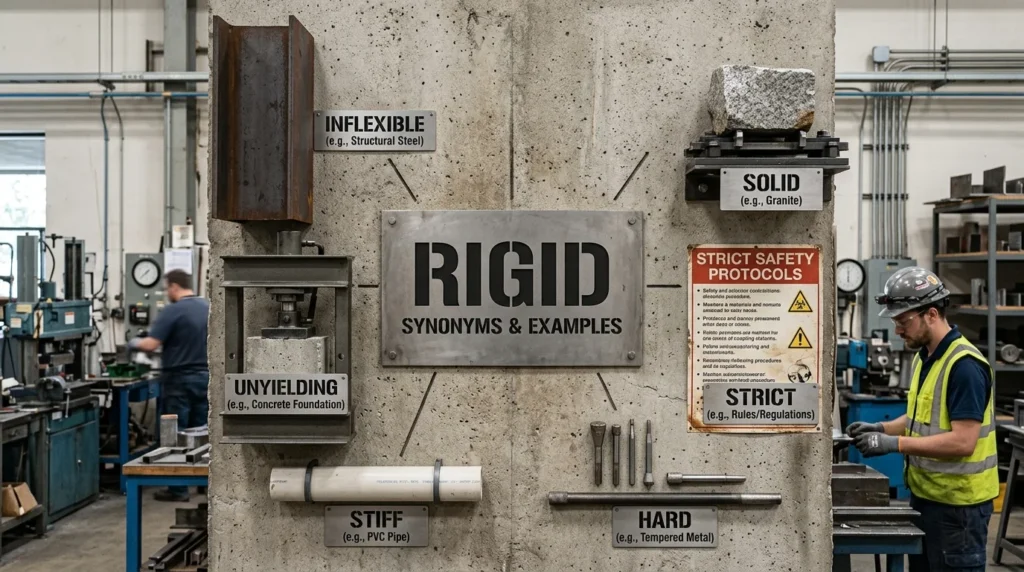
The closest synonyms for rigid include stiff, inflexible, unbending, unyielding, firm, fixed, strict, stringent, uncompromising, stern, hard, immovable, unalterable, and unyielding. For physical objects, use stiff, hard, solid, firm, or unbendable. For rules or behavior, use strict, inflexible, uncompromising, or stringent. For a person who refuses to change, stubborn, unyielding, or unbending may be more precise.
Quick Synonym List
- Stiff
- Inflexible
- Unbending
- Unyielding
- Firm
- Fixed
- Strict
- Stringent
- Uncompromising
- Stern
- Severe
- Hard
- Solid
- Unbendable
- Inelastic
- Unalterable
- Immovable
- Unwavering
- Unrelenting
- Unyielding
- Obstinate
- Stubborn
- Adamant
- Intransigent
- Unpliant
- Unchangeable
- Set
- Firmly fixed
- Cut-and-dried
- Formal
- Austere
- Exacting
- Rigorous
- Harsh
- Wooden
- Tense
- Taut
Not all of these are direct synonyms. Rigid can describe physical stiffness or resistance to change, and Cambridge’s thesaurus separates these uses into physical and behavioral/rule-related meanings.
Closest Synonyms
Stiff
Meaning: Difficult to bend, move, or change shape.
Tone: Neutral
Best for: Materials, objects, muscles, posture, movement
Example:
The material is stiff and difficult to fold.
How it differs: Stiff is particularly natural for physical things. It can also describe someone’s body or manner.
Interchangeability: Usually interchangeable for physical rigidity.
Inflexible
Meaning: Unable or unwilling to change.
Tone: Formal/professional
Best for: Rules, schedules, opinions, systems, people
Example:
The company has an inflexible work schedule.
How it differs: Inflexible strongly emphasizes a lack of adaptability or willingness to change.
Interchangeability: Usually interchangeable when rigid means unwilling to change.
Unbending
Meaning: Unwilling to change an opinion, decision, or position.
Tone: Formal
Best for: People, attitudes, opinions, positions
Example:
She remained unbending in her opposition to the proposal.
How it differs: It often describes a person’s determination not to compromise.
Interchangeability: Context-dependent.
Unyielding
Meaning: Refusing to bend, give way, or change.
Tone: Formal/strong
Best for: Materials, resistance, attitudes, determination
Example:
The committee faced unyielding opposition.
How it differs: Unyielding emphasizes resistance or refusal to give way.
Interchangeability: Often, but it can sound stronger than rigid.
Firm
Meaning: Solid, stable, or not easily changed.
Tone: Neutral
Best for: Materials, decisions, positions, rules
Example:
She took a firm position on the matter.
How it differs: Firm can be positive or neutral, whereas rigid often suggests excessive lack of flexibility.
Interchangeability: Sometimes.
Fixed
Meaning: Set in place or established so that it does not change.
Tone: Neutral
Best for: Positions, schedules, ideas, structures
Example:
The project has a fixed deadline.
How it differs: Fixed emphasizes being established or unchanging rather than necessarily being difficult to change.
Interchangeability: Context-dependent.
Strict
Meaning: Requiring rules or standards to be followed exactly.
Tone: Neutral/formal
Best for: Rules, regulations, discipline, requirements
Example:
The school has strict attendance rules.
How it differs: Strict is usually about rules or standards rather than physical stiffness.
Interchangeability: Usually when rigid describes rules.
Stringent
Meaning: Very strict and requiring careful compliance.
Tone: Formal/professional
Best for: Regulations, requirements, standards, controls
Example:
The industry is subject to stringent safety standards.
How it differs: Stringent emphasizes demanding requirements rather than a general lack of flexibility.
Interchangeability: Sometimes.
Uncompromising
Meaning: Unwilling to change a position or accept another option.
Tone: Formal/strong
Best for: People, attitudes, positions, policies
Example:
He took an uncompromising position during the negotiations.
How it differs: It specifically emphasizes a refusal to compromise.
Interchangeability: Often, when rigid refers to a person’s position.
Stern
Meaning: Serious, strict, and firm.
Tone: Formal
Best for: People, expressions, warnings, discipline
Example:
The manager gave him a stern warning.
How it differs: Stern describes seriousness or strictness, not physical rigidity.
Interchangeability: Rarely.
Unalterable
Meaning: Unable to be changed.
Tone: Formal
Best for: Decisions, conditions, facts, rules
Example:
The deadline is unalterable.
How it differs: It focuses directly on the impossibility of change.
Interchangeability: Context-dependent.
Formal and Professional Alternatives
In formal and professional writing, the best alternative depends on whether rigid refers to a rule, system, opinion, or physical structure.
| Alternative | Meaning | Tone | Best Use | Can Replace “Rigid”? |
|---|---|---|---|---|
| Inflexible | Unable or unwilling to change | Formal | Rules, systems, people | Usually |
| Stringent | Very strict | Formal | Standards, regulations | Sometimes |
| Uncompromising | Refusing to compromise | Formal | Positions, attitudes | Sometimes |
| Unyielding | Refusing to give way | Formal | Resistance, positions | Usually |
| Unbending | Refusing to change | Formal | People, views | Sometimes |
| Exacting | Demanding very high standards | Formal | Requirements | Context-dependent |
| Rigorous | Extremely thorough or strict | Professional | Methods, standards | Sometimes |
| Unalterable | Impossible to change | Formal | Conditions, decisions | Sometimes |
| Intransigent | Refusing to change a position | Formal | Political or organizational positions | Sometimes |
| Austere | Severe or plain | Formal | Style, environments | Rarely |
Inflexible
Inflexible is one of the strongest general alternatives when rigid means not adaptable.
The company’s rigid policy caused problems.
→
The company’s inflexible policy caused problems.
This works because both words can describe rules or systems that do not easily adapt.
Stringent
Use stringent when rules or requirements are particularly demanding.
The laboratory follows stringent safety procedures.
This does not necessarily imply that the procedures are unreasonable or unable to change.
Uncompromising
Use uncompromising when someone refuses to give up a position.
She has a rigid approach to negotiations.
→
She has an uncompromising approach to negotiations.
The second version more clearly emphasizes refusal to compromise.
Neutral and Everyday Alternatives
For everyday writing, these alternatives are usually easiest to understand:
- Stiff
- Firm
- Fixed
- Strict
- Inflexible
- Unchanging
- Hard
- Set
- Unbending
- Unyielding
Examples:
The chair has a rigid frame.
→ The chair has a stiff frame.
He follows a rigid routine.
→ He follows a strict routine.
She has a rigid way of thinking.
→ She has an inflexible way of thinking.
Casual Alternatives
There are fewer true casual synonyms for rigid, but some informal expressions can work depending on the meaning.
Set in Their Ways
This describes someone who does not want to change their habits or opinions.
He’s very set in his ways.
It is conversational rather than a direct synonym.
Stuck in Their Ways
This is more informal and usually has a negative tone.
She’s stuck in her ways and doesn’t want to try anything new.
Hard-Line
Hard-line describes a strict or uncompromising position.
The organization has taken a hard-line approach.
It is common in news, politics, business, and everyday discussion, but it is more specific than rigid.
Set
Set can describe something that has been firmly established.
The schedule is set.
It is much less negative than rigid.
Rigid vs. Near Synonyms
Rigid vs. Inflexible
These are often interchangeable when describing rules, systems, schedules, or opinions.
The rules are rigid.
The rules are inflexible.
Both suggest that the rules do not allow much change. Inflexible more directly emphasizes an inability or unwillingness to adapt.
Rigid vs. Stiff
These overlap when describing physical objects.
The material is rigid.
The material is stiff.
But stiff is more common in everyday descriptions of physical materials, while rigid often suggests that something is structurally fixed and difficult to bend.
Rigid vs. Strict
These overlap when describing rules.
The school has rigid rules.
The school has strict rules.
Strict emphasizes enforcement and compliance. Rigid emphasizes the lack of flexibility.
Rigid vs. Firm
She has a rigid position.
She has a firm position.
Firm can sound positive, suggesting confidence and determination.
Rigid often suggests that the person is unwilling to consider alternatives.
Rigid vs. Unyielding
Both can describe something that refuses to bend or change.
The material is rigid.
The material is unyielding.
But unyielding has a stronger sense of resistance and can sound more dramatic.
Rigid vs. Uncompromising
Uncompromising specifically describes someone who will not make concessions.
He has a rigid approach.
He has an uncompromising approach.
The second sentence focuses more strongly on refusal to compromise.
Rigid vs. Stubborn
Stubborn normally describes a person who refuses to change their mind or behavior.
He is stubborn.
Rigid can describe people, but it is much broader and can also describe objects, systems, rules, schedules, and ideas.
Comparison Table
| Word | Core Meaning | Tone | Strength | Best Use | Interchangeable? |
|---|---|---|---|---|---|
| Rigid | Stiff or resistant to change | Neutral/negative | Strong | General use | — |
| Stiff | Difficult to bend or move | Neutral | Moderate | Physical objects | Usually |
| Inflexible | Unable/unwilling to change | Formal | Strong | Rules, systems, people | Usually |
| Strict | Requiring exact compliance | Neutral/formal | Strong | Rules | Usually |
| Firm | Solid or strongly fixed | Neutral | Moderate | Positions, materials | Sometimes |
| Fixed | Set and unchanging | Neutral | Moderate | Schedules, positions | Sometimes |
| Unbending | Refusing to change | Formal | Strong | People, views | Sometimes |
| Unyielding | Refusing to give way | Formal | Strong | Resistance, materials | Usually |
| Stringent | Very strict | Formal | Strong | Standards, rules | Sometimes |
| Uncompromising | Refusing to compromise | Formal | Strong | Positions, people | Sometimes |
| Stern | Strict and serious | Formal | Strong | People, warnings | Rarely |
| Unalterable | Impossible to change | Formal | Strong | Decisions, conditions | Sometimes |
| Stubborn | Refusing to change one’s mind | Conversational | Strong | People | Sometimes |
| Hard-line | Strict or uncompromising | Informal/professional | Strong | Policies, positions | Sometimes |
| Solid | Firm and structurally strong | Neutral | Moderate | Physical objects | Sometimes |
How to Choose the Right Alternative
Use stiff for physical objects
The cardboard is stiff.
Use inflexible for a lack of adaptability
The schedule is inflexible.
Use strict for rules
The school has strict rules.
Use firm for a strong but reasonable position
She took a firm position.
Use fixed for something already set
We have a fixed deadline.
Use unyielding for strong resistance
They faced unyielding opposition.
Use uncompromising for refusal to compromise
He has an uncompromising attitude.
Use stringent for demanding requirements
The company follows stringent standards.
Use stubborn for a person who refuses to change
He can be stubborn about his routines.
Use unalterable when change is impossible
The terms are unalterable.
Sentence Transformations
1. Rigid rules
Original:
The company has rigid rules.
Alternative:
The company has strict rules.
Difference: Strict emphasizes compliance; rigid emphasizes lack of flexibility.
2. Rigid schedule
Original:
We have a rigid schedule.
Alternative:
We have an inflexible schedule.
Difference: Both emphasize that the schedule is difficult to change.
3. Rigid material
Original:
The material is rigid.
Alternative:
The material is stiff.
Difference: Stiff is a natural everyday choice for physical materials.
4. Rigid position
Original:
She took a rigid position.
Alternative:
She took an uncompromising position.
Difference: Uncompromising emphasizes her refusal to make concessions.
5. Rigid structure
Original:
The structure is rigid.
Alternative:
The structure is unyielding.
Difference: Unyielding emphasizes resistance to bending or movement.
6. Rigid thinking
Original:
His rigid thinking prevented him from considering alternatives.
Alternative:
His inflexible thinking prevented him from considering alternatives.
Difference: Inflexible clearly communicates an inability or unwillingness to adapt.
7. Rigid deadline
Original:
The project has a rigid deadline.
Alternative:
The project has a fixed deadline.
Difference: Fixed emphasizes that the date has already been established.
8. Rigid approach
Original:
The manager has a rigid approach to the problem.
Alternative:
The manager has an inflexible approach to the problem.
Difference: Inflexible more directly highlights the lack of adaptability.
Grammar and Usage
Rigid is an adjective.
Common patterns include:
- rigid rules
- rigid structure
- rigid schedule
- rigid system
- rigid framework
- rigid approach
- rigid thinking
- rigid requirements
- rigid position
- rigid discipline
- rigid material
- rigid plastic
Examples:
The organization follows a rigid structure.
The material is rigid and difficult to bend.
She has a rigid approach to problem-solving.
Cambridge identifies the two major senses as being stiff or fixed physically and unable to be changed or persuaded.
Rigid with people
When used to describe a person, rigid can suggest that they are strict, inflexible, or unwilling to consider alternatives.
He has a rigid way of thinking.
This is usually more critical than:
He has a firm way of thinking.
Rigid vs. rigidly
Rigid is the adjective:
The system is rigid.
Rigidly is the adverb:
The rules are rigidly enforced.
The noun is rigidity:
The rigidity of the system makes adaptation difficult.
Common Mistakes
1. Using “strict” for physical objects
The plastic is strict.
This is incorrect.
Better:
The plastic is rigid.
or
The plastic is stiff.
2. Using “stiff” for every abstract meaning
The company has a stiff policy.
This can work in some contexts, but strict or inflexible is usually clearer.
3. Assuming “firm” always means “rigid”
Firm can suggest strength and stability without implying excessive inflexibility.
She took a firm position.
This does not necessarily mean she refused to consider other views.
4. Using “stubborn” for systems
The computer system is stubborn.
This personifies the system and changes the tone.
Better:
The computer system is inflexible.
5. Confusing “rigorous” with “rigid”
Rigorous means thorough, exact, or demanding.
The researchers used rigorous methods.
Rigid means stiff or resistant to change.
The researchers followed a rigid procedure.
A procedure can be both, but the words describe different qualities.
6. Using “unyielding” when simple language is better
The company’s unyielding schedule…
This is grammatical but may sound unnecessarily formal.
The company’s inflexible schedule…
is often clearer.
7. Assuming rigid is always negative
A rigid structure can sometimes be useful when stability is required. However, when describing rules, systems, or people, rigid often carries a critical implication because it suggests too little flexibility. Cambridge labels the relevant rule/interpretation sense as disapproving.
Commonly Confused Words
Rigid vs. Rigorous
Rigid = unable or unwilling to bend or change.
Rigorous = thorough, exact, and demanding.
rigid rules
rigorous testing
They are not interchangeable.
Rigid vs. Strict
Rigid = little or no flexibility.
Strict = strong enforcement of rules or standards.
a rigid schedule
strict attendance rules
They overlap, but the emphasis differs.
Rigid vs. Firm
Firm = strong, stable, or definite.
Rigid = fixed and resistant to change.
a firm decision
can sound confident.
a rigid decision
can suggest that the decision will not be reconsidered.
Rigid vs. Stubborn
Stubborn generally describes a person who refuses to change their mind or behavior.
Rigid can describe people, but also objects, systems, rules, schedules, and ideas.
When Not to Use an Alternative
Sometimes rigid is more precise than its synonyms.
For example:
The frame is rigid.
This specifically tells the reader that the frame is structurally stiff and does not bend easily. Using strict would be incorrect, while firm may not communicate the same physical property.
Likewise:
The company operates under a rigid system.
Here, rigid communicates more than “strict.” It suggests that the system allows little room for adaptation.
Use a synonym only when it preserves the specific kind of rigidity you mean.
Writing Tips
Identify the type of rigidity first
- Physical stiffness → stiff, hard, solid, unbendable
- Rules → strict, stringent
- Schedules → fixed, inflexible
- Opinions → unbending, inflexible
- Positions → firm, uncompromising
- Resistance → unyielding
- People → stubborn, inflexible, unbending
- Systems → inflexible, fixed, unadaptable
Don’t confuse strength with inflexibility
A firm position can be reasonable and deliberate. A rigid position suggests there is little or no willingness to adjust.
Use “inflexible” for professional writing
When discussing policies, systems, schedules, or working arrangements, inflexible is often a clear and natural choice. Cambridge specifically uses inflexible for situations that cannot adapt to changing conditions.
Reserve stronger words for stronger meanings
Uncompromising, intransigent, and unyielding can sound stronger than rigid. Use them when the context truly involves strong resistance to change or compromise.
FAQs
1. What is the closest synonym for rigid?
Inflexible is one of the closest general synonyms when rigid means unable or unwilling to change. Stiff is a close synonym when rigid describes something physical.
2. What is a professional synonym for rigid?
Useful professional alternatives include inflexible, stringent, fixed, unyielding, uncompromising, and rigorous, depending on the context. These words are not identical, so the specific meaning matters.
3. What is a synonym for rigid rules?
Common alternatives include strict rules, inflexible rules, stringent rules, and uncompromising rules. Strict is usually the most natural everyday choice.
4. What is a synonym for rigid in terms of personality?
Depending on the intended meaning, you can use inflexible, stubborn, unbending, unyielding, uncompromising, or intransigent. Each emphasizes a different aspect of resistance to change.
5. What is a synonym for rigid physically?
Stiff, hard, solid, firm, unbendable, and inelastic can describe something that is difficult to bend or deform.
6. What is the difference between rigid and inflexible?
Both can mean resistant to change. Rigid can describe both physical stiffness and resistance to change, while inflexible strongly emphasizes an inability or unwillingness to adapt.
7. What is the opposite of rigid?
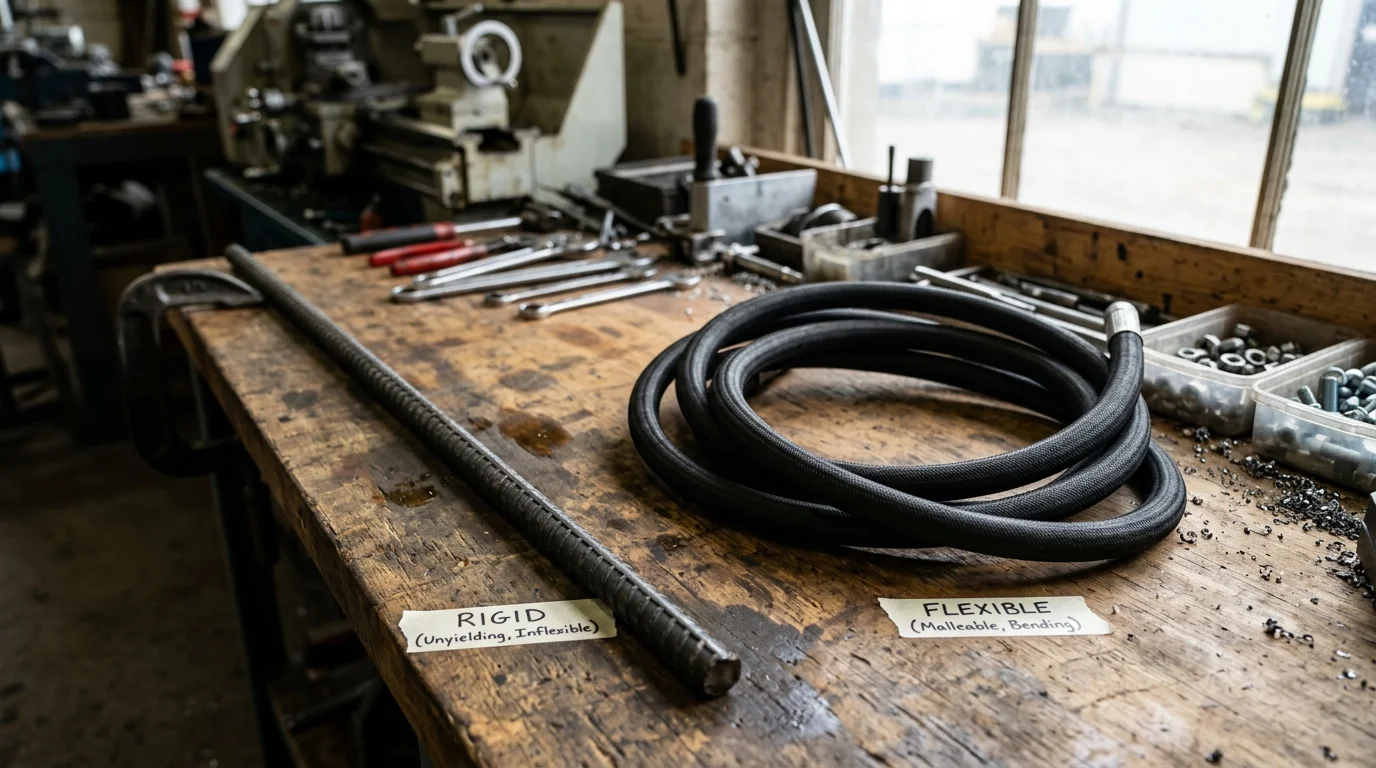
Common opposites include flexible, adaptable, pliable, supple, elastic, and lenient, depending on the meaning. A physical object may be flexible or pliable, while a rule or person may be flexible or open-minded.
Editor’s Choice
For different meanings, these alternatives are especially useful:
- Stiff — physical objects and materials
- Inflexible — systems, rules, schedules, and behavior
- Strict — rules and standards
- Unyielding — strong resistance
- Uncompromising — refusal to make concessions
These are use-case choices rather than an overall ranking.
Key Takeaways
- Rigid has two major meanings: physically stiff or resistant to change.
- Stiff, hard, solid, and unbendable work best for physical rigidity.
- Inflexible, strict, and stringent are useful for rules, systems, and schedules.
- Unyielding, unbending, and uncompromising emphasize strong resistance to change or compromise.
- Choose the synonym based on whether you mean physical stiffness, strictness, lack of flexibility, or refusal to change.
Internal Link Opportunities
- Synonyms for inflexible — directly expands the most important abstract meaning of rigid.
- Synonyms for strict — useful for rules, standards, and requirements.
- Synonyms for stiff — covers the physical meaning of rigid.
- Synonyms for firm — explores the difference between strength and inflexibility.
- Synonyms for stubborn — useful for the personality-related meaning.
- Synonyms for strict — supports rules and discipline vocabulary.
- Synonyms for flexible — useful as a contrasting vocabulary topic.
- Synonyms for unyielding — explores strong resistance and determination.