
Quick Answer
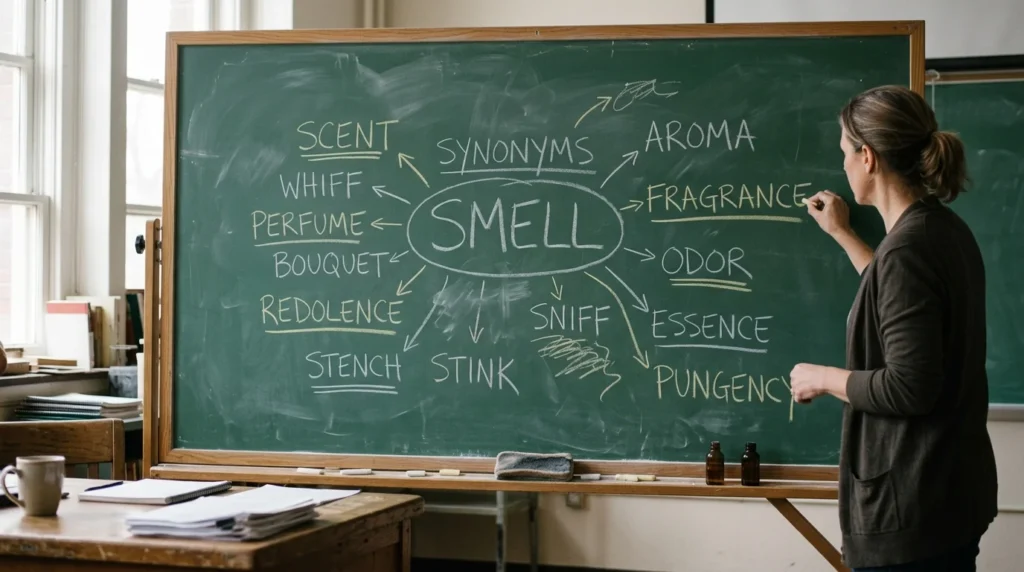
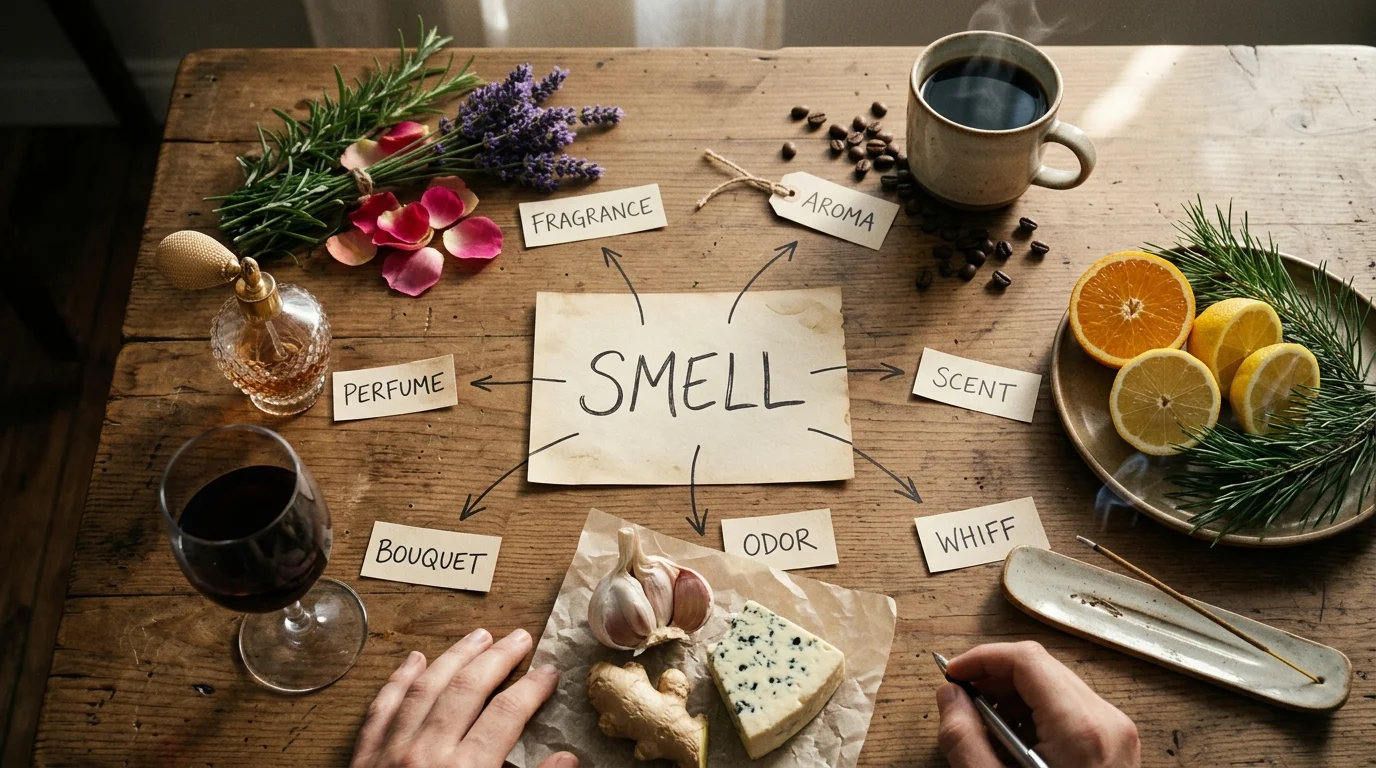
The best synonyms for smell include scent, aroma, fragrance, odor, perfume, bouquet, whiff, essence, stench, stink, reek, and fume. Use scent for a neutral term, aroma or fragrance for pleasant smells, and odor, stench, or stink for unpleasant ones.
Quick List of Synonyms for Smell
Neutral or General
- scent
- odor
- aroma
- smell
- essence
- fragrance
- whiff
- trace
- hint
- scent trail
Pleasant Smells
- aroma
- fragrance
- perfume
- bouquet
- sweetness
- freshness
- scent
- essence
- floral scent
- pleasant aroma
Unpleasant Smells
- odor
- stench
- stink
- reek
- foulness
- malodor
- bad odor
- unpleasant odor
- rankness
- funk
Strong or Noticeable Smells
- pungency
- intensity
- reek
- stench
- fumes
- aroma
- fragrance
- whiff
- odor
Faint or Brief Smells
- whiff
- hint
- trace
- suggestion
- trace scent
- faint aroma
Closest Synonyms for Smell
Scent
Scent is one of the closest and most versatile synonyms for smell.
It usually refers to a distinctive smell that can be detected by the nose. It can be pleasant, neutral, or sometimes unpleasant.
- “I noticed a strange smell.”
- “I noticed a strange scent.”
Tone: Neutral
Best for: General descriptions, nature, food, animals, perfumes, and everyday writing.
Odor
Odor means a smell, but it often carries a mildly negative association in everyday American English.
- “There was an unusual odor in the room.”
In technical, scientific, medical, and formal contexts, odor can be completely neutral.
Tone: Neutral to slightly negative
Best for: Formal, technical, scientific, and descriptive writing.
Aroma
Aroma usually describes a noticeable and pleasant smell, especially from food, coffee, spices, or plants.
- “The aroma of fresh coffee filled the kitchen.”
Tone: Pleasant, sensory
Best for: Food, drinks, cooking, flowers, and descriptive writing.
Fragrance
Fragrance usually refers to a pleasant smell, particularly from flowers, perfume, cosmetics, or scented products.
- “The fragrance of roses filled the garden.”
Tone: Pleasant, elegant
Best for: Perfume, flowers, beauty products, and literary descriptions.
Perfume
Perfume can mean a pleasant scent, especially one created or used intentionally.
- “The room had the perfume of fresh flowers.”
It can also specifically mean a scented cosmetic product.
Watch out: Perfume is more specific than smell.
Synonyms for a Pleasant Smell
When you want to make it clear that a smell is attractive or enjoyable, use words such as:
- aroma
- fragrance
- perfume
- bouquet
- sweetness
- freshness
- pleasant scent
- delightful aroma
- floral scent
- enticing aroma
Aroma
Best for food and drinks:
“The rich aroma of freshly baked bread filled the kitchen.”
Fragrance
Best for flowers and scented products:
“The fragrance of jasmine drifted through the garden.”
Bouquet
Bouquet is a specialized term often used for the combined smell of wine, flowers, or other things with complex aromas.
- “The wine has a delicate floral bouquet.”
It isn’t a general synonym for smell.
Perfume
Use perfume when the scent is particularly pleasant or deliberately created.
- “The room was filled with the perfume of roses.”
Synonyms for a Bad Smell
When smell means something unpleasant, choose a word that matches the intensity.
Odor
A relatively neutral or mildly negative choice:
- “There was a strange odor coming from the kitchen.”
Stench
Stench means a very unpleasant and powerful smell.
- “A terrible stench came from the garbage.”
Strength: Strong
Tone: Negative
Stink
Stink is an informal word for a very bad smell.
- “There was a terrible stink in the room.”
Tone: Informal, direct
Reek
Reek can be a noun or verb and suggests a very strong, unpleasant smell.
- “The room had a reek of smoke.”
- “The garbage reeked.”
As a verb, reek is particularly useful when describing something that gives off a strong bad smell.
Malodor
Malodor means an unpleasant or offensive odor.
- “The researchers investigated the source of the malodor.”
Tone: Formal, technical
Synonyms for a Faint Smell
If the smell is weak or only briefly noticeable, these words work better:
- whiff
- hint
- trace
- suggestion
- trace scent
- faint aroma
Whiff
A whiff is a brief or small amount of a smell.
- “I caught a whiff of fresh bread.”
Hint
A hint can describe a small amount of a particular smell.
- “There was a hint of citrus in the drink.”
Trace
A trace refers to a very small amount.
- “A trace of smoke remained in the air.”
Synonyms for Smell as a Verb
Smell has several meanings as a verb.
Detect a Smell
When you mean “notice something through your sense of smell,” alternatives include:
- detect
- notice
- sense
- perceive
- pick up
- catch
- identify
Example:
“I smelled smoke.”
Possible alternatives:
“I detected smoke.”
“I noticed the smell of smoke.”
“I caught a whiff of smoke.”
These aren’t all exact replacements. Detect emphasizes noticing, while catch a whiff suggests a brief or small amount.
Have a Particular Smell
When something produces a scent:
- scent
- smell of
- give off
- emit
- exude
- reek of
Examples:
“The flowers smell wonderful.”
“The flowers give off a wonderful fragrance.”
“The flowers emit a pleasant scent.”
Smell Bad
Useful alternatives include:
- stink
- reek
- smell foul
- smell unpleasant
- give off an unpleasant odor
Examples:
- “The garbage stinks.”
- “The garbage reeks.”
- “The garbage gives off a foul odor.”
Comparison Table: Synonyms for Smell
| Alternative | Relationship | Can Replace “Smell”? | Tone | Best Context |
|---|---|---|---|---|
| Scent | Close synonym | Usually | Neutral | General use |
| Odor | Close synonym | Usually | Neutral/slightly negative | Formal and general |
| Aroma | Near synonym | Usually for pleasant smells | Pleasant | Food and drinks |
| Fragrance | Near synonym | Usually for pleasant smells | Elegant | Flowers and perfume |
| Perfume | Contextual | Sometimes | Pleasant | Cosmetics and flowers |
| Bouquet | Specialized | Limited | Refined | Wine and complex scents |
| Whiff | Narrower | Limited | Neutral | Brief/faint smell |
| Hint | Contextual | Limited | Neutral | Subtle scents |
| Stench | Strong synonym | Only for bad smells | Strongly negative | Very unpleasant smells |
| Stink | Near synonym | Only for bad smells | Informal/negative | Everyday speech |
| Reek | Strong synonym | Limited | Strongly negative | Very strong bad smells |
| Malodor | Close synonym | Usually | Formal/technical | Scientific and formal writing |
| Fume | Related term | Limited | Often negative | Smoke, chemicals, vapors |
| Essence | Related term | Sometimes | Literary | Abstract or descriptive writing |
Meaning and Strength Comparison
| Word/Phrase | Meaning | Tone | Strength | Best Use | Interchangeable? |
|---|---|---|---|---|---|
| Smell | General scent detected by the nose | Neutral | Any | General use | — |
| Scent | Distinctive smell | Neutral | Mild to strong | General descriptions | Often |
| Odor | Detectable smell | Neutral/slightly negative | Mild to strong | Formal/general | Often |
| Aroma | Pleasant smell | Positive | Mild to strong | Food and drinks | Context-dependent |
| Fragrance | Pleasant or sweet smell | Positive | Mild to strong | Flowers and perfume | Context-dependent |
| Perfume | Pleasant, often intentional scent | Positive | Moderate | Beauty and flowers | Sometimes |
| Whiff | Small or brief smell | Neutral | Weak | Brief encounters | No |
| Stench | Very bad smell | Negative | Very strong | Foul odors | No |
| Stink | Very bad smell | Negative/informal | Strong | Casual speech | Sometimes |
| Reek | Very strong bad smell | Negative | Very strong | Garbage, smoke, decay | Sometimes |
| Malodor | Unpleasant odor | Negative/formal | Moderate to strong | Technical writing | Often |
| Fume | Strong vapor or smell | Negative/neutral | Strong | Chemicals and smoke | Limited |
Smell vs. Scent: What’s the Difference?
Smell is the broadest everyday term. Scent often suggests a distinctive or identifiable smell.
Compare:
- “What’s that smell?”
- “What’s that scent?”
Both can work, but scent often sounds more descriptive and can be more positive.
Scent is also commonly used when talking about animals tracking a person or another animal.
Smell vs. Odor: What’s the Difference?
Odor can be a neutral technical term, but in everyday American English it often suggests an unpleasant smell.
Compare:
- “The smell of bread was wonderful.”
- “The odor of bread was wonderful.”
The second sentence sounds unusual because odor commonly carries a less pleasant association in ordinary speech.
For a neutral or pleasant smell, scent or aroma is often more natural.
Smell vs. Aroma: What’s the Difference?
Aroma usually has a positive meaning.
- coffee aroma
- bread aroma
- spice aroma
- floral aroma
You generally wouldn’t call the smell of garbage an aroma unless you’re being humorous or ironic.
Smell vs. Fragrance: What’s the Difference?
Fragrance strongly suggests something pleasant.
It is especially common for:
- perfume
- flowers
- soap
- candles
- lotions
- scented products
“Fragrance of garbage” would normally sound inappropriate because fragrance usually has a positive association.
Smell vs. Stench: What’s the Difference?
The main difference is intensity and emotional meaning.
Smell = neutral
Stench = extremely unpleasant
- “There was a smell coming from the drain.”
- “There was a terrible stench coming from the drain.”
The second sentence clearly tells the reader that the smell is very unpleasant.
Smell vs. Stink: What’s the Difference?
Stink is informal and strongly negative.
- “What’s that smell?”
- “What’s that stink?”
Stink is more direct and casual. It works well in conversation but may not be appropriate in formal writing.
Smell vs. Reek: What’s the Difference?
Reek indicates a powerful and unpleasant smell.
- “The room smelled of smoke.”
- “The room reeked of smoke.”
Reek is much stronger and more negative.
How to Choose the Right Synonym for Smell
Use smell when you need a general, neutral word.
Use scent for a distinctive or identifiable smell.
Use aroma for a pleasant smell, especially food or drinks.
Use fragrance for pleasant scents from flowers, perfume, cosmetics, or scented products.
Use odor for a neutral or potentially unpleasant smell, especially in formal or technical contexts.
Use whiff for a brief or faint smell.
Use hint for a subtle scent.
Use stench for a very unpleasant smell.
Use stink for an unpleasant smell in informal language.
Use reek when emphasizing a very strong, foul smell.
Use malodor for formal or technical descriptions of unpleasant odors.
Sentence Transformations
1. Original
“I noticed a strange smell.”
Better alternative:
“I noticed a strange scent.”
Why: Scent is a natural neutral alternative for a distinctive smell.
2. Original
“The smell of coffee filled the room.”
Better alternative:
“The aroma of coffee filled the room.”
Why: Aroma is especially natural for pleasant food and drink smells.
3. Original
“The smell of roses was wonderful.”
Better alternative:
“The fragrance of roses was wonderful.”
Why: Fragrance strongly suggests a pleasant floral smell.
4. Original
“There was a bad smell in the basement.”
Better alternative:
“There was a terrible odor in the basement.”
Why: Odor is useful for unpleasant smells in descriptive and formal writing.
5. Original
“There was a very bad smell near the garbage.”
Better alternative:
“There was a terrible stench near the garbage.”
Why: Stench emphasizes extreme unpleasantness.
6. Original
“I smelled fresh bread.”
Better alternative:
“I caught a whiff of fresh bread.”
Why: Caught a whiff emphasizes briefly noticing the smell.
7. Original
“The garbage smells terrible.”
Better alternative:
“The garbage stinks.”
Why: Stinks is concise and natural in casual conversation.
8. Original
“The room smelled strongly of smoke.”
Better alternative:
“The room reeked of smoke.”
Why: Reeked emphasizes a powerful and unpleasant smell.
9. Original
“The researchers measured the unpleasant smell.”
Better alternative:
“The researchers measured the malodor.”
Why: Malodor is a specialized formal term for an unpleasant odor.
10. Original
“I could smell something sweet.”
Better alternative:
“I could detect a sweet scent.”
Why: Detect emphasizes the act of noticing the smell.
Grammar and Usage of Smell
Smell as a Noun
Smell can be countable or uncountable.
Uncountable:
- “I love the smell of rain.”
- “This soap has a strong smell.”
Countable:
- “I noticed several different smells.”
- “The kitchen was filled with unfamiliar smells.”
Smell + Of
Use smell of to identify what produces a particular scent.
- the smell of coffee
- the smell of flowers
- the smell of smoke
- the smell of fresh bread
- the smell of rain
Smell Like
Use smell like when comparing a smell to something else.
- “It smells like chocolate.”
- “The room smells like fresh paint.”
Smell Of
Use smell of when saying that something has the scent of something.
- “The kitchen smells of garlic.”
- “His clothes smelled of smoke.”
Smell + Adjective
As a linking verb, smell can be followed by an adjective.
- “The flowers smell wonderful.”
- “The milk smells bad.”
- “The room smells strange.”
Don’t normally use an adverb after smell in this structure.
- ❌ “The flowers smell wonderfully.”
- ✅ “The flowers smell wonderful.”
Common Collocations With Smell
These combinations are natural and useful:
- strong smell
- strange smell
- unpleasant smell
- pleasant smell
- bad smell
- sweet smell
- fresh smell
- familiar smell
- distinctive smell
- strange odor
- foul odor
- pleasant aroma
- rich aroma
- floral fragrance
- fresh scent
- sweet fragrance
- faint scent
- strong scent
- pungent odor
- terrible stench
Common Mistakes With Smell Synonyms
1. Using “aroma” for every smell
Aroma usually suggests something pleasant.
For garbage, odor, stench, or stink is more appropriate.
2. Using “fragrance” for unpleasant smells
Fragrance normally has a positive association.
Use odor or stench for unpleasant smells.
3. Treating “stench” as neutral
Stench is strongly negative and usually describes a very unpleasant smell.
4. Using “stink” in formal writing
Stink is informal.
For formal writing, use odor, malodor, or unpleasant odor.
5. Confusing “whiff” with a general smell
A whiff usually means a brief or small amount of a smell.
6. Using “perfume” for every pleasant smell
Perfume can refer to a pleasant smell, but it often suggests a deliberately created scent or a fragrance product.
7. Confusing smell with taste
Smell and taste are related senses, but they are not the same. A food can have a pleasant aroma and a particular taste.
8. Replacing smell when it is already the clearest choice
Sometimes smell is more natural than a fancy alternative. Don’t use fragrance or aroma simply to make ordinary writing sound sophisticated.
When Not to Use a Synonym for Smell
Keep smell when you need a simple, neutral, everyday word.
For example:
“What’s that smell?”
This is more natural than:
“What’s that fragrance?”
unless you already know the smell is pleasant.
Likewise, technical writing may require precise terms such as odor, volatile compounds, or olfactory perception. A general synonym may reduce accuracy.
The goal is not to replace smell every time. The goal is to choose a more precise word when the context requires it.
Editor’s Choice: Best Alternatives to Smell
- Scent — the best general alternative in many contexts.
- Aroma — excellent for pleasant food and drink smells.
- Fragrance — ideal for flowers, perfume, and scented products.
- Odor — useful for formal, technical, or potentially unpleasant smells.
- Stench — the strongest common choice for a very unpleasant smell.
Related Questions
- What is another word for smell?
- What is a synonym for smell?
- What is a better word for smell?
- What is another word for a good smell?
- What is another word for a bad smell?
- What is a synonym for pleasant smell?
- What is a synonym for unpleasant smell?
- What is the difference between smell and scent?
- What is the difference between smell and odor?
- What is the difference between aroma and fragrance?
FAQs
What is the best synonym for smell?
Scent is one of the best general synonyms for smell. For specific contexts, aroma works well for pleasant food smells, fragrance for pleasant floral or cosmetic smells, and odor for formal or potentially unpleasant smells.
What is a positive synonym for smell?
Good positive alternatives include aroma, fragrance, perfume, bouquet, and pleasant scent. Aroma is especially common for food and drinks, while fragrance works well for flowers and perfumes.
What is a negative synonym for smell?
Common negative alternatives include odor, stench, stink, reek, malodor, and foulness. Stench and reek are particularly strong.
What is a formal synonym for smell?
Odor is a common formal and technical alternative. Malodor is useful when specifically referring to an unpleasant smell in scientific or technical writing.
What is another word for a faint smell?
Use whiff, hint, trace, or faint scent. Whiff is especially useful for a small or brief amount of smell.
What is the difference between scent and smell?
Smell is the broad everyday term, while scent often refers to a distinctive or identifiable smell. Scent can also have a more descriptive or positive tone.
What is the difference between aroma and fragrance?
Both usually describe pleasant smells, but aroma is especially common for food and drinks, while fragrance is especially common for flowers, perfume, cosmetics, and scented products.
Key Takeaways
- Scent is the most versatile general alternative to smell.
- Use aroma for pleasant food and drink smells and fragrance for flowers and scented products.
- Use odor for neutral or potentially unpleasant smells, especially in formal writing.
- Use stench, stink, or reek when the smell is strongly unpleasant.
- Choose the synonym according to the smell’s meaning, intensity, tone, and context rather than simply avoiding repetition.