
Quick Answer
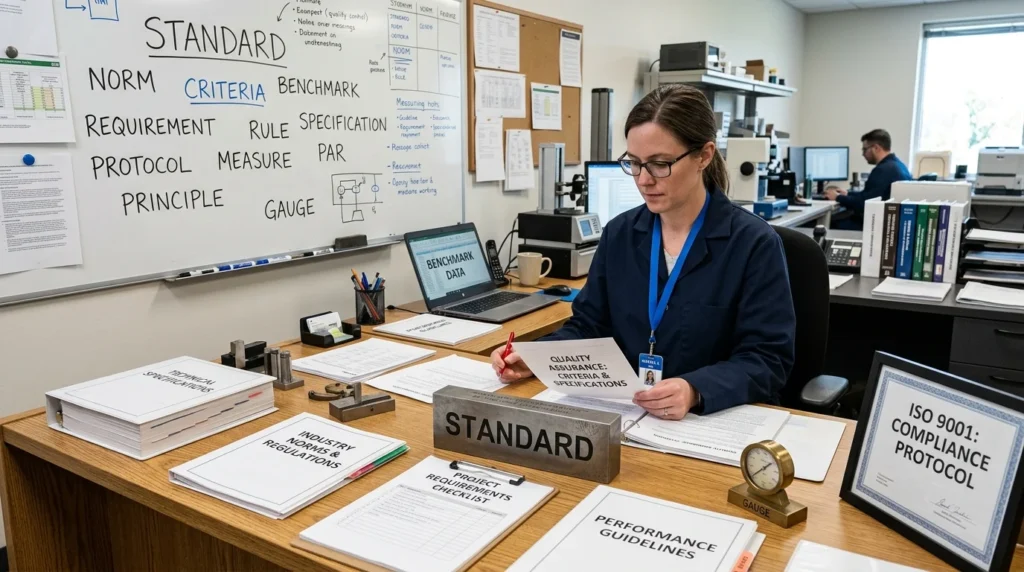
Common synonyms for standard include normal, usual, typical, ordinary, customary, accepted, regular, basic, conventional, benchmark, criterion, requirement, guideline, specification, measure, and norm. The right choice depends on whether standard means something ordinary, an expected level of quality, a rule, or a model used for comparison.
Quick Synonym List
Here are useful alternatives grouped by meaning:
- Normal — usual or expected
- Usual — commonly occurring
- Typical — characteristic of a type or group
- Ordinary — not unusual or special
- Regular — usual or recurring
- Customary — traditionally usual
- Common — occurring frequently
- Conventional — based on accepted practice
- Basic — ordinary or fundamental
- Routine — regularly followed
- Accepted — generally approved or recognized
- Established — long accepted or recognized
- Typical — representative of what is usual
- Average — ordinary or typical in level
- Norm — accepted level or behavior
- Benchmark — reference point for comparison
- Criterion — rule used for judgment
- Measure — basis for evaluating something
- Yardstick — measure or reference for comparison
- Touchstone — reliable test or measure
- Requirement — something that must be met
- Specification — precise required detail
- Guideline — recommended rule or principle
- Principle — basic rule or belief
- Rule — prescribed requirement
- Expectation — level or result that is anticipated
- Level — degree of quality or achievement
- Quality — degree of excellence
- Model — example or pattern to follow
- Norm — accepted or expected condition
Not all of these are interchangeable. Normal, usual, and typical usually describe what is expected, while benchmark, criterion, and requirement refer to standards used for evaluation or compliance.

Closest Synonyms
Normal
Meaning: Something ordinary, expected, or within the usual range.
How it differs: Normal is one of the closest alternatives when standard means usual rather than special.
Tone: Neutral
Best for: Everyday descriptions and general writing.
Example:
- It is standard procedure to check the equipment first.
- It is normal procedure to check the equipment first.
Watch out: Normal does not necessarily suggest an established rule or specification.
Interchangeability: Usually interchangeable when standard means usual or expected.
Usual
Meaning: Something that commonly happens or is normally expected.
How it differs: Usual emphasizes familiarity or frequency rather than an official standard.
Tone: Neutral, conversational
Best for: Everyday situations and routines.
Example:
- She followed the standard process.
- She followed the usual process.
Watch out: Usual can sound less formal and less rule-based than standard.
Interchangeability: Usually interchangeable in contexts involving routine or customary practice.
Typical
Meaning: Characteristic of a particular person, group, type, or situation.
How it differs: Typical means representative, while standard can mean accepted, required, or usual.
Tone: Neutral
Best for: Describing representative examples or behavior.
Example:
- This is a standard response from the company.
- This is a typical response from the company.
Watch out: A typical response is not necessarily an approved or required response.
Interchangeability: Context-dependent.
Ordinary
Meaning: Common, normal, or not special.
How it differs: Ordinary often emphasizes a lack of distinction or exceptional quality.
Tone: Neutral
Best for: Describing everyday or unremarkable things.
Example:
It was an ordinary business day.
Watch out: Calling something ordinary can sometimes suggest that it is unremarkable, which is not always intended by standard.
Interchangeability: Context-dependent.
Customary
Meaning: Usually done according to established custom or practice.
How it differs: Customary emphasizes tradition or established practice.
Tone: Formal
Best for: Formal writing, traditions, procedures, and established practices.
Example:
Employees followed the standard greeting.
Employees followed the customary greeting.
Watch out: Use customary when tradition or habit matters.
Interchangeability: Usually interchangeable in practice-related contexts.
Conventional
Meaning: Generally accepted or traditionally used.
How it differs: Conventional often suggests an established method or approach, sometimes contrasted with something innovative or unconventional.
Tone: Neutral to formal
Best for: Academic, professional, and technical writing.
Example:
The researchers used a standard approach.
The researchers used a conventional approach.
Watch out: Conventional can imply a contrast with newer or unconventional methods.
Interchangeability: Context-dependent.
Accepted
Meaning: Generally recognized, approved, or regarded as valid.
How it differs: Accepted focuses on approval or recognition rather than simply being common.
Tone: Neutral to formal
Best for: Rules, practices, methods, terminology, and professional contexts.
Example:
This is a standard method of measurement.
This is an accepted method of measurement.
Watch out: Something can be common without being officially accepted.
Interchangeability: Context-dependent.
Regular
Meaning: Usual, recurring, or ordinary.
How it differs: Regular can mean normal or recurring, but it does not always convey the idea of an established standard.
Tone: Neutral
Best for: Products, schedules, routines, and ordinary versions of something.
Example:
The standard package contains four items.
The regular package contains four items.
Watch out: Regular has many meanings, including recurring and standard-sized.
Interchangeability: Context-dependent.
Basic
Meaning: Simple, fundamental, or without additional features.
How it differs: Basic often means the simplest or least elaborate option, while standard may simply mean the usual option.
Tone: Neutral
Best for: Products, services, equipment, and introductory information.
Example:
The standard plan includes email support.
The basic plan includes email support.
Watch out: Basic can imply fewer features or a lower level than standard.
Interchangeability: Sometimes interchangeable.
Conventional
Meaning: Following an accepted or traditional method.
Tone: Neutral to formal
Best for: Methods, practices, approaches, and academic writing.
Example:
The study compares conventional and experimental techniques.
Watch out: It does not always mean “average” or “ordinary.”
Interchangeability: Usually interchangeable only when standard refers to an established method.
Formal and Professional Alternatives
When standard means a measure, rule, requirement, or accepted level, more precise professional alternatives are often better.
| Alternative | Meaning | Best Context | Interchangeable? |
|---|---|---|---|
| Criterion | Rule or basis for judging | Academic, professional | Often |
| Benchmark | Reference point for comparison | Business, performance | Often |
| Requirement | Something that must be satisfied | Rules, compliance | Sometimes |
| Specification | Exact required feature or condition | Technical writing | Sometimes |
| Guideline | Recommended principle or instruction | Policies, procedures | Sometimes |
| Measure | Basis for evaluating something | Research, performance | Sometimes |
| Norm | Accepted level or behavior | Academic, social | Sometimes |
| Yardstick | Measure used for comparison | General, figurative | Sometimes |
| Touchstone | Reliable basis for judging | Formal, literary | Rarely |
| Principle | Basic rule or idea | Ethics, policy, theory | Sometimes |
Cambridge specifically lists requirement, specification, criterion, guideline, principle, measure, yardstick, touchstone, ideal, and guide among words related to the noun standard.
Criterion
Use criterion when you mean a specific rule or condition used to judge something.
Example:
Cost is an important criterion for selecting a supplier.
Better than “standard” when: You are describing one particular basis for evaluation.
Benchmark
Use benchmark when something serves as a reference point for measuring performance or progress.
Example:
The company uses customer satisfaction as a benchmark.
Better than “standard” when: Comparison or measurement is the main idea.
Requirement
Use requirement when something must be done or achieved.
Example:
Applicants must meet the minimum requirements.
Watch out: A requirement is more specific and obligatory than a general standard.
Specification
Use specification for a precise technical requirement.
Example:
The product must meet the manufacturer’s specifications.
Best for: Engineering, technology, manufacturing, contracts, and technical documents.
Guideline
A guideline provides recommended direction rather than necessarily imposing a strict requirement.
Example:
The organization published new safety guidelines.
Watch out: Do not automatically replace standard with guideline. A standard can be mandatory, while a guideline may simply be recommended.
Neutral and Everyday Alternatives
For everyday writing, these alternatives are often natural:
- Normal
- Usual
- Typical
- Ordinary
- Regular
- Common
- Basic
- Routine
- Average
- Customary
Example
Original:
The standard delivery time is three days.
Possible alternatives:
- The usual delivery time is three days.
- The typical delivery time is three days.
- The normal delivery time is three days.
But if the company has officially established three days as its service requirement, standard delivery time may be more precise than all three.
Casual Alternatives
Standard itself is already neutral and common, so casual alternatives are limited.
Depending on context, you might use:
- Usual
- Normal
- Regular
- Typical
- Everyday
- Basic
- Run-of-the-mill
- Nothing special
Examples
Standard version → regular version
Standard procedure → usual procedure
Standard meal → regular meal
Standard quality → normal quality
For informal speech, phrases such as nothing special or run-of-the-mill can work when you mean ordinary rather than officially established.
Standard vs. Near Synonyms
Standard vs. Normal
These overlap when both mean “usual” or “expected.”
- Standard procedure → an established or usual procedure
- Normal procedure → a procedure that is usual or expected
Standard can sound more institutional or rule-based.
Standard vs. Usual
Usual focuses on what normally happens.
Standard can mean what normally happens, but it can also mean what is officially accepted or required.
The usual price is $20.
The standard price is $20.
The first emphasizes what normally happens. The second can imply an established pricing level.
Standard vs. Typical
Typical means representative.
Standard can mean accepted, expected, or officially established.
That is typical behavior.
That is standard behavior.
The first says the behavior is characteristic. The second may suggest that the behavior is an accepted norm or established practice.
Standard vs. Benchmark
A benchmark is a reference point for comparison.
A standard can be the level that must be reached or the accepted model itself.
The company established a new quality standard.
The company used the market leader as a benchmark.
These ideas are related but not identical.
Standard vs. Criterion
A criterion is a specific basis for judgment.
A standard can refer to the overall level or set of expectations.
Quality is an important standard.
Quality is one of the criteria used in the evaluation.
Standard vs. Requirement
A requirement is something that must be satisfied.
A standard may be an expected level without necessarily being an individual requirement.
Employees must meet the required safety standards.
Here, the standards establish the level, while the requirements describe what must be satisfied.
Comparison Table
| Word | Relationship to “standard” | Can Replace Original? | Tone | Best Context |
|---|---|---|---|---|
| Normal | Near synonym | Often | Neutral | Everyday use |
| Usual | Near synonym | Often | Neutral | Routine situations |
| Typical | Near synonym | Sometimes | Neutral | Representative examples |
| Ordinary | Near synonym | Sometimes | Neutral | Non-special things |
| Customary | Near synonym | Often | Formal | Established practices |
| Conventional | Near synonym | Sometimes | Formal | Traditional methods |
| Accepted | Contextual alternative | Sometimes | Neutral/formal | Approved practices |
| Basic | Contextual alternative | Sometimes | Neutral | Simple versions |
| Benchmark | Related term | Sometimes | Professional | Measurement |
| Criterion | Related term | Sometimes | Formal | Evaluation |
| Requirement | Related term | Sometimes | Formal | Compliance |
| Specification | Related term | Sometimes | Technical | Exact details |
| Guideline | Related term | Sometimes | Professional | Recommendations |
| Norm | Near synonym | Sometimes | Formal | Social or professional expectations |
| Yardstick | Metaphorical alternative | Rarely | Neutral | Comparison |
How to Choose the Right Alternative
Use this simple guide:
If you mean “usual”
Choose:
- normal
- usual
- typical
- regular
Example:
This is the standard response.
→ This is the usual response.
If you mean “ordinary or not special”
Choose:
- ordinary
- basic
- average
- run-of-the-mill
Example:
It was a standard hotel room.
→ It was an ordinary hotel room.
If you mean “accepted practice”
Choose:
- customary
- conventional
- accepted
- established
Example:
This is standard industry practice.
→ This is established industry practice.
If you mean “level used for judgment”
Choose:
- criterion
- benchmark
- measure
- yardstick
- touchstone
Example:
The award is considered a standard of excellence.
→ The award is considered a benchmark of excellence.
If you mean “something that must be met”
Choose:
- requirement
- specification
- condition
- criterion
Example:
The product must meet safety standards.
→ The product must meet safety requirements.
Sentence Transformations
Here are natural ways to replace standard without changing the basic idea:
- Standard practice is to review the document twice.
→ Usual practice is to review the document twice. - The company follows standard procedures.
→ The company follows established procedures. - This is a standard method of testing.
→ This is a conventional method of testing. - The hotel offers standard rooms and premium rooms.
→ The hotel offers regular rooms and premium rooms. - The product meets international standards.
→ The product meets international requirements. - Quality is an important standard for the organization.
→ Quality is an important criterion for the organization. - The results exceeded the standard.
→ The results exceeded the benchmark. - Employees must meet the required standard.
→ Employees must meet the required level. - The standard response time is 24 hours.
→ The usual response time is 24 hours. - The study uses a standard measurement.
→ The study uses an accepted measurement.
The best transformation depends on what standard means in the original sentence. Replacing it mechanically can change the meaning.
Grammar and Usage
Standard as a noun
As a noun, standard can mean a level of quality, a rule of behavior, or an accepted model or pattern.
Common patterns include:
- a high standard
- a low standard
- acceptable standard
- professional standards
- safety standards
- quality standards
- moral standards
- meet a standard
- set a standard
- maintain standards
- raise standards
- lower standards
- fall below a standard
- live up to a standard
Example:
The school maintains high academic standards.
Standard as an adjective
As an adjective, standard commonly means usual, expected, or not involving anything special or extra.
Common combinations include:
- standard procedure
- standard practice
- standard size
- standard format
- standard model
- standard equipment
- standard procedure
- standard feature
- standard contract
- standard method
- standard version
Example:
The software uses a standard file format.
Standard and “of”
Use standard of when talking about a level of quality, behavior, or living:
- standard of living
- standard of care
- standard of service
- standard of education
Example:
The company maintains a high standard of customer service.
Standard and “for”
Use standard for when identifying the thing that a standard applies to.
Example:
There is a new standard for data security.
Standard and “against”
Standard against which introduces a reference point for comparison.
Example:
The results provide a standard against which future performance can be measured.
Common Mistakes
1. Treating every synonym as identical
Standard, normal, usual, and benchmark overlap, but they do not have the same meaning in every sentence.
2. Using “basic” for every meaning of “standard”
A standard product is not necessarily a basic product. Basic often suggests the simplest or least elaborate option.
3. Confusing a standard with a requirement
A standard can establish an expected level. A requirement specifically identifies something that must be satisfied.
4. Using “typical” when you mean “official”
Typical means representative. It does not necessarily mean formally approved.
5. Using “benchmark” to mean “ordinary”
A benchmark is a reference point for comparison. It does not mean “usual.”
6. Assuming “normal” means “official”
Something can be normal without being officially established.
7. Using “guideline” for a mandatory rule
A guideline often offers recommended direction. If something must be followed, requirement, rule, or standard may be more accurate.
8. Replacing “standard” with “average”
Average generally refers to a mathematical or typical middle level. Standard can refer to quality, rules, specifications, or accepted practice.
Commonly Confused Words
Standard vs. Standardized
Standard can be a noun or adjective describing a level, model, or usual form.
Standardized means made consistent according to a particular standard.
The company uses a standard format.
The company uses a standardized format.
The second emphasizes consistency across different items or situations. Cambridge defines standardize as making things of the same type have the same basic features.
Standard vs. Norm
A norm is an accepted or expected level, behavior, or practice.
A standard can be broader and may include formal technical or quality requirements.
Standard vs. Quality
Quality refers to the degree of excellence or characteristics of something.
Standard can refer to the level of quality expected or required.
The product has excellent quality.
The product meets a high quality standard.
When Not to Use an Alternative
Sometimes standard is the clearest word.
Keep standard when you mean an established level, specification, or accepted model.
For example:
The equipment must meet international safety standards.
Replacing standards with usuals or typicals would completely change the meaning.
Likewise:
The meter is the standard unit of measurement.
Here, standard identifies an accepted measurement reference.
Use the original word when precision matters. A synonym is only an improvement if it preserves the intended meaning.
Writing Tips
- Use usual for something that normally happens.
- Use normal for something expected or within the ordinary range.
- Use typical for something representative.
- Use customary when tradition or established practice matters.
- Use conventional for established methods or approaches.
- Use benchmark when comparing performance.
- Use criterion for a specific basis of evaluation.
- Use requirement when something must be satisfied.
- Use specification for precise technical details.
- Use guideline for recommended rather than necessarily mandatory instructions.
- Keep standard when it is the clearest term for an accepted level or established rule.
FAQs
1. What is the best synonym for standard?
There is no single best synonym for every use. Normal, usual, and typical work well when standard means ordinary or expected. Benchmark, criterion, and requirement are more suitable when it refers to evaluation, comparison, or conditions that must be met.
2. What is a synonym for standard in formal writing?
Depending on the meaning, formal alternatives include criterion, benchmark, specification, requirement, guideline, norm, measure, and established practice.
3. What is another word for standard quality?
Depending on the intended meaning, you could use expected quality, acceptable quality, required level, benchmark, or quality level.
4. What is a synonym for standard procedure?
Good alternatives include usual procedure, normal procedure, routine procedure, established procedure, and conventional procedure.
5. Is “normal” a synonym for “standard”?
Sometimes. Normal is a close synonym when standard means usual or expected. It is not a full replacement when standard means a formal requirement, specification, or benchmark.
6. Is “benchmark” the same as “standard”?
Not exactly. A benchmark is mainly a reference point used for comparison or measurement. A standard can also serve this purpose, but it can additionally mean an expected quality level, rule, or accepted specification.
7. What is the opposite of standard?
The opposite depends on the meaning. For standard meaning usual, possible contrasts include unusual, exceptional, uncommon, or nonstandard. For a quality standard, the opposite idea may be substandard or below standard.
Editor’s Choice
Instead of looking for one universal replacement, choose according to the job the word needs to do:
- For “usual”: normal, usual, typical
- For “established”: customary, conventional, accepted
- For “measurement”: benchmark, measure, yardstick
- For “evaluation”: criterion, standard, touchstone
- For “must meet”: requirement, specification
- For “recommendation”: guideline
This approach keeps the original meaning intact while making the wording more precise.
Key Takeaways
- Standard has several meanings, so its synonyms are highly context-dependent.
- Normal, usual, and typical are useful when standard means ordinary or expected.
- Customary, conventional, and accepted work well for established practices.
- Benchmark, criterion, measure, and yardstick are better when standard means a basis for comparison or evaluation.
- Requirement and specification are more precise when something must meet a defined condition.
Internal Link Opportunities
| Anchor Text | Suggested Topic | Why It Fits |
|---|---|---|
| synonyms for normal | Synonyms for Normal | Directly covers one of the closest alternatives to standard. |
| synonyms for usual | Synonyms for Usual | Helps readers distinguish routine language from formal standards. |
| synonyms for typical | Synonyms for Typical | Useful for understanding the difference between representative and officially accepted. |
| synonyms for benchmark | Synonyms for Benchmark | Extends the measurement and comparison meaning. |
| synonyms for requirement | Synonyms for Requirement | Useful for formal and compliance-related contexts. |
| synonyms for common | Synonyms for Common | Supports the everyday meaning of standard. |
| synonyms for ordinary | Synonyms for Ordinary | Covers the “not special” sense. |
| synonyms for conventional | Synonyms for Conventional | Builds topical coverage around established practices and methods. |