

Quick Answer
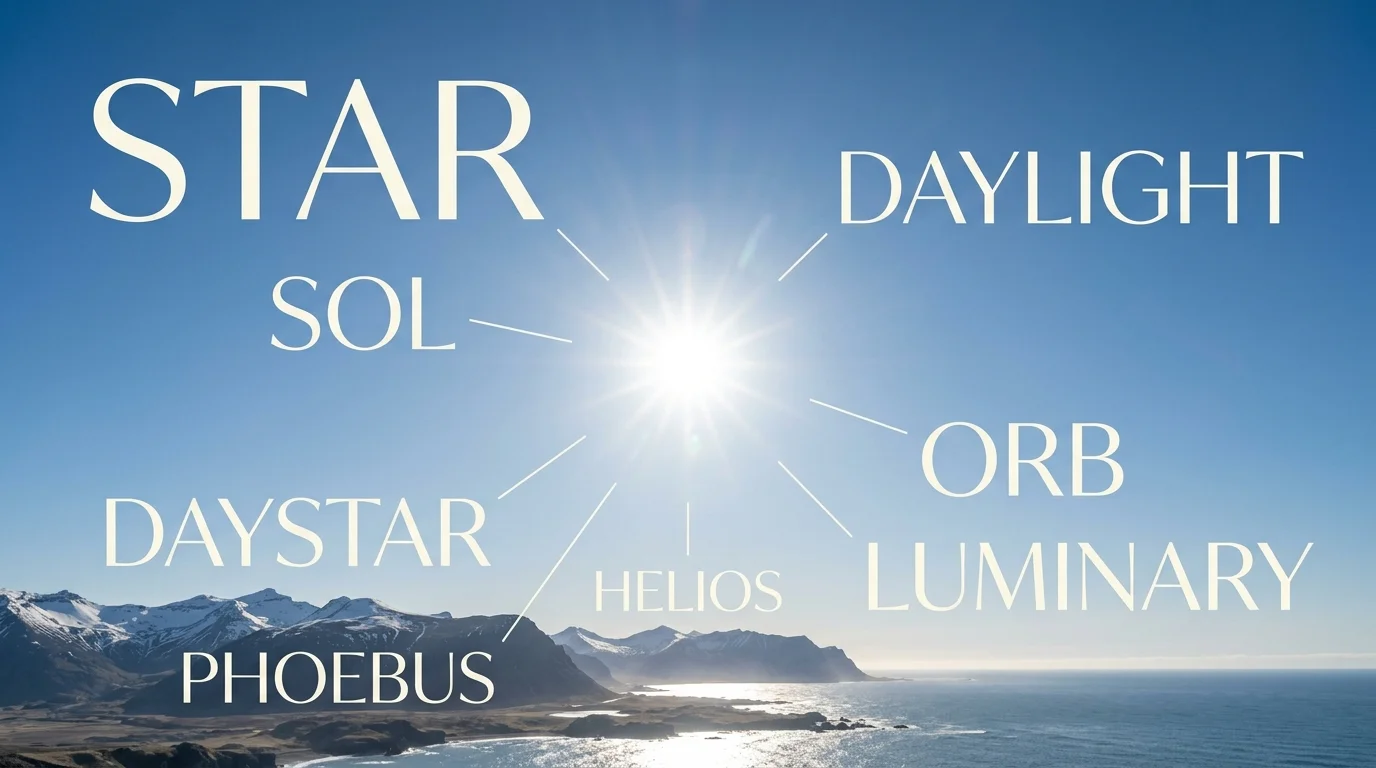
Useful synonyms and related alternatives for sun include sunlight, sunshine, daylight, sunshine, star, celestial body, solar light, rays, sunbeam, radiance, brightness, illumination, glow, light, and daylight. The closest choice depends on meaning. Sunlight and sunshine usually describe the light from the sun, while star describes the astronomical object itself.
Quick Synonym List
Here are useful alternatives and related words for sun:
- Sunlight — light that comes from the sun
- Sunshine — direct or visible light from the sun
- Daylight — natural light during the day
- Solar light — light originating from the sun
- Ray — a narrow beam of sunlight
- Sunbeam — a visible beam of sunlight
- Radiance — bright, glowing light
- Brightness — the quality of giving or reflecting light
- Illumination — light that makes something visible
- Light — a general term for visible brightness
- Glow — soft, warm-looking light
- Beam — a concentrated line or shaft of light
- Sunray — a ray of sunlight
- Sunshine — warm or cheerful sunlight
- Star — the astronomical category of the sun
- Celestial body — a broader astronomical term
- Heavenly body — a broader, somewhat literary term
- Solar disk — the visible disk of the sun
- Solar orb — literary description of the sun
- Sol — a name for the sun, especially in astronomy or literary contexts
Not all of these are interchangeable with sun. Some describe its light, while others describe the object itself.
Closest Synonyms
Sunlight
Meaning: The light that comes from the sun.
How it differs: Sunlight describes the light rather than the sun itself. Cambridge lists sunlight among words related to the light produced by the sun.
Tone: Neutral
Best for: Everyday writing, descriptions, science, and nature writing.
Example:
Sunlight streamed through the window.
Watch out: You cannot normally replace the sun with sunlight when referring to the astronomical object.
Interchangeability: Context-dependent.
Sunshine
Meaning: Light from the sun, especially when it is shining brightly.
How it differs: Sunshine often creates a warmer, more pleasant image than the neutral sunlight.
Tone: Neutral, warm
Best for: Weather, descriptive writing, and everyday conversation.
Example:
The garden was filled with sunshine.
Watch out: Sunshine does not mean the physical star.
Interchangeability: Context-dependent.
Daylight
Meaning: Natural light available during the day.
How it differs: Daylight does not necessarily specify the sun as its source. It can describe the general natural light of daytime.
Tone: Neutral
Best for: Time, visibility, and descriptions of outdoor light.
Example:
The room looked brighter in daylight.
Watch out: A cloudy day can still have daylight even when the sun is not visible.
Interchangeability: Similar meaning but not interchangeable.
Star
Meaning: A luminous astronomical object; the sun is a star.
How it differs: Star is scientifically broader than sun. It can refer to many other objects in the universe.
Tone: Neutral, scientific
Best for: Astronomy and educational writing.
Example:
The sun is the closest star to Earth.
Watch out: In ordinary English, replacing the sun with the star can sound unnatural unless the context is clearly astronomical.
Interchangeability: Usually not interchangeable.
Sunbeam
Meaning: A visible beam or shaft of sunlight.
Tone: Neutral, descriptive
Best for: Nature writing, photography, and visual descriptions.
Example:
A sunbeam entered through the window.
Watch out: A sunbeam is a portion of sunlight, not the entire sun.
Interchangeability: Not interchangeable.
Ray
Meaning: A narrow line or beam of light coming from the sun.
Tone: Neutral
Best for: Scientific, descriptive, and literary writing.
Example:
A ray of sunlight broke through the clouds.
Watch out: Ray is broader than sunray and can refer to other kinds of radiation or light.
Interchangeability: Not interchangeable.
Radiance
Meaning: Brightness or glowing light.
Tone: Literary, formal
Best for: Creative writing, descriptions, and figurative language.
Example:
The radiance of the morning sun filled the valley.
Watch out: Radiance describes the quality of light, not the sun itself.
Interchangeability: Not interchangeable.
Brightness
Meaning: The quality or amount of light produced or reflected.
Tone: Neutral
Best for: General descriptions and technical contexts.
Example:
The brightness of the sun made it difficult to see.
Watch out: Brightness can describe artificial light, screens, colors, or other sources too.
Interchangeability: Not interchangeable.
Formal and Professional Alternatives
Scientific and technical writing usually uses precise terms rather than poetic replacements for sun.
| Alternative | Meaning | Tone | Best Context |
|---|---|---|---|
| Solar source | Source associated with the sun | Technical | Science |
| Solar radiation | Energy emitted by the sun | Technical | Physics, climate |
| Solar light | Light originating from the sun | Technical | Science |
| Solar disk | Visible disk of the sun | Scientific | Astronomy |
| Celestial body | Object in space | Formal | Astronomy |
| Star | A luminous astronomical object | Scientific | Astronomy |
| Sol | Proper name for the sun | Scientific/Literary | Astronomy |
| Solar orb | Figurative name for the sun | Literary | Creative writing |
Solar Radiation
Solar radiation refers to electromagnetic energy emitted by the sun. It is much more precise than sun and should be used only when discussing energy or radiation.
Example:
Solar radiation provides energy that drives Earth’s climate system.
Solar Disk
Solar disk refers to the visible circular appearance of the sun.
Example:
The telescope captured an image of the solar disk.
Celestial Body
Celestial body is a broad scientific term for a natural object in space.
Example:
The sun is a celestial body at the center of our solar system.
It is not a direct synonym because planets, moons, asteroids, and other objects can also be celestial bodies.
Sol
Sol is a name used for our sun, particularly in astronomical contexts. It can also have literary or historical uses.
Example:
The planet orbits Sol.
For ordinary American English, the sun remains much more natural.
Neutral and Everyday Alternatives
Sunlight
Use sunlight when you mean the light coming from the sun.
The plants need plenty of sunlight.
Sunshine
Use sunshine when you want a warmer, more pleasant everyday expression.
We spent the afternoon enjoying the sunshine.
Daylight
Use daylight when the important idea is natural daytime light rather than the sun itself.
We arrived before daylight disappeared.
Light
Light can sometimes replace sun when the context clearly refers to sunlight.
The morning sun filled the room.
The morning light filled the room.
However, light has a much broader meaning.
Rays
Rays works when you want to emphasize individual lines or beams of sunlight.
The sun’s rays warmed the pavement.
Casual Alternatives
English does not have many genuinely casual synonyms for sun. The word itself is already short, familiar, and conversational.
Common informal or descriptive alternatives include:
- Sunshine
- Sunlight
- Rays
- Sunbeams
- The bright star — humorous or explanatory
- Old Sol — playful or literary
Old Sol
Old Sol is a playful or literary expression for the sun.
Example:
Old Sol finally appeared after several cloudy days.
It is not appropriate for most formal or scientific writing.
Sun vs. Near Synonyms
Sun vs. Sunlight
Sun = the star.
Sunlight = the light produced by that star.
- The sun is behind the clouds.
- Sunlight is coming through the clouds.
These words are closely related but cannot generally replace one another.
Sun vs. Sunshine
Sunshine means sunlight, especially in a pleasant or cheerful context.
- The sun is rising.
- The sunshine feels warm.
You cannot say “The sunshine is at the center of the solar system.”
Sun vs. Daylight
Daylight means natural light during the daytime.
- The sun came out.
- There was plenty of daylight.
Daylight can exist even when the sun is hidden by clouds.
Sun vs. Ray
A ray is a narrow line or beam of light.
- The sun was bright.
- A ray of sunlight entered the room.
A ray is part of the light from the sun, not the sun itself.
Sun vs. Radiance
Radiance describes glowing brightness.
- The sun was setting.
- The radiance of the setting sun was beautiful.
Radiance is more descriptive and literary.
Comparison Table
| Alternative | Relationship | Can Replace “Sun”? | Tone | Best Context |
|---|---|---|---|---|
| Sunlight | Direct related term | Sometimes | Neutral | Light from the sun |
| Sunshine | Direct related term | Sometimes | Warm/Neutral | Pleasant sunlight |
| Daylight | Related term | Sometimes | Neutral | Natural daytime light |
| Star | Broader scientific category | Rarely | Scientific | Astronomy |
| Sunbeam | Part of sunlight | No | Descriptive | Visual writing |
| Ray | Part of sunlight | No | Neutral | Light and science |
| Radiance | Quality of light | No | Literary | Creative writing |
| Brightness | Quality/amount of light | No | Neutral | Light descriptions |
| Illumination | Light that makes things visible | No | Formal | Technical/formal writing |
| Glow | Soft light | No | Descriptive | Creative writing |
| Solar light | Light from the sun | Sometimes | Technical | Science |
| Solar disk | Visible appearance of sun | Sometimes | Scientific | Astronomy |
| Sol | Name for the sun | Yes, in specialized contexts | Scientific/Literary | Astronomy |
| Celestial body | Broad category | No | Formal | Astronomy |
How to Choose the Right Alternative
If you mean the astronomical object
Use:
- the sun
- Sol
- star in a scientific context
- solar disk when discussing its visible disk
Example:
The sun is a star.
If you mean its light
Use:
- sunlight
- sunshine
- solar light
- daylight
Example:
The sunlight was very bright.
If you mean a narrow portion of its light
Use:
- ray
- sunray
- sunbeam
- beam
Example:
A sunbeam entered through the window.
If you want a literary description
Use:
- radiance
- glow
- brilliance
- golden light
- solar orb
Example:
The golden radiance of the setting sun covered the hills.
If you are writing scientifically
Prefer precise terms such as:
- solar radiation
- solar light
- solar disk
- star
- celestial body
Avoid replacing sun with poetic terms when technical accuracy matters.
Sentence Transformations
- Original:
The sun was shining brightly.
Alternative:
Bright sunlight filled the sky. - Original:
The sun came through the window.
Alternative:
Sunlight came through the window. - Original:
We sat in the sun.
Alternative:
We sat in the sunshine. - Original:
The sun’s rays warmed the garden.
Alternative:
Sunbeams warmed the garden. - Original:
The sun disappeared behind the clouds.
Alternative:
The sunlight disappeared behind the clouds. - Original:
A ray of sun entered the room.
Alternative:
A sunbeam entered the room. - Original:
The sun illuminated the landscape.
Alternative:
The daylight illuminated the landscape. - Original:
The sun was bright that morning.
Alternative:
The morning light was bright. - Original:
The sun’s radiance filled the valley.
Alternative:
The solar radiance filled the valley. - Original:
The sun is the closest star to Earth.
Alternative:
Our sun is the closest star to Earth.
Grammar and Usage
The sun
In ordinary English, sun is usually used with the when referring to our star:
- The sun is rising.
- The sun is bright today.
- The sun sets in the west.
Cambridge defines the sun as the star that provides Earth’s light and heat, while also recognizing sun as the light or heat Earth receives from it.
Sun as a noun
The most common use is as a noun:
The sun is shining.
It can refer either to the astronomical object or, in some contexts, to the light and heat it provides.
Sun as a verb
Sun can also be a verb meaning to sit or lie somewhere with a lot of sun.
The cat sunned itself on the wall.
Cambridge lists sunbathe as a synonym for this verb use.
Sun vs. sunlight
Compare:
The sun is behind the clouds.
with:
The sunlight is fading.
The first refers to the star; the second refers to its light.
Useful collocations
Common expressions include:
- bright sun
- hot sun
- morning sun
- afternoon sun
- evening sun
- setting sun
- rising sun
- direct sunlight
- bright sunshine
- sun’s rays
- warm sunlight
- full sun
Cambridge’s corpus examples include combinations such as afternoon sun, blazing sun, and evening sun.
Common Mistakes
1. Treating “sun” and “sunlight” as identical
They are related but have different meanings.
Sun = the star
Sunlight = its light
2. Using “daylight” as a direct replacement every time
Daylight means natural light during daytime. It does not specifically identify the sun.
3. Calling a sunbeam “the sun”
A sunbeam is a narrow beam of sunlight, not the astronomical object.
4. Using “star” in ordinary sentences without context
Although the sun is a star, star can refer to billions of other astronomical objects.
5. Using overly poetic alternatives in technical writing
Words such as radiance, solar orb, and golden light can sound attractive in creative writing but may reduce precision in scientific writing.
6. Confusing “sunny” with “sun”
Sunny is an adjective describing a place, day, or weather condition.
- It is a sunny day.
- The sun is bright.
7. Confusing “sun” and “Son”
Sun refers to the star or its light.
Son means a male child in relation to a parent.
Commonly Confused Words
Sun vs. Sunshine
Sun is the star or, in some contexts, its heat/light.
Sunshine specifically refers to the light from the sun and often has a warm, pleasant feeling.
Sun vs. Sunny
Sun is a noun or verb.
Sunny is an adjective.
- The sun is shining.
- It is a sunny day.
Sun vs. Solar
Solar is an adjective meaning “related to the sun.”
- solar energy
- solar system
- solar radiation
You generally cannot use solar by itself as a direct replacement for sun.
Sun vs. Son
These are homophones in standard English but have completely different meanings:
- sun = the star
- son = a male child
When Not to Use an Alternative
Sometimes sun is the clearest and most natural word.
For example:
The sun rises in the east.
Replacing it with:
The celestial body rises in the east.
is technically possible but unnecessarily formal and less natural.
Likewise:
The sun is at the center of our solar system.
is clearer than trying to replace sun with solar orb, radiance, or heavenly body.
Use a synonym when it adds a real difference in meaning, tone, or imagery. Do not replace sun simply to avoid repeating a common word.
Writing Tips
- Use sun for the astronomical object.
- Use sunlight for light produced by the sun.
- Use sunshine for warm or pleasant sunlight.
- Use daylight for natural daytime light.
- Use ray or sunbeam for a narrow portion of sunlight.
- Use radiance for a more literary description.
- Use solar as an adjective when discussing things related to the sun.
- Use star mainly in scientific or astronomical contexts.
- Keep the sun when it is already the clearest choice.
- In creative writing, combine precise nouns with descriptive modifiers rather than forcing unusual synonyms.
FAQs
1. What is the best synonym for “sun”?
There is no single synonym that works in every context. Sunlight, sunshine, and daylight are useful when referring to light, while Sol or star may work in specialized astronomical contexts.
2. What is another word for sunlight?
Common alternatives include sunshine, daylight, solar light, rays, sunbeams, radiance, and illumination, although these words have different meanings and uses.
3. What is a poetic word for sun?
Poetic descriptions include solar orb, radiant star, golden orb, celestial light, and Old Sol. These are better for creative writing than ordinary conversation.
4. Is “sunshine” a synonym for “sun”?
Not exactly. Sunshine means light from the sun, while sun normally refers to the star itself. In some contexts, sun can also refer to the light or heat received from it.
5. What is a scientific synonym for sun?
Star can describe the sun scientifically because the sun is a star. Sol is also used as a name for our sun. Terms such as solar disk and solar radiation are more specific rather than true synonyms.
6. What is the difference between sun and sunlight?
Sun is the star that provides Earth’s light and heat. Sunlight is the light that comes from that star.
7. What are good synonyms for sun in creative writing?
Depending on the mood, try radiance, golden orb, glowing star, solar orb, sunbeam, brilliance, or golden light. Choose based on the image you want rather than treating these as exact replacements.
Editor’s Choice
For different writing situations, these alternatives are particularly useful:
- Everyday writing: sunlight
- Warm, positive description: sunshine
- Daytime light: daylight
- Visual imagery: sunbeam
- Scientific context: solar radiation
- Astronomical context: star or Sol
- Poetic writing: radiance or solar orb
These are choices by use case, not universal replacements for sun.
Key Takeaways
- Sun can mean the star itself or the light and heat it provides.
- Sunlight and sunshine describe light from the sun, not the star itself.
- Daylight means natural light during the daytime and does not necessarily mean direct sunlight.
- Ray, sunbeam, radiance, and brightness describe aspects or qualities of sunlight rather than the sun itself.
- In most everyday and scientific writing, the sun remains the clearest and most natural choice.
Internal Link Opportunities
| Anchor Text | Suggested Topic | Why It Fits |
|---|---|---|
| synonyms for sunlight | Synonyms for Sunlight | Directly expands the light-related meaning of sun. |
| synonyms for sunshine | Synonyms for Sunshine | Useful for warm, weather, and descriptive writing. |
| synonyms for bright | Synonyms for Bright | Connects with descriptions of sunlight and radiance. |
| synonyms for light | Synonyms for Light | Covers the broader concept behind sunlight and illumination. |
| synonyms for glow | Synonyms for Glow | Supports creative descriptions of light. |
| synonyms for daylight | Synonyms for Daylight | Explores the distinction between sunlight and natural daytime light. |
| synonyms for star | Synonyms for Star | Useful for the astronomical meaning of sun. |
| sun vs. sunlight | Sun vs. Sunlight: Meaning and Usage | Helps readers understand the most important distinction. |